
Andere Kunden interessierten sich auch für
 Fanny Burney and Her Friends: Select Passages From Her Diary and Other Writings23,99 €
 Dr. Johnson & Fanny Burney22,99 €
 Diary And Letters Of Madame D'arblay25,99 €
 Diary and Letters of Madame D'Arblay 1778 1840 Vol I27,99 €
 Oliver Goldsmith, John Bunyan, Madame D'arblay18,99 €
 Frances Burney38,99 €
 Rambles in Germany and Italy in 1840, 1842, and 1843; Volume 222,99 €


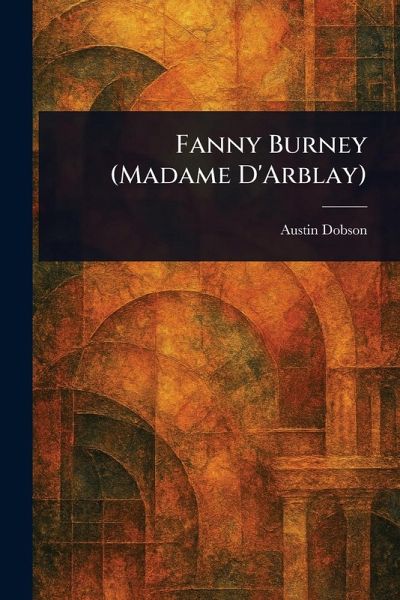
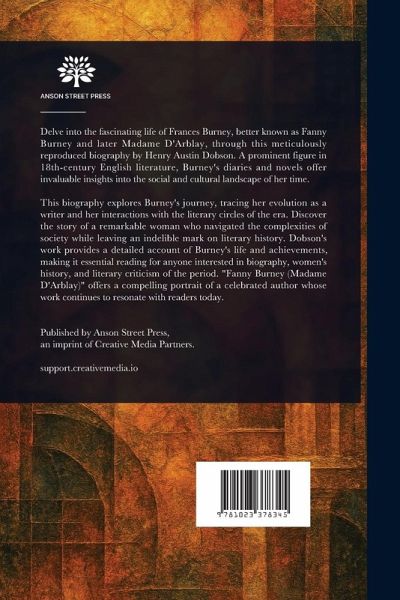
Delve into the fascinating life of Frances Burney, better known as Fanny Burney and later Madame D'Arblay, through this meticulously reproduced biography by Henry Austin Dobson. A prominent figure in 18th-century English literature, Burney's diaries and novels offer invaluable insights into the social and cultural landscape of her time. This biography explores Burney's journey, tracing her evolution as a writer and her interactions with the literary circles of the era. Discover the story of a remarkable woman who navigated the complexities of society while leaving an indelible mark on literary history. Dobson's work provides a detailed account of Burney's life and achievements, making it essential reading for anyone interested in biography, women's history, and literary criticism of the period. "Fanny Burney (Madame D'Arblay)" offers a compelling portrait of a celebrated author whose work continues to resonate with readers today. This work has been selected by scholars as being culturally important, and is part of the knowledge base of civilization as we know it. This work is in the public domain in the United States of America, and possibly other nations. Within the United States, you may freely copy and distribute this work, as no entity (individual or corporate) has a copyright on the body of the work. Scholars believe, and we concur, that this work is important enough to be preserved, reproduced, and made generally available to the public. We appreciate your support of the preservation process, and thank you for being an important part of keeping this knowledge alive and relevant.