
Andere Kunden interessierten sich auch für
 Cereal Productivity Comparison Between Model and Non-Model Farmers41,99 €
 Farmers' territory invaded by a water company56,99 €
 THE INTERFACE BETWEEN RISKS AND FARMER LIVELIHOOD DIVERSIFICATION39,99 €
 A Theory of the Producer-Consumer Household38,99 €
 Value-Added Producer Grants23,99 €
 Economic benefits for the white chuño or tunta producer29,99 €
 A Theory of the Producer-Consumer Household38,99 €




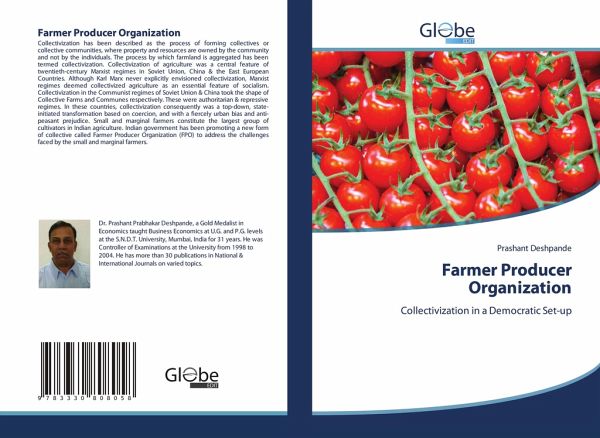
Collectivization has been described as the process of forming collectives or collective communities, where property and resources are owned by the community and not by the individuals. The process by which farmland is aggregated has been termed collectivization. Collectivization of agriculture was a central feature of twentieth-century Marxist regimes in Soviet Union, China & the East European Countries. Although Karl Marx never explicitly envisioned collectivization, Marxist regimes deemed collectivized agriculture as an essential feature of socialism. Collectivization in the Communist regimes of Soviet Union & China took the shape of Collective Farms and Communes respectively. These were authoritarian & repressive regimes. In these countries, collectivization consequently was a top-down, state-initiated transformation based on coercion, and with a fiercely urban bias and anti-peasant prejudice. Small and marginal farmers constitute the largest group of cultivators in Indian agriculture. Indian government has been promoting a new form of collective called Farmer Producer Organization (FPO) to address the challenges faced by the small and marginal farmers.