
Andere Kunden interessierten sich auch für
") Fathers and Sons(Illustrated)22,99 €
Fathers and Sons(Illustrated)22,99 € (Illustrated)") Robinson Crusoe (Deluxe Library Edition) (Illustrated)30,99 €
Robinson Crusoe (Deluxe Library Edition) (Illustrated)30,99 €") War and Peace (Deluxe Library Edition)63,99 €
War and Peace (Deluxe Library Edition)63,99 €") The Idiot (Deluxe Library Edition)50,99 €
The Idiot (Deluxe Library Edition)50,99 € (Illustrated)") The Adventures of Sherlock Holmes (Deluxe Library Edition) (Illustrated)39,99 €
The Adventures of Sherlock Holmes (Deluxe Library Edition) (Illustrated)39,99 €") Hard Times (Deluxe Library Edition)39,99 €
Hard Times (Deluxe Library Edition)39,99 €") Dubliners (Deluxe Library Edition)30,99 €
Dubliners (Deluxe Library Edition)30,99 €

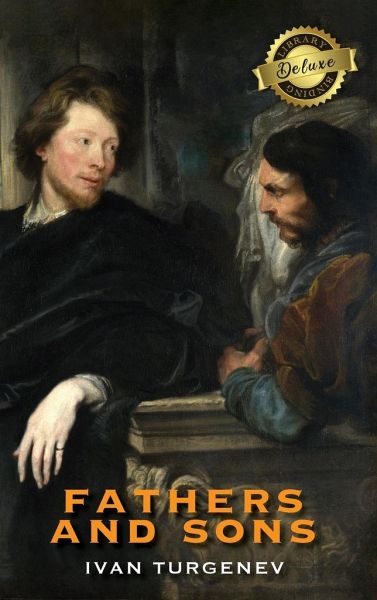
After graduating from the University of Petersburg, Arkady Kirsanov returns home to his father, Nikolay, with his friend, Bazarov. But Nikolay's brother, Pavel, soon becomes upset by the strange new philosophy called "nihilism" which the young men, especially Bazarov, advocate. Nikolay begins to feel uneasy around his son. To complicate this, Nikolay has taken a servant, Fenechka, into his house to live with him and has already had a son by her. Arkady and Bazarov visit a neighbouring province where they meet two women who begin to pull them apart. Turgenev wrote Fathers and Sons as a response to the growing cultural schism that he saw between liberals of the 1830s and 1840s, and the growing nihilist movement. Both the nihilists (the "sons") and the 1830s liberals (the "fathers") sought Western-based social change in Russia. Additionally, these two modes of thought were contrasted with the Slavophiles, who believed that Russia's path lay in its traditional spirituality. Turgenev's novel was responsible for popularizing the use of the term nihilism, which became widely used after the novel was published.