

Andere Kunden interessierten sich auch für
 Faust, Part I, Egmont & Hermann, Dorothea, Dr. Faustus36,99 €
 Dramatic Works of Goethe. Comprising Faust, Iphigenia in Tauris, Torquato Tasso, Egmont69,90 €
 Dramatic Works of Goethe. Comprising Faust, Iphigenia in Tauris, Torquato Tasso, Egmont89,90 €
 The History Of Dr. John Faustus25,99 €
") An Essay Towards A Bibliography Of Marlowe's Tragical History Of Dr. Faustus (1884)25,99 €
An Essay Towards A Bibliography Of Marlowe's Tragical History Of Dr. Faustus (1884)25,99 € Faustus21,99 €
 Faustus29,99 €
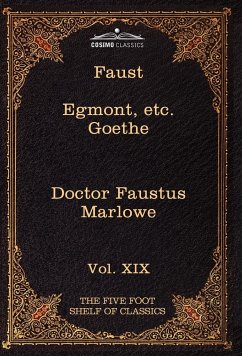






Originally published between 1909 and 1917 under the name "Harvard Classics," this stupendous 51-volume set-a collection of the greatest writings from literature, philosophy, history, and mythology-was assembled by American academic CHARLES WILLIAM ELIOT (1834-1926), Harvard University's longest-serving president. Also known as "Dr. Eliot's Five Foot Shelf," it represented Eliot's belief that a basic liberal education could be gleaned by reading from an anthology of works that could fit on five feet of bookshelf. Volume XIX features important plays that continue to inspire modern works of literature: ¿ Faust, Part I, the 1808 deal-with-the-Devil morality play by German writer JOHANN WOLFGANG VON GOETHE (1749-1832), as well as his 1788 tragedy Egmont and his 1797 verse novelette of the French Revolution, *Hermann and Dorothea* ¿ Dr. Faustus, by English dramatist CHRISTOPHER MARLOWE (1564-1593), the earlier take on the Faust legend, which remains one of the finest examples of Elizabethan drama.