
Andere Kunden interessierten sich auch für
 Increasing Female Employment in Rural Areas and Mentoring Relationship56,99 €
 Female Workforce Participation Decision And Factors Behind It51,99 €
 Aid for Africa: Its Mapping and Effectiveness in the Case of Ethiopia59,90 €
 How role conflicts of female executives lead to perception changes in the Top Management Team29,00 €
 Language Proficiency and Returns to Female Immigrants in Canada18,95 €
 Storytelling of Female Entrepreneurs36,99 €
 Which impediments do female immigrants face when entering the German labor market?47,95 €


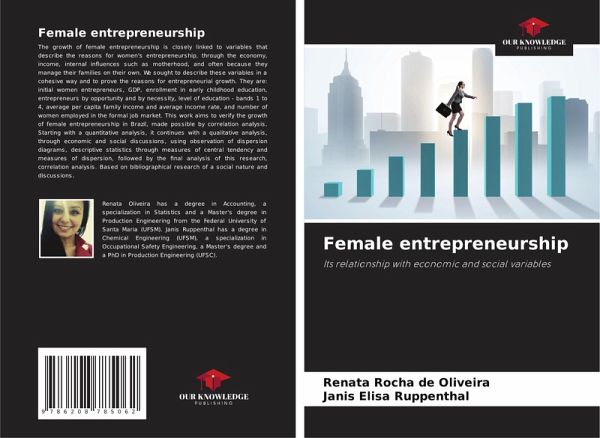
The growth of female entrepreneurship is closely linked to variables that describe the reasons for women's entrepreneurship, through the economy, income, internal influences such as motherhood, and often because they manage their families on their own. We sought to describe these variables in a cohesive way and to prove the reasons for entrepreneurial growth. They are: initial women entrepreneurs, GDP, enrollment in early childhood education, entrepreneurs by opportunity and by necessity, level of education - bands 1 to 4, average per capita family income and average income rate, and number of women employed in the formal job market. This work aims to verify the growth of female entrepreneurship in Brazil, made possible by correlation analysis. Starting with a quantitative analysis, it continues with a qualitative analysis, through economic and social discussions, using observation of dispersion diagrams, descriptive statistics through measures of central tendency and measures ofdispersion, followed by the final analysis of this research, correlation analysis. Based on bibliographical research of a social nature and discussions.