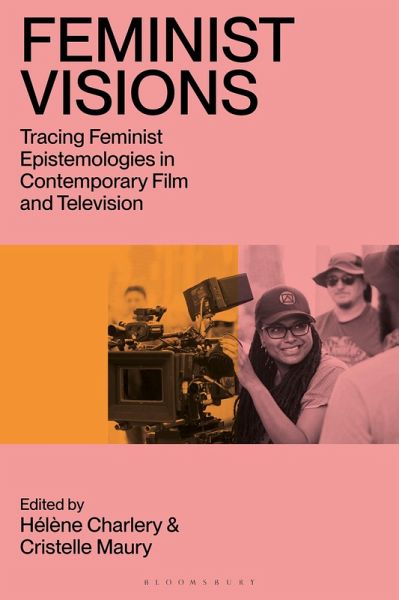
An in-depth examination of how contemporary films and TV series have incorporated ideas of western feminist movements into their narratives, and how feminist film scholarship has influenced industry practitioners.
An in-depth examination of how contemporary films and TV series have incorporated ideas of western feminist movements into their narratives, and how feminist film scholarship has influenced industry practitioners.
Cristelle Maury is Associate Professor of English and Film Studies at at Université Toulouse Jean Jaurès, France. She is co-editor of Women Who Kill: Gender and Sexuality in Film and Series of the Post-feminist Era (Bloomsbury Academic, 2020). Hélène Charlery is Associate Professor of American and Films Studies at Université Toulouse Jean-Jaurès, France. She is co-editor of Erasure and Recollection. Memories of Racial Passing Within and Beyond the United States (2021). Her research focuses on the intersectional representations of Black female characters in American film and television series.
Inhaltsangabe
1. Defining Feminist filmmaking from the angle of reception 1.1.Janet Staiger, University of Texas at Austin, "Finding Feminist Filmmaking" 1.2.Sheril Brenna, University of Cincinnati, "'He Doesn't Get to Win': Gone Girl (2014), the Anti-Heroine, and Social Media Fandom" 1.3.Elizabeth Mullen, Université de Bretagne occidentale, "From Calculating Cool Girl to Conniving Caregiver: Power, Privilege and the Monstrous Feminine in I Care a Lot (2021)" 1.4. Samuel Fernández-Pichel "A Feminist Archive of Past Future Sounds: Archiveology in Lisa Rovner's Sisters with Transistors (2020)" 1.5. Audrey Haensler, Université Paul Valéry, Montpellier, "Nothing but a "woke façade"? Intersectional feminism in contemporary reboots of female-centric TV shows". 2. Is There a #MeToo Genre? 2.1. Katrjin Bekers "The #Metoo Biopic: #Metoo Narratives in Recent Biopics about Women Activists" 2.2. Delphine Letort, Le Mans University, "Unbelievable (2019): A feminist tale of rape" 2.3. Arya Rani Prakash, University of Texas at Dallas "Sexual Assault and the Eye of the Camera: An Investigation Into the Gaze in #MeToo Films" 2.4. Audrey Haensler, Université Paul Valéry, Montpellier, "Nothing but a 'woke façade'? Intersectional feminism in contemporary reboots of female-centric TV shows Charmed (1998-2006) and Sex and the City (1998-2004)" 3. Reframing traditional Hollywood Genres 3.1. Linda Badley "Feminist Film Theory and 21st-century Women's Independent Horror Cinema" 3.2. Cristelle Maury "From the erotic male gaze to the surveilling gaze: De-eroticizing and Politicizing the Noir Gaze in Kelly Reichardt's Night Moves" 3.3. Kristine Chick "Subverting genres and reversing roles: how the female artist and the child assassin demolish conventions and become the patriarch's dangerous rivals in Lynne Ramsay's You Were Never Really Here (2018)" 3.5. Hélène Machinal Université de Rennes 2 "Posthuman bodies and Empowerment: reaching beyond dualism in Sci-fi TV series" 3.6. Kyra Clark, Massey University, and Lauren O'Mahony, Murdoch University, "Stitching together feminism, genre and couture in The Dressmaker (2015)" 4) Testing Intersectional feminist film theory 4.1. Sabine Elisabeth Aretz (KU Eichstaett-Ingolstadt) "'Monstrous and Shameless': Trauma, Agency, and Narrative (of) Empowerment in I May Destroy You" (2020) 4.2. Mikaël Toulza "Black Feminism, Womanism, and Empowerment through Religion in Greenleaf (OWN, 2016-2020)" 4.3 Emilie Cheyroux, Institut National Universitaire Champollion, Albi, "The figure of the Latina maid in independent productions made by Latina filmmakers: a counter-stereotypical and feminist approach" 4.4. Acharna Jakakumar "Indian Feminisms on Screen: Discreet Charm of Savarna 'Feminism' and Social Justice via Dalit Feminism" 4.5. Anne Crémieux, Université Paul Valéry Montpellier 3 "The Gaze is the Message"
1. Defining Feminist filmmaking from the angle of reception 1.1.Janet Staiger, University of Texas at Austin, "Finding Feminist Filmmaking" 1.2.Sheril Brenna, University of Cincinnati, "'He Doesn't Get to Win': Gone Girl (2014), the Anti-Heroine, and Social Media Fandom" 1.3.Elizabeth Mullen, Université de Bretagne occidentale, "From Calculating Cool Girl to Conniving Caregiver: Power, Privilege and the Monstrous Feminine in I Care a Lot (2021)" 1.4. Samuel Fernández-Pichel "A Feminist Archive of Past Future Sounds: Archiveology in Lisa Rovner's Sisters with Transistors (2020)" 1.5. Audrey Haensler, Université Paul Valéry, Montpellier, "Nothing but a "woke façade"? Intersectional feminism in contemporary reboots of female-centric TV shows". 2. Is There a #MeToo Genre? 2.1. Katrjin Bekers "The #Metoo Biopic: #Metoo Narratives in Recent Biopics about Women Activists" 2.2. Delphine Letort, Le Mans University, "Unbelievable (2019): A feminist tale of rape" 2.3. Arya Rani Prakash, University of Texas at Dallas "Sexual Assault and the Eye of the Camera: An Investigation Into the Gaze in #MeToo Films" 2.4. Audrey Haensler, Université Paul Valéry, Montpellier, "Nothing but a 'woke façade'? Intersectional feminism in contemporary reboots of female-centric TV shows Charmed (1998-2006) and Sex and the City (1998-2004)" 3. Reframing traditional Hollywood Genres 3.1. Linda Badley "Feminist Film Theory and 21st-century Women's Independent Horror Cinema" 3.2. Cristelle Maury "From the erotic male gaze to the surveilling gaze: De-eroticizing and Politicizing the Noir Gaze in Kelly Reichardt's Night Moves" 3.3. Kristine Chick "Subverting genres and reversing roles: how the female artist and the child assassin demolish conventions and become the patriarch's dangerous rivals in Lynne Ramsay's You Were Never Really Here (2018)" 3.5. Hélène Machinal Université de Rennes 2 "Posthuman bodies and Empowerment: reaching beyond dualism in Sci-fi TV series" 3.6. Kyra Clark, Massey University, and Lauren O'Mahony, Murdoch University, "Stitching together feminism, genre and couture in The Dressmaker (2015)" 4) Testing Intersectional feminist film theory 4.1. Sabine Elisabeth Aretz (KU Eichstaett-Ingolstadt) "'Monstrous and Shameless': Trauma, Agency, and Narrative (of) Empowerment in I May Destroy You" (2020) 4.2. Mikaël Toulza "Black Feminism, Womanism, and Empowerment through Religion in Greenleaf (OWN, 2016-2020)" 4.3 Emilie Cheyroux, Institut National Universitaire Champollion, Albi, "The figure of the Latina maid in independent productions made by Latina filmmakers: a counter-stereotypical and feminist approach" 4.4. Acharna Jakakumar "Indian Feminisms on Screen: Discreet Charm of Savarna 'Feminism' and Social Justice via Dalit Feminism" 4.5. Anne Crémieux, Université Paul Valéry Montpellier 3 "The Gaze is the Message"
Es gelten unsere Allgemeinen Geschäftsbedingungen: www.buecher.de/agb
Impressum
www.buecher.de ist ein Internetauftritt der buecher.de internetstores GmbH
Geschäftsführung: Monica Sawhney | Roland Kölbl | Günter Hilger
Sitz der Gesellschaft: Batheyer Straße 115 - 117, 58099 Hagen
Postanschrift: Bürgermeister-Wegele-Str. 12, 86167 Augsburg
Amtsgericht Hagen HRB 13257
Steuernummer: 321/5800/1497
USt-IdNr: DE450055826