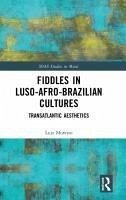
Fiddles in Luso-Afro-Brazilian Cultures presents fresh data and debates drawn from extensive research to broaden the study of African music by focusing on fiddle playing, exploring rhythm aesthetics and tonal systems within cultural contexts. Focused on Cape Verde, Mozambique and Brazil, the research maps cultural affiliations, addressing cultural displacement and historical ties. It engages with post-colonial power dynamics, highlighting fiddle playing as a form of resistance and revival. Primarily aimed at academic researchers in ethnomusicology and related fields, the book provides…mehr
Fiddles in Luso-Afro-Brazilian Cultures presents fresh data and debates drawn from extensive research to broaden the study of African music by focusing on fiddle playing, exploring rhythm aesthetics and tonal systems within cultural contexts. Focused on Cape Verde, Mozambique and Brazil, the research maps cultural affiliations, addressing cultural displacement and historical ties. It engages with post-colonial power dynamics, highlighting fiddle playing as a form of resistance and revival.
Primarily aimed at academic researchers in ethnomusicology and related fields, the book provides detailed analytical descriptions and narratives of artists, instruments and playing styles. It contributes to discussions on music, decolonisation and diasporic communities' demands for authenticity and recognition. By revealing lesser-known fiddle traditions, it enriches the world music genre, attracting both academic and general readers interested in transcultural music studies.
Dr Luiz Moretto holds an honors degree in music from Santa Catarina State University and a doctorate in ethnomusicology from King's College London. He is a professional fiddle player and composer whose performances and recordings encompass various styles of African and Brazilian music, subjects that have been the focus of his research over many years. Personal website: www.luizmoretto.com
Inhaltsangabe
1 Introduction: Mapping Afro-Fiddle Playing in Three Different Contexts Busking in Lisbon First beatsUpbeat down-bow: musical identitiesAfrican musical aesthetics? Perception, the 'sensuous' and improvisationRhythm as a diasporic reinvention Approaching the fieldworkFiddles in transit2 The Kriolu Violin of Cape VerdeThe archipelago at the Atlantic crossroads Transnational culturesThe violin in Cape Verde Antoninho Travadinha - the improviserResearch in the Ilhas do Sotavento (Santiago) Kim Alves Nhô Djonzinho Alves Nhô NaniResearch in the Ilhas do Barlavento Francisco Sequeira (archivist) and Malaquias Costa (violinist) César Costa Nhô Kzik Breka ('The Tall Man')Kriolu violin playing: a dynamic tradition3 The Cimboa in Cape VerdeRumours of extinction A Fulbe heritage? The cimboa in batukuThe rhythm of cimboa music Mano Mendi and Pascoal Fernandes Ntóni Denti d'OroTranscultural revivals4 The Cimboa Becomes the Orocongo The transformation of the cimboa in Brazil Gentil do OrocongoThe orocongo, the rhizome and 'creative creolisation' 5 Vanished Fiddles: Vestiges of Mozambique in BrazilInvestigating historical traces Fiddle paintings Across the 'emaka' (ocean): the journey from east to westThe disappearance of the one-stringed fiddle 6 The Tchakare in MozambiqueThe Makua people On the way to Niassa The Makua tchakare and tchkwèsa Between Mandimba and Mitande Nfani Wathunia A traditional Makua village Almirante Bilale The Makua tchakare and a nationalist agenda 7 The Rabeca in a Brazilian Quilombo Quilombola culture: resistance, identity and ethnic reassertion Vale do Ribeira Quilombos: cultural heritage and the struggle for recognition Caiçaras, quilombos and music Rabeca players in Quilombo do Morro Seco Bonifácio Modesto Pereira The fandango-rufado The role of the rabeca Hermes Modesto Pereira Music and religion Musical and social change 8 Conclusion: Creolisation and the Revival of Fiddle Traditions The fiddle and the African diaspora The Kriolu violin: local and overseas circuits, transnational identities One-stringed fiddle connections Fiddling in a quilombo: land, memory and identity Unperceived aesthetics and disappearing traditions Glossary of Terms
Es gelten unsere Allgemeinen Geschäftsbedingungen: www.buecher.de/agb
Impressum
www.buecher.de ist ein Internetauftritt der buecher.de internetstores GmbH
Geschäftsführung: Monica Sawhney | Roland Kölbl | Günter Hilger
Sitz der Gesellschaft: Batheyer Straße 115 - 117, 58099 Hagen
Postanschrift: Bürgermeister-Wegele-Str. 12, 86167 Augsburg
Amtsgericht Hagen HRB 13257
Steuernummer: 321/5800/1497
USt-IdNr: DE450055826