
Andere Kunden interessierten sich auch für
 Making Books in Fifteenth-Century Cambridge128,99 €
 Chaucer and Fifteenth-Century Verse and Prose148,99 €
") Metrical Romances Of The Thirteenth, Fourteenth, And Fifteenth Centuries V3 (1810)38,99 €
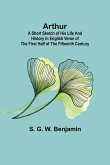
Metrical Romances Of The Thirteenth, Fourteenth, And Fifteenth Centuries V3 (1810)38,99 € Arthur; A Short Sketch of His Life and History in English Verse of the First Half of the Fifteenth Century15,99 €
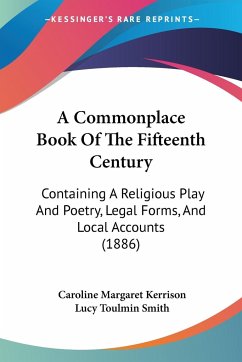
 A Commonplace Book Of The Fifteenth Century25,99 €
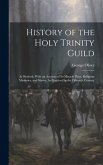
 History of the Holy Trinity Guild: At Sleaford, With an Account of Its Miracle Plays, Religious Mysteries, and Shows, As Practiced in the Fifteenth Ce29,99 €
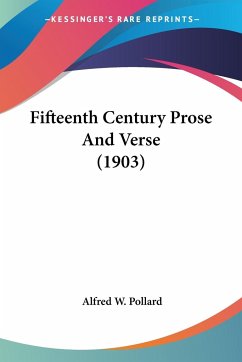
") Fifteenth Century Prose And Verse (1903)32,99 €
Fifteenth Century Prose And Verse (1903)32,99 €
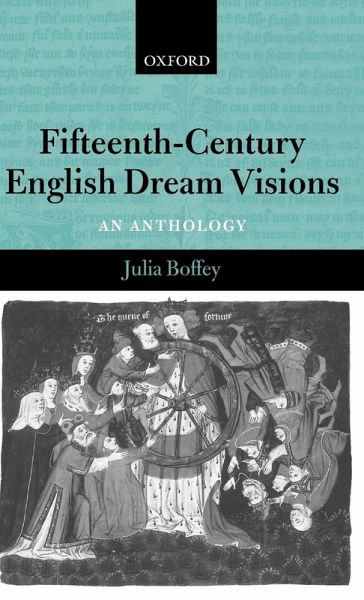
This anthology presents new editions of five English dream vision poems from the fifteenth century, exploring issues of love, philosophy, governance, life at court, and some of the anxieties of writing in a newly-forged English tradition. The texts are fully glossed and annotated, with introductions discussing their contexts and critical history.
This anthology provides new editions of five fifteenth-century English poems framed as dreams, and demonstrates the energy with which this influential medieval form was explored by post-Chaucerian writers. Lydgate's Temple of Glass, a complex love vision, generates a counsel of a wide-ranging kind; The Kingis Quair of James I of Scotland and Love's Renewal from the English poems of Charles of Orleans manipulate autobiographical detail to philosophical and political ends; the anonymous Assembly of Ladies foregrounds women's voices; finally, Skelton's Bowge of Court adapts the love vision to the purposes of a satire on court life. The editions are in lightly modernized spelling and accompanied by glosses, explanatory notes, and textual commentary. Each text has its own introduction and recommendations for further reading, and a general introduction discusses the significance of the dream form, its importance for Middle English writers, and the extraordinary variety of directions in which it was developed by fifteenth-century poets.
This anthology provides new editions of five fifteenth-century English poems framed as dreams, and demonstrates the energy with which this influential medieval form was explored by post-Chaucerian writers. Lydgate's Temple of Glass, a complex love vision, generates a counsel of a wide-ranging kind; The Kingis Quair of James I of Scotland and Love's Renewal from the English poems of Charles of Orleans manipulate autobiographical detail to philosophical and political ends; the anonymous Assembly of Ladies foregrounds women's voices; finally, Skelton's Bowge of Court adapts the love vision to the purposes of a satire on court life. The editions are in lightly modernized spelling and accompanied by glosses, explanatory notes, and textual commentary. Each text has its own introduction and recommendations for further reading, and a general introduction discusses the significance of the dream form, its importance for Middle English writers, and the extraordinary variety of directions in which it was developed by fifteenth-century poets.