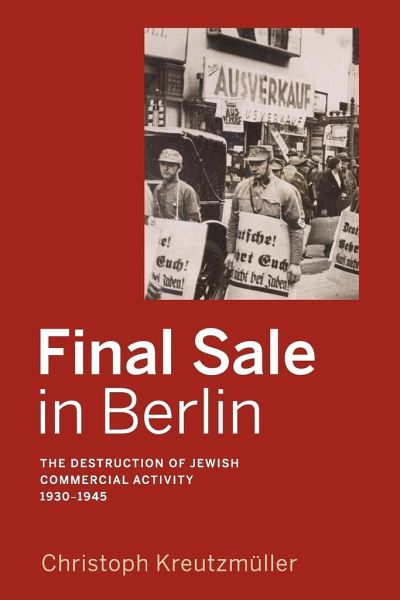
The book has many unusual case studies but is not a case study in itself, it draws on a real mountain of material. The database the book is based on is accessible to all readers (www2.hu-berlin.de/djgb). For a German study it is - everyone says - really well written. The study makes innovative use of photographs.
The book has many unusual case studies but is not a case study in itself, it draws on a real mountain of material. The database the book is based on is accessible to all readers (www2.hu-berlin.de/djgb). For a German study it is - everyone says - really well written. The study makes innovative use of photographs.
Christoph Kreutzmüller is a curator of the new permanent exhibition of the Jewish Museum in Berlin. He has written extensively in the field of the Holocaust, economic and photographic history. His publications include National Economies: Volks-Wirtschaft, Racism and Economy in Europe between the Wars (2015, co-editor Michael Wildt and Moshe Zimmermann) and Fixiert: Fotografische Quellen zur Verfolgung und Ermordung der Juden in Europa (2016, with Julia Werner), forthcoming is Dispossession, Plundering German Jewry 1933-1953 (2017, co-editor with Jonathan Zatlin). Together with Hans-Christian Jasch he has just edited The Participants: The Men of the Wannsee Conference (Berghahn, 2017).
Inhaltsangabe
List of Illustrations Acknowledgements Introduction PART I: CONTEXT Chapter 1. Berlin Chapter 2. Economy Chapter 3. Jewish Commercial Activity PART II: ATTACKING JEWISH COMMERCIAL ACTIVITY Chapter 4. Violent Persecution Chapter 5. Bureaucratic Persecution Chapter 6. Voyeurs and Profiteers Chapter 7. The Destruction of Jewish Commercial Activity PART III: ASSERTING JEWISH COMMERCIAL ACTIVITY Chapter 8. Institutional Counter-Strategies Chapter 9. Individual Counter-Strategies Chapter 10. Emigration Chapter 11. Case Studies PART IV Chapter 12. The Deportation of Jewish Businesspeople Summary Bibliography Index