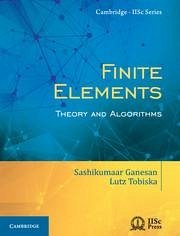
A useful guide explaining the theory and algorithms of finite element methods, with a focus on Sobolov spaces, finite element spaces, biharmonic equations, and parabolic problems. Numerous solved examples and mathematical theorems make it useful for graduate students.
A useful guide explaining the theory and algorithms of finite element methods, with a focus on Sobolov spaces, finite element spaces, biharmonic equations, and parabolic problems. Numerous solved examples and mathematical theorems make it useful for graduate students.
Sashikumaar Ganesan obtained his Ph.D. from Otto-von-Guericke-Universität Magdeburg, Germany 2006. He was Postdoctoral Fellow at Otto-von-Guericke-Universität Magdeburg, Germany (2006-08) and Research Associate (2008-09) at the Imperial College of Science, Technology and Medicine, London. He joined the Indian Institute of Science (IISc), Bangalore as Assistant Professor in 2011. He is currently heading a research group on Numerical Mathematics and Scientific Computing at Supercomputer Education and Research Centre, IISc, Bangalore. His areas of interest include numerical analysis, finite elements in fluid dynamics and high performance computing.
Inhaltsangabe
Preface 1. Sobolev spaces 1.1. Banach and Hilbert spaces 1.2. Weak derivatives 1.3. Sobolev spaces 2. Elliptic scalar problems 2.1. A general elliptic problem of second order 2.2. Weak solution 2.3. Standard Galerkin method 2.4. Abstract error estimate 3. Finite element spaces 3.1. Simplices and barycentric coordinates 3.2. Simplicial finite elements and local spaces 3.3. Construction of finite elements spaces 3.4. The concept of mapped finite elements: affine mappings 3.5. Finite elements on rectangular and brick meshes 3.6. Mapped finite elements: general bijective mappings 3.7. Mapped Qk finite elements 3.8. Isoparametric finite elements 3.9. Further examples of finite elements in C0 and C1 4. Interpolation and discretization error 4.1. Transformation formulas 4.2. Affine equivalent finite elements 4.3. Canonical interpolation 4.4. Local and global interpolation error 4.5. Improved L2 error estimates by duality 4.6. Interpolation of less smooth functions 5. Biharmonic equation 5.1. Deflection of a thin clamped plate 5.2. Weak formulation of the biharmonic equation 5.3. Conforming finite element methods 5.4. Nonconforming finite element methods 6. Parabolic problems 6.1. Conservation of energy 6.2. A general parabolic problem of initial boundary value problems 6.3. Weak formulation of initial boundary value problems 6.4. Semidiscretization by finite elements 6.5. Time discretization 6.6. Finite elements for high-dimensional parabolic problems 7. Systems in solid mechanics 7.1. Linear elasticity 7.2. Mindlin-Reissner plate 8. Systems in fluid mechanics 8.1. Conservation of mass and momentum 8.2. Weak formulation of the Stokes problem 8.3. Conforming discretizations of the Stokes problem 8.4. Nonconforming discretizations of the Stokes problem 8.5. The nonconforming Crouzeix-Raviart element 8.6. Further inf-sup stable finite element pairs 8.7. Equal order stabilized finite elements 8.8. Navier-Stokes problem with mixed boundary conditions 8.9. Time discretization and linearization of the Navier-Stokes problem 9. Implementation of the finite element method 9.1. Mesh handling and data structure 9.2. Numerical integration 9.3. Sparse matrix storage 9.4. Assembling of system matrices and load vectors 9.5. Inclusion of boundary conditions 9.6. Solution of the algebraic systems 9.7. Object-oriented C++ programming Bibliography Index.
Preface 1. Sobolev spaces 1.1. Banach and Hilbert spaces 1.2. Weak derivatives 1.3. Sobolev spaces 2. Elliptic scalar problems 2.1. A general elliptic problem of second order 2.2. Weak solution 2.3. Standard Galerkin method 2.4. Abstract error estimate 3. Finite element spaces 3.1. Simplices and barycentric coordinates 3.2. Simplicial finite elements and local spaces 3.3. Construction of finite elements spaces 3.4. The concept of mapped finite elements: affine mappings 3.5. Finite elements on rectangular and brick meshes 3.6. Mapped finite elements: general bijective mappings 3.7. Mapped Qk finite elements 3.8. Isoparametric finite elements 3.9. Further examples of finite elements in C0 and C1 4. Interpolation and discretization error 4.1. Transformation formulas 4.2. Affine equivalent finite elements 4.3. Canonical interpolation 4.4. Local and global interpolation error 4.5. Improved L2 error estimates by duality 4.6. Interpolation of less smooth functions 5. Biharmonic equation 5.1. Deflection of a thin clamped plate 5.2. Weak formulation of the biharmonic equation 5.3. Conforming finite element methods 5.4. Nonconforming finite element methods 6. Parabolic problems 6.1. Conservation of energy 6.2. A general parabolic problem of initial boundary value problems 6.3. Weak formulation of initial boundary value problems 6.4. Semidiscretization by finite elements 6.5. Time discretization 6.6. Finite elements for high-dimensional parabolic problems 7. Systems in solid mechanics 7.1. Linear elasticity 7.2. Mindlin-Reissner plate 8. Systems in fluid mechanics 8.1. Conservation of mass and momentum 8.2. Weak formulation of the Stokes problem 8.3. Conforming discretizations of the Stokes problem 8.4. Nonconforming discretizations of the Stokes problem 8.5. The nonconforming Crouzeix-Raviart element 8.6. Further inf-sup stable finite element pairs 8.7. Equal order stabilized finite elements 8.8. Navier-Stokes problem with mixed boundary conditions 8.9. Time discretization and linearization of the Navier-Stokes problem 9. Implementation of the finite element method 9.1. Mesh handling and data structure 9.2. Numerical integration 9.3. Sparse matrix storage 9.4. Assembling of system matrices and load vectors 9.5. Inclusion of boundary conditions 9.6. Solution of the algebraic systems 9.7. Object-oriented C++ programming Bibliography Index.
Es gelten unsere Allgemeinen Geschäftsbedingungen: www.buecher.de/agb
Impressum
www.buecher.de ist ein Internetauftritt der buecher.de internetstores GmbH
Geschäftsführung: Monica Sawhney | Roland Kölbl | Günter Hilger
Sitz der Gesellschaft: Batheyer Straße 115 - 117, 58099 Hagen
Postanschrift: Bürgermeister-Wegele-Str. 12, 86167 Augsburg
Amtsgericht Hagen HRB 13257
Steuernummer: 321/5800/1497
USt-IdNr: DE450055826