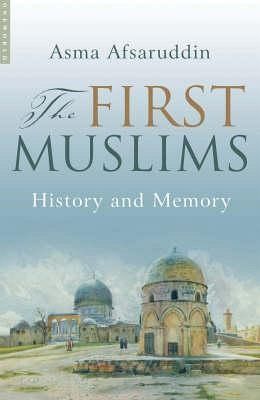
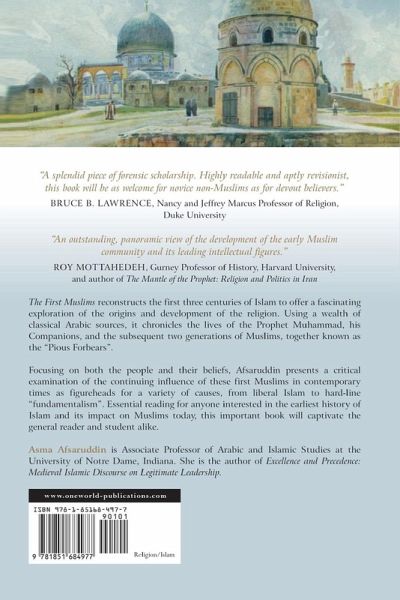
A fresh look at the origins and development of Islam, this is a fascinating reconstruction of the era of the first three generations of Muslims. Using a wealth of classical Arabic sources, it chronicles the lives of the Prophet Muhammad, his Companions, and the subsequent two generations of Muslims, together known as the "the Pious Forebears". Examining the adoption in contemporary times of these early Muslims as legitimizing figureheads for a variety of causes, both religious and political, Afsaruddin tries to establish where their sympathies really lay. Essential reading for anyone…mehr
A fresh look at the origins and development of Islam, this is a fascinating reconstruction of the era of the first three generations of Muslims. Using a wealth of classical Arabic sources, it chronicles the lives of the Prophet Muhammad, his Companions, and the subsequent two generations of Muslims, together known as the "the Pious Forebears". Examining the adoption in contemporary times of these early Muslims as legitimizing figureheads for a variety of causes, both religious and political, Afsaruddin tries to establish where their sympathies really lay. Essential reading for anyone interested in the inception of the Islam, this important book will captivate the general reader and student alike.
Asma Afsaruddin is Associate Professor of Arabic and Islamic Studies at the University of Notre Dame, Indiana. She is the author of /Excellence and Precedence: Medieval Islamic Discourse on Legitimate Leadership/.
Inhaltsangabe
Introduction: Writing about the "First Muslims" Chapter One: The Rise of Islam and Life of the Prophet Muhammad Chapter Two: The Issue of Succession to the Prophet Chapter Three: The Age of the Rightly-Guided Caliphs Chapter Four: the End of Rightly-Guided Leadership Chapter Five: The Age of the Companions Chapter Six: The Age of the Successors Chapter Seven: The Successors to the Successors I: Administration, Leadership, and Jihad Chapter Eight: The Successors to the Successors II: Education, Humanism, and Mystical Spirituality Chapter Nine: Constructing the Pious Forbears: Historical Memory and the Present. Part One: The Islamist Construction Chapter Ten: Constructing the Pious Forbears: Historical Memory and the Present. Part Two: The Significance of the Salaf al-Salih for the Modernists Chapter Eleven: Assessment of Islamist and Modernist Views Conclusion
Es gelten unsere Allgemeinen Geschäftsbedingungen: www.buecher.de/agb
Impressum
www.buecher.de ist ein Internetauftritt der buecher.de internetstores GmbH
Geschäftsführung: Monica Sawhney | Roland Kölbl | Günter Hilger
Sitz der Gesellschaft: Batheyer Straße 115 - 117, 58099 Hagen
Postanschrift: Bürgermeister-Wegele-Str. 12, 86167 Augsburg
Amtsgericht Hagen HRB 13257
Steuernummer: 321/5800/1497
USt-IdNr: DE450055826