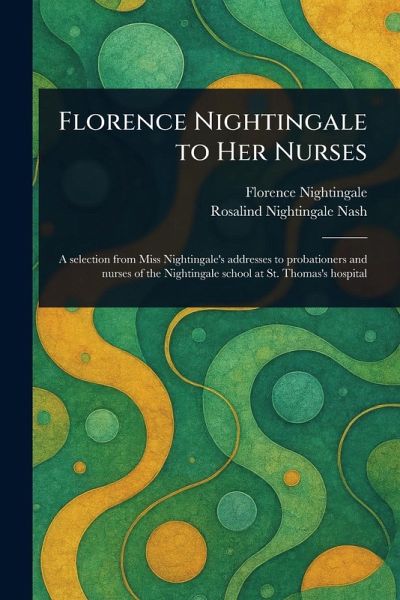
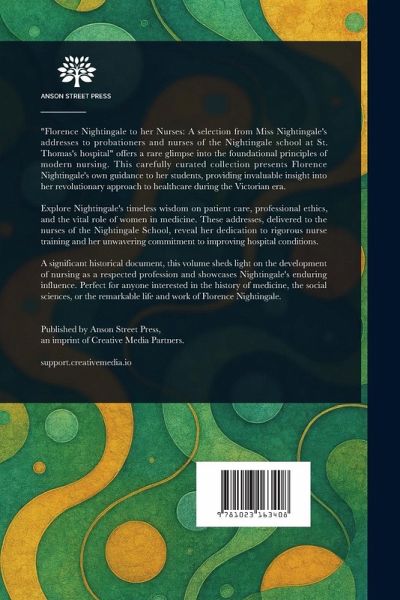
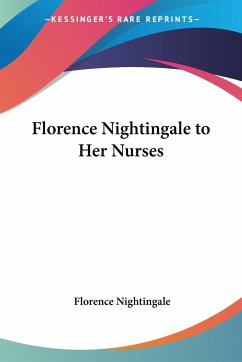
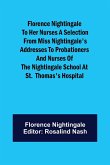
"Florence Nightingale to her Nurses: A selection from Miss Nightingale's addresses to probationers and nurses of the Nightingale school at St. Thomas's hospital" offers a rare glimpse into the foundational principles of modern nursing. This carefully curated collection presents Florence Nightingale's own guidance to her students, providing invaluable insight into her revolutionary approach to healthcare during the Victorian era. Explore Nightingale's timeless wisdom on patient care, professional ethics, and the vital role of women in medicine. These addresses, delivered to the nurses of the…mehr
"Florence Nightingale to her Nurses: A selection from Miss Nightingale's addresses to probationers and nurses of the Nightingale school at St. Thomas's hospital" offers a rare glimpse into the foundational principles of modern nursing. This carefully curated collection presents Florence Nightingale's own guidance to her students, providing invaluable insight into her revolutionary approach to healthcare during the Victorian era. Explore Nightingale's timeless wisdom on patient care, professional ethics, and the vital role of women in medicine. These addresses, delivered to the nurses of the Nightingale School, reveal her dedication to rigorous nurse training and her unwavering commitment to improving hospital conditions. A significant historical document, this volume sheds light on the development of nursing as a respected profession and showcases Nightingale's enduring influence. Perfect for anyone interested in the history of medicine, the social sciences, or the remarkable life and work of Florence Nightingale. This work has been selected by scholars as being culturally important, and is part of the knowledge base of civilization as we know it. This work is in the public domain in the United States of America, and possibly other nations. Within the United States, you may freely copy and distribute this work, as no entity (individual or corporate) has a copyright on the body of the work. Scholars believe, and we concur, that this work is important enough to be preserved, reproduced, and made generally available to the public. We appreciate your support of the preservation process, and thank you for being an important part of keeping this knowledge alive and relevant.
Florence Nightingale /'na¿t¿nge¿l/, OM, RRC, DStJ (12 May 1820 - 13 August 1910) was a British social reformer and statistician, and the founder of modern nursing. Nightingale came to prominence while serving as a manager and trainer of nurses during the Crimean War, in which she organised care for wounded soldiers.[3] She gave nursing a favourable reputation and became an icon of Victorian culture, especially in the persona of "The Lady with the Lamp" making rounds of wounded soldiers at night.[4][5] Recent commentators have asserted Nightingale's Crimean War achievements were exaggerated by media at the time, but critics agree on the importance of her later work in professionalising nursing roles for women.[6] In 1860, Nightingale laid the foundation of professional nursing with the establishment of her nursing school at St Thomas' Hospital in London. It was the first secular nursing school in the world, and is now part of King's College London. In recognition of her pioneering work in nursing, the Nightingale Pledge taken by new nurses, and the Florence Nightingale Medal, the highest international distinction a nurse can achieve, were named in her honour, and the annual International Nurses Day is celebrated on her birthday. Her social reforms included improving healthcare for all sections of British society, advocating better hunger relief in India, helping to abolish prostitution laws that were harsh for women, and expanding the acceptable forms of female participation in the workforce. Nightingale was a prodigious and versatile writer. In her lifetime, much of her published work was concerned with spreading medical knowledge. Some of her tracts were written in simple English so that they could easily be understood by those with poor literary skills. She was also a pioneer in data visualization with the use of infographics, effectively using graphical presentations of statistical data.[6] Much of her writing, including her extensive work on religion and mysticism, has only been published posthumously.
Es gelten unsere Allgemeinen Geschäftsbedingungen: www.buecher.de/agb
Impressum
www.buecher.de ist ein Internetauftritt der buecher.de internetstores GmbH
Geschäftsführung: Monica Sawhney | Roland Kölbl | Günter Hilger
Sitz der Gesellschaft: Batheyer Straße 115 - 117, 58099 Hagen
Postanschrift: Bürgermeister-Wegele-Str. 12, 86167 Augsburg
Amtsgericht Hagen HRB 13257
Steuernummer: 321/5800/1497
USt-IdNr: DE450055826