38,99 €
inkl. MwSt.
Versandkostenfrei*
Versandfertig in 6-10 Tagen
payback
19 °P sammeln
  • Broschiertes Buch

This book provides a critical review of recent advances in the development of fluorescent organic nanoparticles as materials of choice for the design and fabrication of sensors, bioimaging agents and drug delivery systems. The properties and functions of nanoparticles differ significantly from those of their parent entities or their bulk phases. Two of their most important features are their increased surface-to volume ratio, and the formation of surface structures differing from those in their bulk phases. In addition, the book discusses the synthesis of fluorescent conjugated polymers,…mehr

Produktbeschreibung
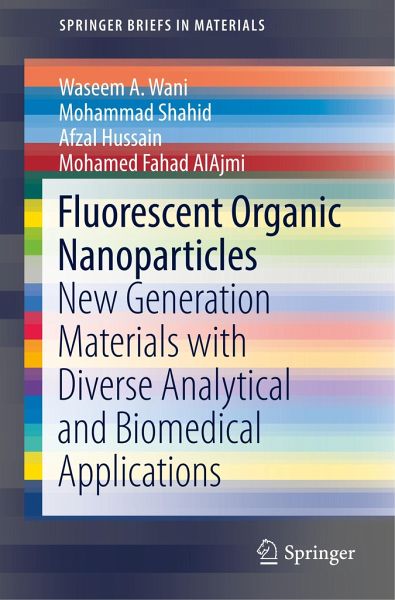
This book provides a critical review of recent advances in the development of fluorescent organic nanoparticles as materials of choice for the design and fabrication of sensors, bioimaging agents and drug delivery systems. The properties and functions of nanoparticles differ significantly from those of their parent entities or their bulk phases. Two of their most important features are their increased surface-to volume ratio, and the formation of surface structures differing from those in their bulk phases.
In addition, the book discusses the synthesis of fluorescent conjugated polymers, self-assembled fluorescent nanoparticles, polydopamine nanoparticles, and aggregation-induced-emission or aggregation-induced-emission enhancement nanomaterials. In closing, the book provides an outlook on future research and development in fluorescent organic nanoparticles as smart materials with an impressive range of potential applications.
Autorenporträt
Dr. Afzal Hussain is an associate professor at the Department of Pharmacognosy, College of Pharmacy, King Saud University, Riyadh, Saudi Arabia. He completed his Ph.D. in Chemistry at Jamia Millia Islamia, New Delhi, India. in 2010. He has worked as a postdoctoral fellow at Sultan Qaboos University, Muscat, Oman, and Aligarh Muslim University, Aligarh, India. Having been admitted as a member to the Royal Society of Chemistry (MRSC) in 2018, he has 12 years of experience in teaching and research. His areas of research include separation science, bioanalysis, drug analysis, cosmeceutical analysis, nutraceutical analysis, and synthesis of novel nanomaterials as drug delivery carriers. Dr. Hussain completed a research project as a co-investigator entitled "Synthesis and Characterization of Novel Metal-Based Anticancer Drugs" Grant No: ¿ ¿- 36 - 227 Funded by KACST, Riyadh. Prof. Mohamed Fahad AlAjmi is the head of the Skills Development Unit at the Department of Pharmacognosy, College of Pharmacy, King Saud University, Riyadh, Saudi Arabia. He completed his Ph.D. in Pharmacy in 2007. Dr. AlAjmi has published more than 150 papers in international journals and is a member of many professional societies, including the American Society for Mass Spectrometry and the American Society of Pharmacognosy. He has received two prestigious awards from King Saud University: Excellence Award in Skills Development (2013) and Creative Learning and Teaching Award (2016). Prof. Mushtaq Ahmad Lone is working as an associate professor and principal of Govt. Degree College Tral. Prof. Lone obtained his Masters Degree in Chemistry in 1984 and M.Phil. in 1987. He has worked on the complex formation between amino acids, peptides, and metal ions in the aqueous phase. He has been a prolific teacher with 30 years of teaching experience at college level. He has research interests in anticancer metallodrugs. Dr. Waseem A. Wani is working as an assistant professor and the head of the Department of Chemistry at Govt. Degree College Tral, Kashmir, J&K, India. Dr. Waseem earned Ph.D. in Chemistry from Jamia Millia Islamia (Central University), New Delhi, in 2014. He has worked as a postdoctoral research fellow at Universiti Teknologi Malaysia (UTM), Malaysia, Institute of Nano Science and Technology (INST), India, and University of Minnesota (UMN), Twin Cities Campus, Saint Paul-Minneapolis, USA. He has research interests in anticancer metallodrugs, nanofunctionalization of anticancer metallodrugs, drug delivery, bioproducts, and water chemistry. He has authored and co-authored more than fifty research publications (original research papers, reviews, editorials, book chapters, books, brief books, and conference papers) of national and international repute. Dr. Waseem is an active reviewer of many reputed journals.