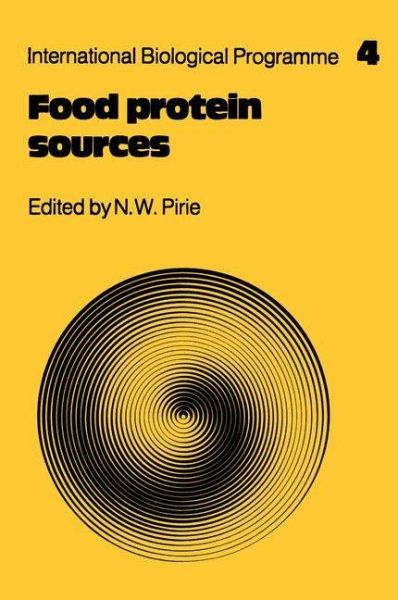
This book was first published in 1975. Food protein can be produced in many different ways. Some sources, e.g. products from domestic animals, are so well known that they need only brief mention in a book such as this. Others necessitate the use of sophisticated technology; their merits and potentialities are discussed at sufficient length to allow their world role to be assessed and to illustrate the directions in which research is needed. Special attention is given to sources from which food protein could be made by simple techniques in regions where protein deficiency is acute. The methods…mehr
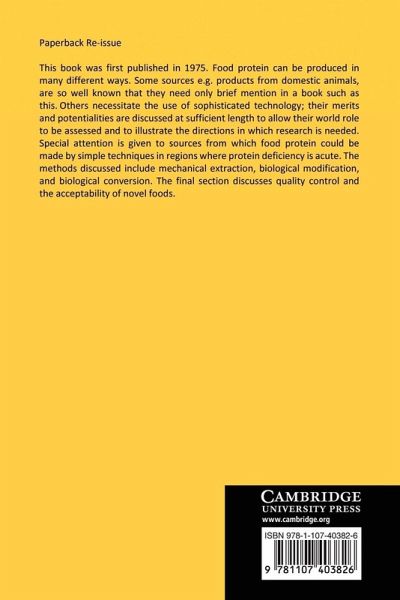
This book was first published in 1975. Food protein can be produced in many different ways. Some sources, e.g. products from domestic animals, are so well known that they need only brief mention in a book such as this. Others necessitate the use of sophisticated technology; their merits and potentialities are discussed at sufficient length to allow their world role to be assessed and to illustrate the directions in which research is needed. Special attention is given to sources from which food protein could be made by simple techniques in regions where protein deficiency is acute. The methods discussed include mechanical extraction, biological modification, and biological conversion. The final section discusses quality control and the acceptability of novel foods.
List of contributors Preface Part I. Sources Edible after Minimal Processing: 1. Protein-rich cereal seeds A. K. Kaul 2. Varietal improvement of seed legumes in India L. M. Jeswani 3. Minor food seeds D. A. V. Dendy, Bernice Emmett and O. L. Oke 4. Vegetables F. W. Shepherd 5. The Spirulina algae N. W. Pirie 6. Green micro-algae H. Tamiya Part II. Concentrates Made by Mechanical Extraction: 7. Protein products from coconuts D. A. Dendy 8. Soybeans: processing and products S. J. Circle and A. K. Smith 9. Rapeseed and other crucifers R. Ohlson and R. Sepp 10. Sunflower, safflower, sesame and castor protein Antoinette A. Betschart, C. K. Lyon and G. O. Kohler 11. Groundnut O. L. Oke, R. H. Smith and A. A. Woodham 12. Broad bean A. Hagberg and J. Sjödin 13. Concentrates by wet and dry processing of cereals R. M. Saunders and G. O. Kohler 14. Leaf protein N. W. Pirie 15. Industrial production of leaf protein in the USA G. O. Kohler and E. M. Bickoff Part III. Concentrates Made by Biological Conversion: 16. Protein from non-domesticated herbivores K. L. Blaxter 17. The use of non-protein nitrogen by ruminants T. R. Preston 18. Non-protein nitrogen in pig nutrition R. Braude 19. The domestic non-ruminant animal as consumer and provider of protein A. A. Woodham 20. The conversion of animal products such as wool and feathers into food F. B. Shorland 21. Increasing the direct consumption of fish G. H. O. Burgess 22. Funghi W. E. Trevelyan 23. Yeasts grown on hydrocarbons C. A. Shacklady 24. Variation in the composition of bacteria and yeast and its significance to single-cell protein production C. L. Clooney and S. R. Tannenbaum Part IV. The Use of Novel Foods: 25. Quality standards, safety and legislation F. Aylward 26. Acceptance of novel foods by the consumer R. P. Devadas Index.
Es gelten unsere Allgemeinen Geschäftsbedingungen: www.buecher.de/agb
Impressum
www.buecher.de ist ein Internetauftritt der buecher.de internetstores GmbH
Geschäftsführung: Monica Sawhney | Roland Kölbl | Günter Hilger
Sitz der Gesellschaft: Batheyer Straße 115 - 117, 58099 Hagen
Postanschrift: Bürgermeister-Wegele-Str. 12, 86167 Augsburg
Amtsgericht Hagen HRB 13257
Steuernummer: 321/5800/1497
USt-IdNr: DE450055826