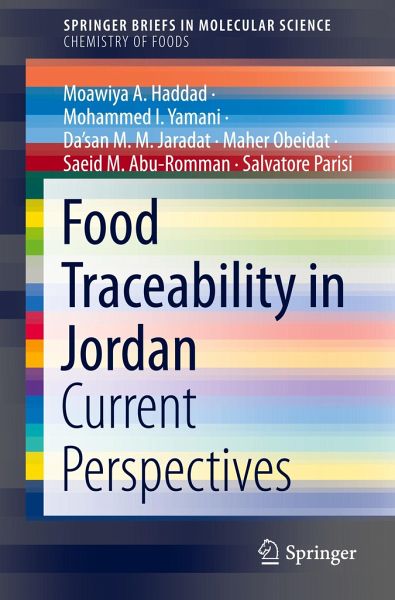
This book outlines the evolution of food traceability matters in the current traditional foods market and particularly with regard to selected historical foods based in Jordan. At present, traceability is just one of the many requirements the food industry is forced to meet. The topic can be approached from various angles: regulation, technological perspectives, food business operators, packaging manufacturers, software producers, and consumer views. In addition, traceable food products provide an interesting legacy for many geographical and ethnic cultures. Consequently, the examination of…mehr
This book outlines the evolution of food traceability matters in the current traditional foods market and particularly with regard to selected historical foods based in Jordan.
At present, traceability is just one of the many requirements the food industry is forced to meet. The topic can be approached from various angles: regulation, technological perspectives, food business operators, packaging manufacturers, software producers, and consumer views. In addition, traceable food products provide an interesting legacy for many geographical and ethnic cultures. Consequently, the examination of certain recipes or food products linked with history and traditions can make a unique and valuable contribution to future developments in this area.
In this regard, Jordanian foods offer a prime example. This book examines three traditional products from different viewpoints, paying special attention to their chemical composition, the identification of raw materials, preparation procedures, and traceability. The book begins with a more general discussion on food traceability without detailed regional implications, while the second chapter discusses the product hummus in its many versions. In turn, the third and fourth chapters focus on two fermented dairy products, labaneh and jameed, and their connections with the Mediterranean diet. The book offers a valuable reference guide to many traditional/historical products in the Middle East, with a particular focus on traceability matters and solutions.
Moawiya A. Haddad holds a Ph.D. in Nutrition and Food Technology. He is an Associate Professor in the department of nutrition and food processing, Al-Balqa Applied University. He was the head of the department of nutrition and food technology between 2018-2021. he was the vice chairman of two Jordanian societies: Jordanian dietetic association and Jordanian society for sensory evaluation of food between 2016-2019. He gets a diploma in olive oil in 2019 from international olive council and participated as a member in Judging committee of Mario Solinas award. He taught many courses of food technology, food microbiology and food safety. He taught also dairy science and technology, cereal science and technology, meat science and technology and nutritional assessment. He published more than 55th articles in reputable and peer reviewed journals. He focuses chiefly on food traceability, product development, fermented dairy products quality and safety, and functional foods. Mohammed I. Yamani had his Ph.D. from Berlin Free University, Germany, and has been professor of Food Microbiology and Hygiene and Quality Management Systems at the Department of Nutrition and Food Technology, Faculty of Agriculture, University of Jordan, Amman-Jordan. He was Dean of the Faculty of Agriculture, and Head of the Amman Municipality Food Control Laboratories. He has taught, proposed, and directed academic activities work in different fields of food science and technology in three universities. He published tens of papers and articles in international refereed research periodicals and professional scientific periodicals and was the author of the book Hazard Analysis and Critical Control Point Generic Models for some Traditional Foods: A Manual for the Eastern Mediterranean Region published by World Health Organization. He was a professional member of the Institute of Food Technologists, the American Dairy Association, and the International Association for Food Protection. He had been a certified ISO 9001, ISO 22000, and HACCP System lead auditor. Saeid M. Abu-Romman is currently Professor of Molecular Crop Physiology and Biotechnology at Al-Balqa Applied University, where he has been since 2009. He received a B.S. from Mutah University in 2000, and an M.S. from the University of Jordan. He received his Ph.D. in Plant Physiology and Biotechnology from the University of Hohenheim-Germany in 2008, working with Prof. Andreas Schaller. Saeid's research interests include functional genomics; stress physiology; and allelopathy. His research projects has been supported by Al-Balqa Applied University, Scientific Research Fund (Ministry of Higher Education-Jordan), Abdulhameed Shoman Foundation, and IHE Delft (The Netherland). Prof. Abu-Romman is the former director of the Office of Cooperation and International Relations and is currently the Dean of Scientific Research & Innovation. Saeid has over 65refereed publications. Maher Obeidat is Associate Professor of Microbiology and was the dean for the Faculty of Science at Al-Balqa Applied University in 2019-2020. He specializes in microbiology, immunology, and cancer therapy and get many research funds from Scientific research fund (Ministry of Higher Education) -Jordan, and Abdulhameed Shoman Foundation. He taught many courses to faculty of agricultural technology and faculty of science in Al-Balqa Applied University.
Inhaltsangabe
An Introduction to Food Traceability.- Traditional Foods in Jordan and Traceability. Hummus and Related Variations.- Jordan Dairy Products and Traceability. Labaneh, a Concentrated Strained Yogurt.- Dried Fermented Dairy Products in Jordan. Jameed and Traceability.
An Introduction to Food Traceability.- Traditional Foods in Jordan and Traceability. Hummus and Related Variations.- Jordan Dairy Products and Traceability. Labaneh, a Concentrated Strained Yogurt.- Dried Fermented Dairy Products in Jordan. Jameed and Traceability.
Es gelten unsere Allgemeinen Geschäftsbedingungen: www.buecher.de/agb
Impressum
www.buecher.de ist ein Internetauftritt der buecher.de internetstores GmbH
Geschäftsführung: Monica Sawhney | Roland Kölbl | Günter Hilger
Sitz der Gesellschaft: Batheyer Straße 115 - 117, 58099 Hagen
Postanschrift: Bürgermeister-Wegele-Str. 12, 86167 Augsburg
Amtsgericht Hagen HRB 13257
Steuernummer: 321/5800/1497
USt-IdNr: DE450055826