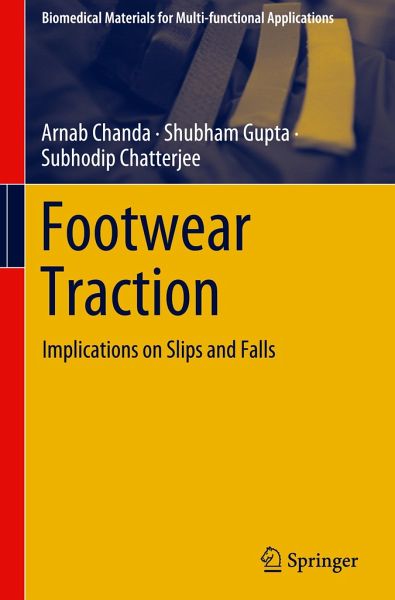
This book discusses the science of footwear traction and its relationship with slips and falls. It presents a detailed introduction to slips and falls and how crucial footwear traction is to avoid such incidents. The book covers ergonomics involved in the development of tread designs and the study of their effect on traction across footwear and systematically modified shoes. It discusses characterization techniques employed in the study of footwear traction across normal gait activities, such as walking and running and in sports, such as sprinting, basketball, and football. The book also…mehr
This book discusses the science of footwear traction and its relationship with slips and falls. It presents a detailed introduction to slips and falls and how crucial footwear traction is to avoid such incidents. The book covers ergonomics involved in the development of tread designs and the study of their effect on traction across footwear and systematically modified shoes. It discusses characterization techniques employed in the study of footwear traction across normal gait activities, such as walking and running and in sports, such as sprinting, basketball, and football. The book also covers the role of flooring and slippery contaminants on footwear traction and its generalizability. Additionally, the book also presents how the wear of footwear outsoles may reduce the traction at the shoe-floor and lead to slips and falls. It also discusses the challenges with the existing footwear traction testing methods, and the latest developments in this niche area are highlighted. The bookis a valuable reference for researchers and professionals interested in ergonomics, footwear technology, manufacturing engineering, safety engineering, and design engineering and its allied fields.
Produktdetails
Produktdetails
Biomedical Materials for Multi-functional Applications
Dr. Arnab Chanda is an assistant professor in the Centre for Biomedical Engineering, IIT Delhi, and a joint faculty at the Department of Biomedical Engineering at AIIMS, Delhi. He is also the founder of a start-up company BIOFIT Technologies LLC, USA. Dr. Chanda is an expert in the fabrication and manufacturing of artificial tissues, sensors, and wearable robotic devices. Also, his work has been cited extensively, and he is a recipient of the "Early Career Award" in 2024, "IOP Publishing¿Top Cited Paper Award" in 2023, and the "AO Spine National Research Grant Award" in 2022 by the prestigious AO Foundation, Davos, Switzerland. His research also received extensive media coverage, with over five articles cited in The Times of India. Dr. Vivek Gupta is a senior mechatronics engineer at Next Big Innovation Labs® (NBIL), where he designs and develops 3D Bioprinters for biomedical applications. He manages projects from conception to completion, ensuring adherence to budgets and timelines, and collaborating closely with cross-functional teams. He also designs control algorithms, part design and assembly, and embedded software for the 3D Bioprinters, using Autodesk EAGLE and other tools. Prior to this, Dr. Vivek has completed his Ph.D. in Biomedical Engineering from the Indian Institute of Technology Delhi (IITD), where he conducted groundbreaking research on skin grafting and auxetic structures, aiming to improve the care of severe burn patients. He has authored 22 international journal articles, including 18 as the first author, and has been awarded multiple patents for his innovations. Dr. Vivek is passionate about making India self-dependent in surgery and creating new technologies that can enhance human health and well-being. Shubham Gupta is a Ph.D. scholar and Prime Minister Research Fellow (PMRF) in the Disease and Injury Mechanics Lab (DIML), IIT Delhi, headed by Dr. Arnab Chanda. He completed his B.Tech. in Mechanical Engineering from the University of Pune in 2019. His research is focused on the study of traction performance of worn footwear. He was instrumental in the development of a state-of-the-art portable footwear traction characterization device and has also experimented with a range of worn footwear to estimate their traction reduction and determine replacement thresholds. Shubham has also developed a pioneering computational fluid dynamics-based (CFD) model to study the underlying physics behind the traction properties presented by a new or worn footwear on slippery fluid-contaminated floorings. His research interests are computational analysis of footwears, slip testing, finite element modeling, healthcare product development, and integration of robotics and AI/ML in medical applications.
Inhaltsangabe
Part I: Slips and Falls.- Chapter 1: Introduction.- Chapter 2: Worldwide Statistics of Slips and Falls.- Chapter 3: Basic Principles of Slip Resistance.- Chapter 4: Impact of Slips in The Realm of Footwear.- Chapter 5: Prevalence of Slips and Falls In Specific Sectors.- Part II: Ergonomics in Footwear.-Chapter 6: Overview of The Footwear Industry.- Chapter 7: Design and Effects of Different Types of Footwear.- Chapter 8: Activity Specific Footwear.- Chapter 9: Biomechanics of different footwear.-Part III: Traction Testing Methodologies of Footwear.- Chapter 10: Traditional Methods of Footwear Traction Testing.- Chapter 11: Recent Methods of Footwear Traction Testing.- Part IV: Effect of Popular Tread Orientations on Slip Performance.- Chapter 12: Horizontal Outsole Tread Orientation.-Chapter 13: Vertical Outsole Tread Orientation.- Chapter 14: Square Outsole Tread Orientation.-Chapter 15: Oblique Outsole Tread Orientation.- Part V: Effect of Wearing or footwear traction.-Chapter 16: Background on Footwear Wear.- Chapter 17: Wear Mechanisms.- Chapter 18: Effect of Footwear Wear on the Available Traction.- Part VI: Future Opportunities on footwear traction methodologies.- Chapter 19: Challenges Involved in Slip Testing in Actual Realistic Locations.- Chapter 20: New developments in the Area of Slip Testers.
Part I: Slips and Falls.- Chapter 1: Introduction.- Chapter 2: Worldwide Statistics of Slips and Falls.- Chapter 3: Basic Principles of Slip Resistance.- Chapter 4: Impact of Slips in The Realm of Footwear.- Chapter 5: Prevalence of Slips and Falls In Specific Sectors.- Part II: Ergonomics in Footwear.-Chapter 6: Overview of The Footwear Industry.- Chapter 7: Design and Effects of Different Types of Footwear.- Chapter 8: Activity Specific Footwear.- Chapter 9: Biomechanics of different footwear.-Part III: Traction Testing Methodologies of Footwear.- Chapter 10: Traditional Methods of Footwear Traction Testing.- Chapter 11: Recent Methods of Footwear Traction Testing.- Part IV: Effect of Popular Tread Orientations on Slip Performance.- Chapter 12: Horizontal Outsole Tread Orientation.-Chapter 13: Vertical Outsole Tread Orientation.- Chapter 14: Square Outsole Tread Orientation.-Chapter 15: Oblique Outsole Tread Orientation.- Part V: Effect of Wearing or footwear traction.-Chapter 16: Background on Footwear Wear.- Chapter 17: Wear Mechanisms.- Chapter 18: Effect of Footwear Wear on the Available Traction.- Part VI: Future Opportunities on footwear traction methodologies.- Chapter 19: Challenges Involved in Slip Testing in Actual Realistic Locations.- Chapter 20: New developments in the Area of Slip Testers.
Es gelten unsere Allgemeinen Geschäftsbedingungen: www.buecher.de/agb
Impressum
www.buecher.de ist ein Internetauftritt der buecher.de internetstores GmbH
Geschäftsführung: Monica Sawhney | Roland Kölbl | Günter Hilger
Sitz der Gesellschaft: Batheyer Straße 115 - 117, 58099 Hagen
Postanschrift: Bürgermeister-Wegele-Str. 12, 86167 Augsburg
Amtsgericht Hagen HRB 13257
Steuernummer: 321/5800/1497
USt-IdNr: DE450055826