
Andere Kunden interessierten sich auch für
 The Water, Climate, and Food Nexus115,99 €
 The Water, Climate, and Food Nexus113,99 €
 Water Challenges in Rural and Urban Sub-Saharan Africa and their Management34,99 €
 Management of Weather and Climate Risk in the Energy Industry151,99 €
 Management of Weather and Climate Risk in the Energy Industry151,99 €
 Parched - The Cape Town Drought Story68,99 €
 Parched - The Cape Town Drought Story98,99 €



Presented with the Award of the Senate of the University of Bucharest for the most prestigious book in the field of Life and Earth Sciences, 2022-2023.
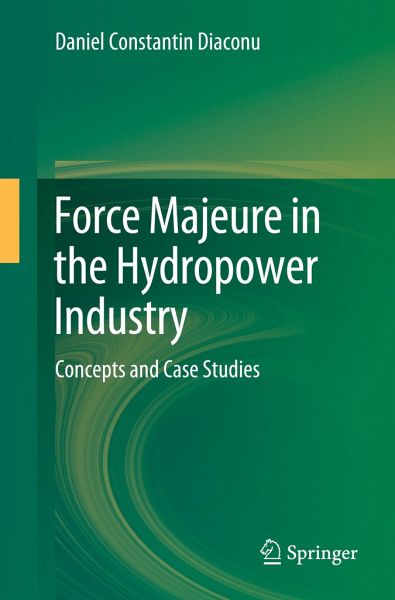
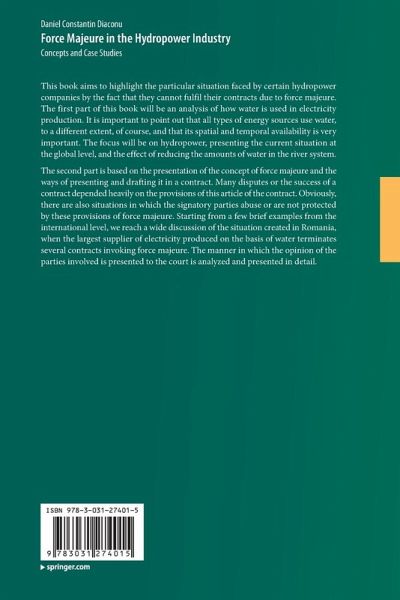
This book aims to highlight the particular situation faced by certain hydropower companies by the fact that they cannot fulfil their contracts due to force majeure. The first part of this book will be an analysis of how water is used in electricity production. It is important to point out that all types of energy sources use water, to a different extent, of course, and that its spatial and temporal availability is very important. The focus will be on hydropower, presenting the current situation at the global level, and the effect of reducing the amounts of water in the river system.
The second part is based on the presentation of the concept of force majeure and the ways of presenting and drafting it in a contract. Many disputes or the success of a contract depended heavily on the provisions of this article of the contract. Obviously, there are also situations in which the signatory parties abuse or are not protected by these provisions of force majeure. Starting from a few brief examples from the international level, we reach a wide discussion of the situation created in Romania, when the largest supplier of electricity produced on the basis of water terminates several contracts invoking force majeure. The manner in which the opinion of the parties involved is presented to the court is analyzed and presented in detail.
This book aims to highlight the particular situation faced by certain hydropower companies by the fact that they cannot fulfil their contracts due to force majeure. The first part of this book will be an analysis of how water is used in electricity production. It is important to point out that all types of energy sources use water, to a different extent, of course, and that its spatial and temporal availability is very important. The focus will be on hydropower, presenting the current situation at the global level, and the effect of reducing the amounts of water in the river system.
The second part is based on the presentation of the concept of force majeure and the ways of presenting and drafting it in a contract. Many disputes or the success of a contract depended heavily on the provisions of this article of the contract. Obviously, there are also situations in which the signatory parties abuse or are not protected by these provisions of force majeure. Starting from a few brief examples from the international level, we reach a wide discussion of the situation created in Romania, when the largest supplier of electricity produced on the basis of water terminates several contracts invoking force majeure. The manner in which the opinion of the parties involved is presented to the court is analyzed and presented in detail.