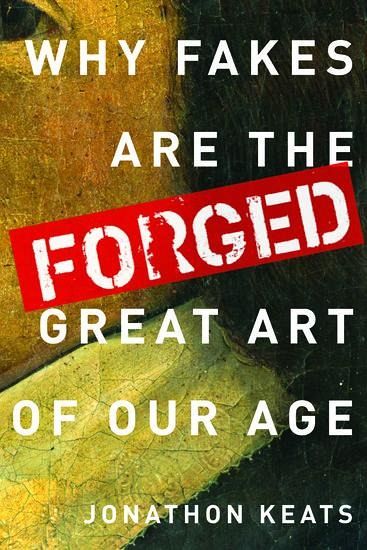
According to Vasari, the young Michelangelo often borrowed drawings of past masters, which he copied, returning his imitations to the owners and keeping originals. Half a millennium later, Andy Warhol made a game of "forging" the Mona Lisa, questioning the entire concept of originality. Forged explores art forgery from ancient times to the present. In chapters combining lively biography with insightful art criticism, Jonathon Keats profiles individual art forgers and connects their stories to broader themes about the role of forgeries in society. From the Renaissance master Andrea del Sarto…mehr
According to Vasari, the young Michelangelo often borrowed drawings of past masters, which he copied, returning his imitations to the owners and keeping originals. Half a millennium later, Andy Warhol made a game of "forging" the Mona Lisa, questioning the entire concept of originality. Forged explores art forgery from ancient times to the present. In chapters combining lively biography with insightful art criticism, Jonathon Keats profiles individual art forgers and connects their stories to broader themes about the role of forgeries in society. From the Renaissance master Andrea del Sarto who faked a Raphael masterpiece at the request of his Medici patrons, to the Vermeer counterfeiter Han van Meegeren who duped the avaricious Hermann Goring, to the frustrated British artist Eric Hebborn, who began forging to expose the ignorance of experts, art forgers have challenged "legitimate" art in their own time, breaching accepted practices and upsetting the status quo. They have also provocatively confronted many of the present-day cultural anxieties that are major themes in the arts. Keats uncovers what forgeries--and our reactions to them--reveal about changing conceptions of creativity, identity, authorship, integrity, authenticity, success, and how we assign value to works of art. The book concludes by looking at how artists today have appropriated many aspects of forgery through such practices as street-art stenciling and share-and-share-alike licensing, and how these open-source "copyleft" strategies have the potential to make legitimate art meaningful again. Forgery has been much discussed--and decried--as a crime. Forged is the first book to assess great forgeries as high art in their own right. "
Jonathon Keats is a critic, journalist and artist. He is the art critic for San Francisco Magazine, and has contributed art criticism to Art & Antiques, Art + Auction, Art in America, ARTnews, Artweek, and Salon.com. His arts writing has also appeared in Wired Magazine, ForbesLife Magazine, The Washington Post, and The Christian Science Monitor. He is most recently the author of Virtual Words: Language on the Edge of Science and Technology (OUP). His conceptual art has been exhibited at venues including the Berkeley Art Museum, the Hammer Museum, and the Wellcome Collection.
Inhaltsangabe
TABLE OF CONTENTS Part One The Art of Forgery Part Two Forgers: Six Modern Masters Lothar Malskat: What is Belief? Alceo Dossena: What is Authenticity? Han van Meegeren: What is Authority? Eric Hebborn: What is Heritage? Elmyr de Hory: What is Identity? Tom Keating: What is Culture? Part Three Forging a New Art Further Reading
TABLE OF CONTENTS Part One The Art of Forgery Part Two Forgers: Six Modern Masters Lothar Malskat: What is Belief? Alceo Dossena: What is Authenticity? Han van Meegeren: What is Authority? Eric Hebborn: What is Heritage? Elmyr de Hory: What is Identity? Tom Keating: What is Culture? Part Three Forging a New Art Further Reading
Es gelten unsere Allgemeinen Geschäftsbedingungen: www.buecher.de/agb
Impressum
www.buecher.de ist ein Internetauftritt der buecher.de internetstores GmbH
Geschäftsführung: Monica Sawhney | Roland Kölbl | Günter Hilger
Sitz der Gesellschaft: Batheyer Straße 115 - 117, 58099 Hagen
Postanschrift: Bürgermeister-Wegele-Str. 12, 86167 Augsburg
Amtsgericht Hagen HRB 13257
Steuernummer: 321/5800/1497
USt-IdNr: DE450055826