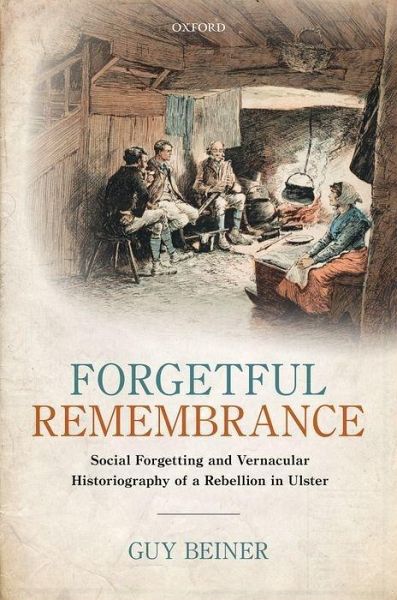
Forgetful Remembrance examines the paradoxes of what actually happens when communities persistently endeavour to forget inconvenient events. The question of how a society attempts to obscure problematic historical episodes is addressed through a detailed case study grounded in the north-eastern counties of the Irish province of Ulster, where loyalist and unionist Protestants -- and in particular Presbyterians -- repeatedly tried to repress over two centuries discomfiting recollections of participation, alongside Catholics, in a republican rebellion in 1798. By exploring a rich variety of…mehr
Forgetful Remembrance examines the paradoxes of what actually happens when communities persistently endeavour to forget inconvenient events. The question of how a society attempts to obscure problematic historical episodes is addressed through a detailed case study grounded in the north-eastern counties of the Irish province of Ulster, where loyalist and unionist Protestants -- and in particular Presbyterians -- repeatedly tried to repress over two centuries discomfiting recollections of participation, alongside Catholics, in a republican rebellion in 1798. By exploring a rich variety of sources, Beiner makes it possible to closely follow the dynamics of social forgetting. His particular focus on vernacular historiography, rarely noted in official histories, reveals the tensions between professed oblivion in public and more subtle rituals of remembrance that facilitated muted traditions of forgetful remembrance, which were masked by a local culture of reticence and silencing. Throughout Forgetful Remembrance, comparative references demonstrate the wider relevance of the study of social forgetting in Northern Ireland to numerous other cases where troublesome memories have been concealed behind a veil of supposed oblivion.
Guy Beiner is a professor of modern history at Ben-Gurion University of the Negev. He specializes in the study of remembering and forgetting, with a particular interest in the history of Ireland. He was a Government of Ireland scholar at University College Dublin, a Government of Ireland Research Fellow at Trinity College Dublin, a National Endowment for the Humanities Fellow at the University of Notre Dame, a Government of Hungary scholar at the Central European University, and a Marie Curie fellow at the University of Oxford. He is the author of the multi-prize-winning book, Remembering the Year of the French: Irish Folk History and Social Memory.
Inhaltsangabe
* Figures * Maps * Abbreviations * Epigraphs * Preface: Forgetful Remembrance * Introduction: Sites of Oblivion * Vernacular Historiography * Social Forgetting * The Turn-Out * Part I: Pre-Forgetting: Before 1798 * 1: Recycling Memory * 2: Initiating Counter-Memory * 3: Silencing * 4: Anticipating Forgetting * Part II: Amnesty and Amnesia: The Aftermath of 1798 * 5: Wilful Forgetting * 6: Unforgivingness * 7: Exiling Memory * 8: Impenitence * 9: The Chimera of Oblivion * Part III: The Generation of Forgetting: The First Half of the Nineteenth Century * 10: Uninscribed Epitaphs * 11: Wilful Muteness * 12: Versified Recall * 13: Fictionalized Memory * 14: Hesitations in Coming Out * 15: Collecting Recollections * 16: Postmemory Anxieties * Part IV: Regenerated Forgetting: The Second Half of the Nineteenth Century * 17: Continued Disremembrance * 18: Excavating Memory * 19: Countering Neglect * 20: Imagined Reminiscence * 21: Cultural Memory and Social Forgetting * 22: Revivalism and Re-Collecting * Part V: Decommemorating: The Turn of the Century * 23: Infighting * 24: Iconoclasm * 25: Rowdyism * 26: Recasting and Performing * 27: Rewriting and Staging * 28: Historical Disregard * 29: Re-Commemorating * Part VI: Restored Forgetting: The Short Twentieth Century * 30: Partitioned Memory * 31: Breaking Silence * 32: Unperceived Remembrance * 33: Troubled Forgetting * 34: Nonconformism * Part VII: Post-Forgetting: Into the Twenty-First Century * 35: Remembrance and Reconciliation * 36: Exhibiting Memory * 37: Countering Disremembering * 38: Disparities of Esteem * Part VIII: Conclusion: Rites of Oblivion * 39: Dealing with the Past * 40: Social Forgetting Beyond Ulster * 41: Rights of Forgetting * Select Bibliography
* Figures * Maps * Abbreviations * Epigraphs * Preface: Forgetful Remembrance * Introduction: Sites of Oblivion * Vernacular Historiography * Social Forgetting * The Turn-Out * Part I: Pre-Forgetting: Before 1798 * 1: Recycling Memory * 2: Initiating Counter-Memory * 3: Silencing * 4: Anticipating Forgetting * Part II: Amnesty and Amnesia: The Aftermath of 1798 * 5: Wilful Forgetting * 6: Unforgivingness * 7: Exiling Memory * 8: Impenitence * 9: The Chimera of Oblivion * Part III: The Generation of Forgetting: The First Half of the Nineteenth Century * 10: Uninscribed Epitaphs * 11: Wilful Muteness * 12: Versified Recall * 13: Fictionalized Memory * 14: Hesitations in Coming Out * 15: Collecting Recollections * 16: Postmemory Anxieties * Part IV: Regenerated Forgetting: The Second Half of the Nineteenth Century * 17: Continued Disremembrance * 18: Excavating Memory * 19: Countering Neglect * 20: Imagined Reminiscence * 21: Cultural Memory and Social Forgetting * 22: Revivalism and Re-Collecting * Part V: Decommemorating: The Turn of the Century * 23: Infighting * 24: Iconoclasm * 25: Rowdyism * 26: Recasting and Performing * 27: Rewriting and Staging * 28: Historical Disregard * 29: Re-Commemorating * Part VI: Restored Forgetting: The Short Twentieth Century * 30: Partitioned Memory * 31: Breaking Silence * 32: Unperceived Remembrance * 33: Troubled Forgetting * 34: Nonconformism * Part VII: Post-Forgetting: Into the Twenty-First Century * 35: Remembrance and Reconciliation * 36: Exhibiting Memory * 37: Countering Disremembering * 38: Disparities of Esteem * Part VIII: Conclusion: Rites of Oblivion * 39: Dealing with the Past * 40: Social Forgetting Beyond Ulster * 41: Rights of Forgetting * Select Bibliography
Es gelten unsere Allgemeinen Geschäftsbedingungen: www.buecher.de/agb
Impressum
www.buecher.de ist ein Internetauftritt der buecher.de internetstores GmbH
Geschäftsführung: Monica Sawhney | Roland Kölbl | Günter Hilger
Sitz der Gesellschaft: Batheyer Straße 115 - 117, 58099 Hagen
Postanschrift: Bürgermeister-Wegele-Str. 12, 86167 Augsburg
Amtsgericht Hagen HRB 13257
Steuernummer: 321/5800/1497
USt-IdNr: DE450055826