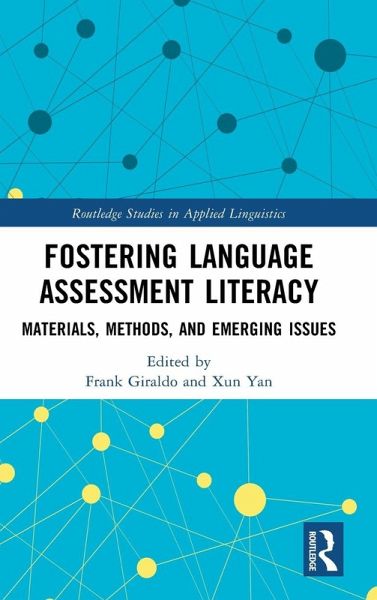
This collection showcases language assessment literacy, understood as the knowledge, skills, and principles necessary to engage in assessment activities, by problematizing different approaches to its development and offering insights for language teachers and other stakeholders.
This collection showcases language assessment literacy, understood as the knowledge, skills, and principles necessary to engage in assessment activities, by problematizing different approaches to its development and offering insights for language teachers and other stakeholders.
Frank Giraldo is a professor at the Foreign Languages Department of Universidad de Caldas in Manizales, Colombia. Xun Yan is a professor of Linguistics and Educational Psychology at University of Illinois Urbana-Champaign.
Inhaltsangabe
Part 1: Materials, 1. Introduction by Frank Giraldo and Xun Yan; 2. LAL training in Vietnam: A teacher-centred approach to resource development by Susan Sheehan and Thuy Thai; 3. Exploring the effect of embedding assessments into a professional development presentation as a means of improving language teachers' assessment competency by Michelle L. Stabler-Havener; 4. Pre-service teachers' language assessment literacy enhancement - Towards pedagogies for LAL by Karin Vogt; Part 2: Methods, 5. Is online language assessment training helpful to improve language assessment literacy? Views of Mexican young learner EFL teachers and training instructors by Elsa Fernanda González and Ricardo de la Garza-Cano ; 6. Put a little imagination in your collaboration: What can thought experiments do for language assessment literacy? by Newton Paulo Monteiro; 7. Investigating educator-participant interaction in a language assessment MOOC by Richard Spiby, Carolyn Westbrook, and Jordan Weide; Part 3: Emerging Issues, 8. Who will teach the teacher educator? Findings and implications of an online workshop for fostering Brazilian teacher educators' language assessment literacy by Isadora Moraes and Viviane Furtoso; 9. Learning about language assessment to teach young learners: The contribution of an online course by Gladys Quevedo-Camargo and Juliana Reichert Assunção Tonelli; 10. Critical language assessment literacy (CLAL) of L2 teachers: Unpacking the impact of CLAL-focused teacher education by Zia Tajeddin and Mohsen Mahdavi; 11. Social justice in classroom assessment through teachers' language assessment literacy by Frank Giraldo and Xun Yan ; 12. Conclusions by Frank Giraldo and Xun Yan;
Part 1: Materials, 1. Introduction by Frank Giraldo and Xun Yan; 2. LAL training in Vietnam: A teacher-centred approach to resource development by Susan Sheehan and Thuy Thai; 3. Exploring the effect of embedding assessments into a professional development presentation as a means of improving language teachers' assessment competency by Michelle L. Stabler-Havener; 4. Pre-service teachers' language assessment literacy enhancement - Towards pedagogies for LAL by Karin Vogt; Part 2: Methods, 5. Is online language assessment training helpful to improve language assessment literacy? Views of Mexican young learner EFL teachers and training instructors by Elsa Fernanda González and Ricardo de la Garza-Cano ; 6. Put a little imagination in your collaboration: What can thought experiments do for language assessment literacy? by Newton Paulo Monteiro; 7. Investigating educator-participant interaction in a language assessment MOOC by Richard Spiby, Carolyn Westbrook, and Jordan Weide; Part 3: Emerging Issues, 8. Who will teach the teacher educator? Findings and implications of an online workshop for fostering Brazilian teacher educators' language assessment literacy by Isadora Moraes and Viviane Furtoso; 9. Learning about language assessment to teach young learners: The contribution of an online course by Gladys Quevedo-Camargo and Juliana Reichert Assunção Tonelli; 10. Critical language assessment literacy (CLAL) of L2 teachers: Unpacking the impact of CLAL-focused teacher education by Zia Tajeddin and Mohsen Mahdavi; 11. Social justice in classroom assessment through teachers' language assessment literacy by Frank Giraldo and Xun Yan ; 12. Conclusions by Frank Giraldo and Xun Yan;
Es gelten unsere Allgemeinen Geschäftsbedingungen: www.buecher.de/agb
Impressum
www.buecher.de ist ein Internetauftritt der buecher.de internetstores GmbH
Geschäftsführung: Monica Sawhney | Roland Kölbl | Günter Hilger
Sitz der Gesellschaft: Batheyer Straße 115 - 117, 58099 Hagen
Postanschrift: Bürgermeister-Wegele-Str. 12, 86167 Augsburg
Amtsgericht Hagen HRB 13257
Steuernummer: 321/5800/1497
USt-IdNr: DE450055826