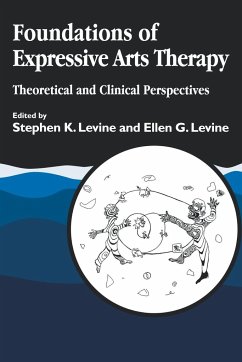
Foundations of Expressive Arts Therapy provides an arts-based approach to the theory and practice of expressive arts therapy. The book explores the various expressive arts therapy modalities both individually and in relationship to each other. The contributors emphasize the importance of the imagination and of aesthetic experience, arguing that these are central to psychological well-being, and challenging accepted views which place primary emphasis on the cognitive and emotional dimensions of mental health and development. Part One explores the theory which informs the practice of expressive…mehr
Foundations of Expressive Arts Therapy provides an arts-based approach to the theory and practice of expressive arts therapy. The book explores the various expressive arts therapy modalities both individually and in relationship to each other. The contributors emphasize the importance of the imagination and of aesthetic experience, arguing that these are central to psychological well-being, and challenging accepted views which place primary emphasis on the cognitive and emotional dimensions of mental health and development. Part One explores the theory which informs the practice of expressive arts therapy. Part Two relates this theory to the therapeutic application of the expressive arts (including music, art, movement, drama, poetry and voicework) in different contexts, ranging from play therapy with children to trauma work with Bosnian refugees and second-generation Holocaust survivors. Comprehensive in its coverage of the most fundamental aspects of expressive arts therapy, this book is a significant contribution to the field and a useful reference for all practitioners.
Introduction Ellen G. Levine ISIS Canada and Stephen K. Levine York University Toronto and ISIS Canada. Part I: Philosophical and Theoretical Perspectives 1. Poiesis and postmodernism: the search for a foundation in expressive arts therapy Stephen K. Levine York University Toronto and ISIS Canada. 2. Soul-nourishment or the metabolism of psyche: a broad concept of diet and medicine Paolo J. Knill Lesley College Cambridge and European Graduate School Switzerland. 3. Ethics and aesthetics: the necessity of form Majken Jacoby ISIS Denmark. 4. Artistic inquiry: research in expressive arts therapy Shaun McNiff Endicott College Massachusetts. Part II: Clinical Perspectives 5. Voicework as therapy: the artistic use of singing and vocal sound to heal mind and body Paul Newham International Association for Voice Movement Therapy and Voice Movement Training. 6. The creative connection: a holistic expressive arts process Natalie Rogers Person-Centered Expressive Therapy Institute California. 7. Living artfully: movement as an integrative process Daria Halprin Tamalpa Institute California. 8. Layer upon layer: a therapeutic experience in the art studio Annette Brederode Centre for the Expressive and Creative Arts Therapies Netherlands. 9. Music as mother: the mothering function of music through expressive and receptive avenues Margareta Warja Lowenstomska Psychiatric Hospital Sweden. 10. Between imagination and belief: poetry as therapeutic intervention Margo Fuchs European Graduate School. 11. Poetry in the oral tradition: serious play with words Elizabeth McKim Lesley College Cambridge Massachusetts. 12. Theatre of the Holocaust Yaacov Naor 'The Inner Theatre' psychodrama centre Israel. 13. In exile from the body Melinda Asher-Meyer The Norwegian Institute of Expressive Arts Therapy. 14. On the play-ground: child psychotherapy and expressive arts therapy Ellen G. Levine ISIS Canada.
Es gelten unsere Allgemeinen Geschäftsbedingungen: www.buecher.de/agb
Impressum
www.buecher.de ist ein Internetauftritt der buecher.de internetstores GmbH
Geschäftsführung: Monica Sawhney | Roland Kölbl | Günter Hilger
Sitz der Gesellschaft: Batheyer Straße 115 - 117, 58099 Hagen
Postanschrift: Bürgermeister-Wegele-Str. 12, 86167 Augsburg
Amtsgericht Hagen HRB 13257
Steuernummer: 321/5800/1497
USt-IdNr: DE450055826