
82,99 €
inkl. MwSt.
Versandkostenfrei*
Versandfertig in über 4 Wochen
payback
41 °P sammeln
  • Gebundenes Buch

In Central Asia, Muslim shrines have served as community centers for centuries, particularly the large urban shrines that seem, in many cases, to have served as the inspiration as well for a city's architectural development. In Four Central Asian Shrines: A Socio-Political History of Architecture R. D. McChesney documents the histories of four such long-standing shrines--Gur-i Mir at Samarqand, Khwajah Abu Nasr Parsa Mazar at Balkh, the Noble Rawzah at Mazar-i Sharif, and the Khirqat al-Nabi at Qandahar. In all four cases the creation and evolution of the architecture of these shrines is…mehr

Produktbeschreibung
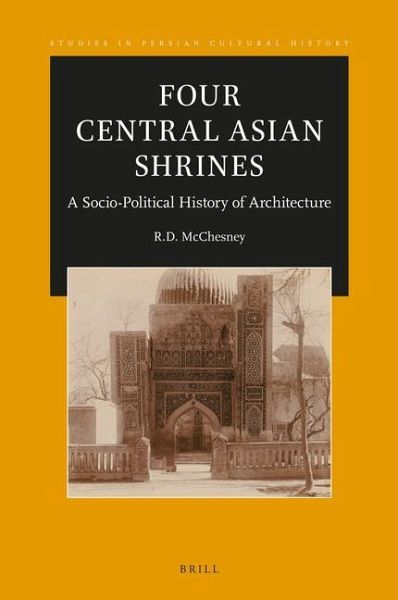
In Central Asia, Muslim shrines have served as community centers for centuries, particularly the large urban shrines that seem, in many cases, to have served as the inspiration as well for a city's architectural development. In Four Central Asian Shrines: A Socio-Political History of Architecture R. D. McChesney documents the histories of four such long-standing shrines--Gur-i Mir at Samarqand, Khwajah Abu Nasr Parsa Mazar at Balkh, the Noble Rawzah at Mazar-i Sharif, and the Khirqat al-Nabi at Qandahar. In all four cases the creation and evolution of the architecture of these shrines is traced through narratives about their social and political histories and in the past century and a half, through the photographic record.
Autorenporträt
R. D. McChesney, (Ph.D. 1973) Emeritus Professor, New York University, has published monographs, translations, and numerous articles on Persianate Central Asia and Afghanistan and is the founder of the Afghanistan Digital Library (https: //afghanistandl.nyu.edu)