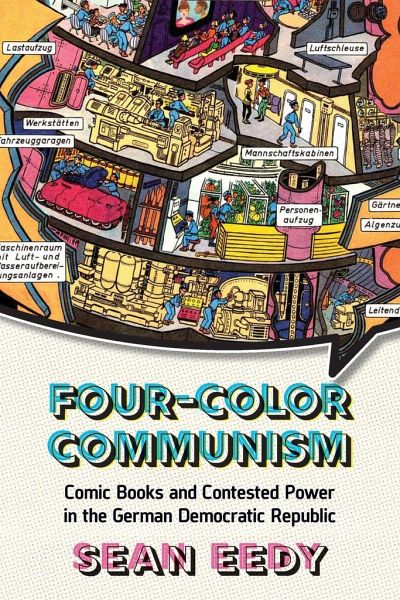
As with all other forms of popular culture, comics in East Germany were tightly controlled by the state. Comics were employed as extensions of the regimeâ s educational system, delivering state ideology to develop the socialist personality among youth. The East German children who avidly read these comics, however, found their own meanings and projected their own desires in them.
As with all other forms of popular culture, comics in East Germany were tightly controlled by the state. Comics were employed as extensions of the regimeâ s educational system, delivering state ideology to develop the socialist personality among youth. The East German children who avidly read these comics, however, found their own meanings and projected their own desires in them.
Sean Eedy holds a doctorate in history from Carleton University in Ottawa, Canada. His publications include articles and chapters on comic book representations of the Holocaust, animated DEFA adaptations of Brothers Grimm's Fairy Tales, and time travel and historical representation in the work of Hannes Hegen. Sean is currently an independent researcher and part-time professor in the Department of History at Trent University.
Inhaltsangabe
List of Illustrations Acknowledgements List of Abbreviations and Terms Introduction: Comics at the Intersection of State Power and Childhood Chapter 1. Comics and the Crisis of Kultur in the SED State Chapter 2. State Power and the East German Zeitgeist Chapter 3. Power, Eigensinn, and the Construction of Space through Comics Chapter 4. Escape, Escapism, and the Cultural Imperialism of Comic Book Travel in Mosaik and Atze Chapter 5. Western Influence, Popular Taste, and the Limitations of the FDJ's Publishing Regime Conclusion Bibliography Index
List of Illustrations Acknowledgements List of Abbreviations and Terms Introduction: Comics at the Intersection of State Power and Childhood Chapter 1. Comics and the Crisis of Kultur in the SED State Chapter 2. State Power and the East German Zeitgeist Chapter 3. Power, Eigensinn, and the Construction of Space through Comics Chapter 4. Escape, Escapism, and the Cultural Imperialism of Comic Book Travel in Mosaik and Atze Chapter 5. Western Influence, Popular Taste, and the Limitations of the FDJ's Publishing Regime Conclusion Bibliography Index
Es gelten unsere Allgemeinen Geschäftsbedingungen: www.buecher.de/agb
Impressum
www.buecher.de ist ein Internetauftritt der buecher.de internetstores GmbH
Geschäftsführung: Monica Sawhney | Roland Kölbl | Günter Hilger
Sitz der Gesellschaft: Batheyer Straße 115 - 117, 58099 Hagen
Postanschrift: Bürgermeister-Wegele-Str. 12, 86167 Augsburg
Amtsgericht Hagen HRB 13257
Steuernummer: 321/5800/1497
USt-IdNr: DE450055826