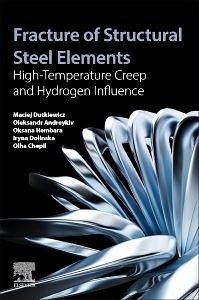
Fracture of Steel in Energy Machine Parts: High-Temperature Creep and Hydrogen Influence presents advanced mathematical modeling approaches for evaluating the effects of high-temperature creep, hydrogen diffusion, damage accumulation, and creep development in steam pipelines, steam turbine discs, heat exchanger tubes, and steam boiler drums. The book discusses the strength and durability of metallic materials and structural elements at the stage of volumetric damage, then at local damage, and, finally, at the end of their residual life. It introduces models and algorithms for simulating these…mehr
Fracture of Steel in Energy Machine Parts: High-Temperature Creep and Hydrogen Influence presents advanced mathematical modeling approaches for evaluating the effects of high-temperature creep, hydrogen diffusion, damage accumulation, and creep development in steam pipelines, steam turbine discs, heat exchanger tubes, and steam boiler drums. The book discusses the strength and durability of metallic materials and structural elements at the stage of volumetric damage, then at local damage, and, finally, at the end of their residual life. It introduces models and algorithms for simulating these complex processes (high-temperature creep, hydrogen diffusion, damage accumulation, and creep development) that evolve at different rates in different areas of a structure. The various types of cracks are addressed, including through-thickness cracks, internal cracks, surface cracks, and elliptical cracks.
Maciej Dutkiewicz is a Professor at Bydgoszcz University of Science and Technology, Poland, with a Doctor of Technical Sciences and a PhD in Civil Engineering. His extensive scientific interests revolve around various areas such as damage identification, Structural Health Monitoring, fracture resistance of elements and structures, durability, loading in hydrogen-containing media, vibration control, metamaterials, dynamic systems, smart technologies for vibration control, the efficiency of vibration dampers, guide waves, machine learning applications, computational, numerical, and experimental fields, Data Science, and exploring inverse and physic-informed machine-learning techniques, as well as probabilistic analysis. He has authored over 150 scientific works and maintains a collaborative network with researchers from Ukraine, USA, Turkey, Brazil, France, Italy, Poland, Ethiopia, Czech Republic, and Romania.
Inhaltsangabe
1. An energetic approach to modeling damage accumulation under creep and hydrogen action 2. Evaluation of the effect of hydrogen on damage accumulation in the Bridgman specimen under high-temperature creep 3. Analytical models of high-temperature creep crack growth 4. Determination of the precritical growth period of oblique high-temperature creep cracks in a plate 5. Evaluation of subcritical creep crack growth using the equivalent area method 6. Subcritical growth of elliptical cracks of high-temperature creep 7. Mathematical model for evaluating the effect of hydrogen on high-temperature creep crack growth 8. Residual life of plates with a system of cracks under long-term loading in a hydrogen-containing environment 9. Residual life of steam turbine disk under high-temperature creep conditions 10. Residual life of steam pipelines under long-term operation 11. Evaluation of metal hydrogenation and creep effects on the durability of heat exchange pipes in horizontal steam generators of a nuclear power plant 12. Calculation of the residual life of a steam boiler drum under high-temperature creep and hydrogen exposure
1. An energetic approach to modeling damage accumulation under creep and hydrogen action 2. Evaluation of the effect of hydrogen on damage accumulation in the Bridgman specimen under high-temperature creep 3. Analytical models of high-temperature creep crack growth 4. Determination of the precritical growth period of oblique high-temperature creep cracks in a plate 5. Evaluation of subcritical creep crack growth using the equivalent area method 6. Subcritical growth of elliptical cracks of high-temperature creep 7. Mathematical model for evaluating the effect of hydrogen on high-temperature creep crack growth 8. Residual life of plates with a system of cracks under long-term loading in a hydrogen-containing environment 9. Residual life of steam turbine disk under high-temperature creep conditions 10. Residual life of steam pipelines under long-term operation 11. Evaluation of metal hydrogenation and creep effects on the durability of heat exchange pipes in horizontal steam generators of a nuclear power plant 12. Calculation of the residual life of a steam boiler drum under high-temperature creep and hydrogen exposure
Es gelten unsere Allgemeinen Geschäftsbedingungen: www.buecher.de/agb
Impressum
www.buecher.de ist ein Internetauftritt der buecher.de internetstores GmbH
Geschäftsführung: Monica Sawhney | Roland Kölbl | Günter Hilger
Sitz der Gesellschaft: Batheyer Straße 115 - 117, 58099 Hagen
Postanschrift: Bürgermeister-Wegele-Str. 12, 86167 Augsburg
Amtsgericht Hagen HRB 13257
Steuernummer: 321/5800/1497
USt-IdNr: DE450055826