This book solves the open problems in fluid flow modeling through the fractured vuggy carbonate reservoirs. Fractured vuggy carbonate reservoirs usually have complex pore structures, which contain not only matrix and fractures but also the vugs and cavities. Since the vugs and cavities are irregular in shape and vary in diameter from millimeters to meters, modeling fluid flow through fractured vuggy porous media is still a challenge. The existing modeling theory and methods are not suitable for such reservoir. It starts from the concept of discrete fracture and fracture-vug networks model, and…mehr
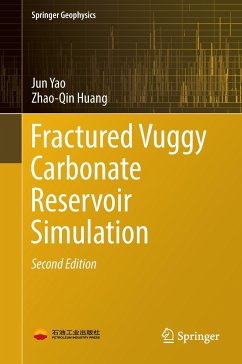
This book solves the open problems in fluid flow modeling through the fractured vuggy carbonate reservoirs. Fractured vuggy carbonate reservoirs usually have complex pore structures, which contain not only matrix and fractures but also the vugs and cavities. Since the vugs and cavities are irregular in shape and vary in diameter from millimeters to meters, modeling fluid flow through fractured vuggy porous media is still a challenge. The existing modeling theory and methods are not suitable for such reservoir. It starts from the concept of discrete fracture and fracture-vug networks model, and then develops the corresponding mathematical models and numerical methods, including discrete fracture model, discrete fracture-vug model, hybrid model and multiscale models. Based on these discrete porous media models, some equivalent medium models and methods are also discussed. All the modeling and methods shared in this book offer the key recent solutions into this area.
Dr. Jiushuai Deng is currently a professor in the School of Chemical and Environmental Engineering, at the China University of Mining and Technology (Beijing). He completed a period of Postdoctoral Fellow Research work in the Faculty of Applied Science and Engineering at the University of Toronto, Canada, and he was a visiting scientist in the Commonwealth Scientific and Industrial Research Organization, Australia. He is a distinguished young scholar in the development of innovative, cost-effective technologies for the metallic mineral processing and recycling of industrial solid wastes and has a proven track record of new technology developments. His publication record includes 93 papers published in prestigious refereed journals. He is a co-inventor on 26 patents and a co-applicant on another 12 patent applications. In recognition of his outstanding research achievements, he awarded Outstanding Young Scientific and Technological Talents in China's Mining, Oil and Safety Field, a Fok Ying Tung Education Foundation Award, a Yueqi Outstanding Scholar, a National Outstanding Youth Science and Technology Award for Nonferrous Metals, Green Mine Youth Science and Technology Award and many awards for scientific and technological achievements, etc. Professor Suping Peng is born in Pingxiang City of Jiangxi Province, Chinese academician of Engineering, China University of Mining and Technology (Beijing). He is an expert in mine geology and engineering geophysical exploration, made rich achievements in mine geology, mine engineering geophysical exploration, hydrogeology, coal exploitation and ecological environment protection, clean coal technology, etc. He successively obtained National Technology Invention Award two prize 2, National Science and Technology Progress Award two prize 3, provincial and ministerial level scientific and technological progress special prize 1, first prize 6 and many other awards. He had national invention patents 37, software copyrights 14, monographs 7 and more than 100 papers. According to the geological structure and ecological environment characteristics of Ordos Basin, he presided over a major project of Shaanxi Coal Group Key Project (2018SMHKJ-A-J-03) and established technology system research and development and ecological demonstration and promoted the harmonious and active development of energy development and environmental restoration. He is the director of the State Key Laboratory of Coal Resources and Safe Mining Laboratory, the expert member of National Energy Expert Advisory Committee and International Energy Commission, IBSS's Chairman, Deputy Director of the Science and Technology Committee of the Ministry of Education, the chairman of the Chinese Society of Public Safety, an expert member of Advisory Committee of the Ministry of Science and Technology in the field of energy major basic research. He is also the dean of the Institute of Mine Ecological Restoration and the director of the Green Mine Environmental Protection Committee at China University of Mining and Technology (Beijing). In 2007, he was elected as an academician of the Department of Energy and Mining Engineering, Chinese Academy of Engineering (the youngest academician at that time), the deputy director of the eighth academic department and the director of the ninth academic department. He is currently a member of the Presidium of the Chinese Academy of Engineering. Mr. Liang Wang is currently a senior engineer, Secretary-General of Zhongguancun Green Mining Industry Alliance, National Registered Examiner, the deputy director of Professional Committee of Resource Economics and Planning of Chinese Society on Economics of Geology and Mineral Resources, a visiting researcher of State Key Laboratory of Explosion Science and Technology, a visiting researcher of State Key Laboratory of Coal Resources and Safe Mining, and the deputy director of the Green Mine Scienceand Technology
Inhaltsangabe
Introduction.- Numerical simulation of discrete fracture model.- Numerical simulation of discrete fracture-vug network model.- Numerical simulation of equivalent media model.- Numerical simulation based on mixed model.- Numerical simulation based on multi-scale finite element methods.
Introduction.- Numerical simulation of discrete fracture model.- Numerical simulation of discrete fracture-vug network model.- Numerical simulation of equivalent media model.- Numerical simulation based on mixed model.- Numerical simulation based on multi-scale finite element methods.
Es gelten unsere Allgemeinen Geschäftsbedingungen: www.buecher.de/agb
Impressum
www.buecher.de ist ein Internetauftritt der buecher.de internetstores GmbH
Geschäftsführung: Monica Sawhney | Roland Kölbl | Günter Hilger
Sitz der Gesellschaft: Batheyer Straße 115 - 117, 58099 Hagen
Postanschrift: Bürgermeister-Wegele-Str. 12, 86167 Augsburg
Amtsgericht Hagen HRB 13257
Steuernummer: 321/5800/1497
USt-IdNr: DE450055826