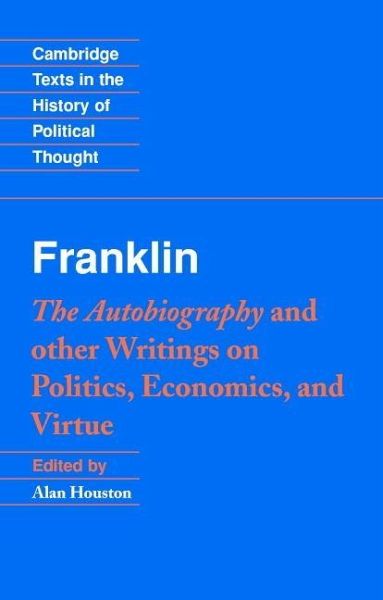
Benjamin Franklin is one of the best known and most widely admired figures in American history. His wit and charm make him endearing; his practical intelligence and commitment to middle-class virtues like thrift and industry make him admirable. Indeed to many he is 'the first American'. Ironically, this identification of Franklin with American popular culture diminishes the breadth and depth of his contributions to modern political thought. The present volume provides the textual foundation for a fuller understanding of Franklin's thought, and represents a major addition to the Cambridge Texts…mehr
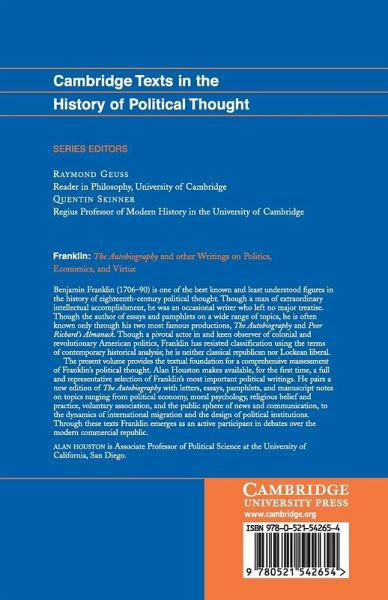
Benjamin Franklin is one of the best known and most widely admired figures in American history. His wit and charm make him endearing; his practical intelligence and commitment to middle-class virtues like thrift and industry make him admirable. Indeed to many he is 'the first American'. Ironically, this identification of Franklin with American popular culture diminishes the breadth and depth of his contributions to modern political thought. The present volume provides the textual foundation for a fuller understanding of Franklin's thought, and represents a major addition to the Cambridge Texts series. Readers interested in the Autobiography will find a new and complete edition based on the original manuscript. Those interested in the full range of Franklin's political ideas will find a selection of his most important letters, essays and pamphlets. Alan Houston's lucid introduction brings life to these texts and sets them in their proper historical context.
Born in 1706 to humble origins, the young Benjamin Franklin made his way into the world with a sense of purpose and an awareness of what he was capable of. These qualities became self-evident and increasingly apprarent to the world around him as his abilities matured. The runaway teen who left his boyhood Boston for Philadelphia proved his developing talents as a prolific writer, printer and future publisher... famous for his Autobiography, Poor Richard's Almanac, and The Pennsylvania Gazette among others. He was also an inventor and scientist; Franklin was the genial genius... an affable common man who just happened to be the smartest person in almost any room he entered. He conducted groundbreaking work in electricity and made innovations that led to practical devices such as bifocals, swim fins, the lightning rod, the Franklin Stove, and the flexible catheter among other inventions in use to this day.After retiring from business at the age of 42, it was Benjamin Franklin as Public Citizen for his remaining 42 years that ultimately led to his role as Statesman and Founder... He helped make the case for the ultimate severance of political ties to Great Britain and for America to take up arms in defense of her liberty. He was present at the creation of a new nation and helped construct the foundation of what the United States would one day become as a beacon of freedom.
Inhaltsangabe
Acknowledgements Introduction Chronology Bibliographical note Biographical guide A note on the texts 1. The autobiography - Part One, Part Two, Part Three, Part Four 2. Plan of conduct (1726) 3. The nature and necessity of a paper currency (1729) 4. Apology for printers (1731) 5. Rules for a club formerly established at Philadelphia (1732) 6. Dialogue between two Presbyterians (1735) 7. Letter to Josiah and Abiah Franklin (1738) 8. Proposal for promoting useful knowledge (1743) 9. Speech of Miss Polly Baker (1747) 10. Plain truth (1747) 11. Form of the association and remarks (1747) 12. Advice to a young tradesman, written by an old one (1748) 13. Proposals relating to the education of youth in Pennsylvania 14. Observations concerning the increase of mankind (1751) 15. Letter to James Parker (1751) 16. Rattlesnakes for Felons (1751) 17. Letter to Peter Collinson (1753) 18. Letter to Peter Collinson (1753) 19. Join or die (1754) 20. Reasons and motives for the Albany Plan of Union (1754) 21. Letters to Governor Shirley (1754) with a preface of 1766 22. Preface to poor Richard improved (1757) 23. Letter to ________ (1757) 24. Letter to Lord Kames (1760) 25. On the price of corn, and the management of the poor (1766) 26. Letter to Lord Kames (1767) 27. Causes of the American discontents before 1768 (1768) 28. The Somersett case and the slave trade (1772) 29. Rules by which a Great Empire may be reduced to a small one (1773) 30. An edict by the King of Prussia (1773) 31. On a proposed act to prevent immigration (1773) 32. Articles of Confederation and Perpetual Union (1775) 33. Morals of Chess (1779) 34. The Whistle (1779) 35. Letter to Joseph Priestley (1780) 36. Letter to Joseph Priestley (1782) 37. Letter to Richard Price (1782) 38. Letter to Robert Morris (1783) 39. Remarks concerning the savages of North America (1784) 40. Letter to Sarah Franklin Bache (1784) 41. Information to those who would remove to America (1784) 42. Letter to Benjamin Vaughan (1784) 43. At the Constitutional Convention (1787) 44. Queries and remarks (1789) 45. On the Slave Trade (1790) Index.
Acknowledgements Introduction Chronology Bibliographical note Biographical guide A note on the texts 1. The autobiography - Part One, Part Two, Part Three, Part Four 2. Plan of conduct (1726) 3. The nature and necessity of a paper currency (1729) 4. Apology for printers (1731) 5. Rules for a club formerly established at Philadelphia (1732) 6. Dialogue between two Presbyterians (1735) 7. Letter to Josiah and Abiah Franklin (1738) 8. Proposal for promoting useful knowledge (1743) 9. Speech of Miss Polly Baker (1747) 10. Plain truth (1747) 11. Form of the association and remarks (1747) 12. Advice to a young tradesman, written by an old one (1748) 13. Proposals relating to the education of youth in Pennsylvania 14. Observations concerning the increase of mankind (1751) 15. Letter to James Parker (1751) 16. Rattlesnakes for Felons (1751) 17. Letter to Peter Collinson (1753) 18. Letter to Peter Collinson (1753) 19. Join or die (1754) 20. Reasons and motives for the Albany Plan of Union (1754) 21. Letters to Governor Shirley (1754) with a preface of 1766 22. Preface to poor Richard improved (1757) 23. Letter to ________ (1757) 24. Letter to Lord Kames (1760) 25. On the price of corn, and the management of the poor (1766) 26. Letter to Lord Kames (1767) 27. Causes of the American discontents before 1768 (1768) 28. The Somersett case and the slave trade (1772) 29. Rules by which a Great Empire may be reduced to a small one (1773) 30. An edict by the King of Prussia (1773) 31. On a proposed act to prevent immigration (1773) 32. Articles of Confederation and Perpetual Union (1775) 33. Morals of Chess (1779) 34. The Whistle (1779) 35. Letter to Joseph Priestley (1780) 36. Letter to Joseph Priestley (1782) 37. Letter to Richard Price (1782) 38. Letter to Robert Morris (1783) 39. Remarks concerning the savages of North America (1784) 40. Letter to Sarah Franklin Bache (1784) 41. Information to those who would remove to America (1784) 42. Letter to Benjamin Vaughan (1784) 43. At the Constitutional Convention (1787) 44. Queries and remarks (1789) 45. On the Slave Trade (1790) Index.
Es gelten unsere Allgemeinen Geschäftsbedingungen: www.buecher.de/agb
Impressum
www.buecher.de ist ein Internetauftritt der buecher.de internetstores GmbH
Geschäftsführung: Monica Sawhney | Roland Kölbl | Günter Hilger
Sitz der Gesellschaft: Batheyer Straße 115 - 117, 58099 Hagen
Postanschrift: Bürgermeister-Wegele-Str. 12, 86167 Augsburg
Amtsgericht Hagen HRB 13257
Steuernummer: 321/5800/1497
USt-IdNr: DE450055826