

- Gebundenes Buch
- Merkliste
- Auf die Merkliste
- Bewerten Bewerten
- Teilen
- Produkt teilen
- Produkterinnerung
- Produkterinnerung
Written for young adults, this biography of Frederick Douglass covers the life of the most famous black abolitionist and intellectual of the 19th century. Frederick Douglass: A Biography explores the life of the most famous black abolitionist and intellectual of the 19th century. The book covers the major developments of Douglass's life from his birth in 1818 through his time as a slave and his rise to prominence as the most famous black voice for freedom of his time. The biography discusses Douglass's relationships with such figures as John Brown, the feminist Elizabeth Cady Stanton, and five…mehr
Andere Kunden interessierten sich auch für
 David B. ChesebroughFrederick Douglass98,99 €
 Frederick DouglassLife and Times of Frederick Douglass36,99 €
 James M. GregoryFrederick Douglass the orator:21,90 €
 Theodore TiltonSonnets to the Memory of Frederick Douglass25,99 €
 Alexander WinchellDouglass Houghton25,99 €
 James Monroe GregoryFrederick Douglass the Orator34,99 €
 Frederick DouglassNarrative of the Life of Frederick Douglass23,99 €
-
-
-
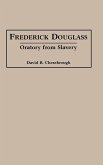




Written for young adults, this biography of Frederick Douglass covers the life of the most famous black abolitionist and intellectual of the 19th century. Frederick Douglass: A Biography explores the life of the most famous black abolitionist and intellectual of the 19th century. The book covers the major developments of Douglass's life from his birth in 1818 through his time as a slave and his rise to prominence as the most famous black voice for freedom of his time. The biography discusses Douglass's relationships with such figures as John Brown, the feminist Elizabeth Cady Stanton, and five presidents of the United States, including Abraham Lincoln. It analyzes his role in national politics before, during, and after the Civil War, and examines the way his life is tied to significant local, regional, and national events. By focusing on the importance of spirituality in Douglass's life, this revealing work adds to our understanding of the man, the way he saw himself, and the many things he accomplished.
Produktdetails
- Produktdetails
- Verlag: Greenwood
- Seitenzahl: 192
- Erscheinungstermin: 4. Januar 2011
- Englisch
- Abmessung: 240mm x 161mm x 15mm
- Gewicht: 458g
- ISBN-13: 9780313350368
- ISBN-10: 0313350361
- Artikelnr.: 31300823
- Herstellerkennzeichnung
- Libri GmbH
- Europaallee 1
- 36244 Bad Hersfeld
- gpsr@libri.de
- Verlag: Greenwood
- Seitenzahl: 192
- Erscheinungstermin: 4. Januar 2011
- Englisch
- Abmessung: 240mm x 161mm x 15mm
- Gewicht: 458g
- ISBN-13: 9780313350368
- ISBN-10: 0313350361
- Artikelnr.: 31300823
- Herstellerkennzeichnung
- Libri GmbH
- Europaallee 1
- 36244 Bad Hersfeld
- gpsr@libri.de
C. James Trotman, PhD, is professor of English and founding director of the Frederick Douglass Institute at West Chester University, USA.
October 3, 1894
Cedar Hill: Anacostia D.C.
Dear Mr. Philips:
I think I may safely promise you a lecture on the first-February 1895 if
life and health permit. I will therefore put West Chester, Penna. for that
date. I find myself unable to be as confident in making appointments than I
once was. I begin to feel the weight of age. I am glad to know that a few
of my Abolitionist friends in West Chester are still living-and it will
give me joy to be there.
Yours Truly,
(signed) Frederick Douglass
Frederick Douglass gave his last public lecture on the campus of West
Chester University of Pennsylvania on February 1, 1895, 19 days before he
died. He was a frequent guest in the town of West Chester, visiting every
decade after his escape from slavery in 1838.
Located approximately 25 miles from center city Philadelphia, the Borough
of West Chester, originally called Turk's Head, had been a seat of radical
abolitionism, primarily due to its Quaker roots and to a certain degree of
high-mindedness among its civic leadership. West Chester offered Douglass
rest from the demanding schedule of the abolitionist movement, time for
fellowship with friends and supporters such as the prominent Darlington
family and George Morris Philips, his host on February 1, and the first
principal of West Chester Normal School, now West Chester University of
Pennsylvania. The borough was an oasis for Douglass, enabling him to relax
and reflect upon the stages of a life that made his name among the most
internationally recognized of Americans and the most distinguished voice of
freedom to come from the African American community in the 19th century.
By the time of this lecture, and nearing his death on February 20, 1895,
Douglass's name and recognition were synonymous with social reform,
particularly in the movement to abolish chattel slavery. He became famous
in 1845 with the publication of the first of three autobiographies, the
Narrative of the Life of Frederick Douglass, An American Slave. Written by
Himself. The ex-slave wrote compellingly about the experience of chattel
slavery. In some of the most memorable prose in American letters, he drew
readers into the traumatic experience of this captivity by describing what
he saw with his own eyes. His direct accounts and the narrative skills used
to tell his story opened up new understandings for his first readers and
left a historical document for future generations.
For all of slavery's damage to human souls, Douglass showed how it was
possible to transform the trauma of chattel slavery into a triumphant
journey toward freedom. One has only to read chapters 6 and 7 of the 1845
Narrative to discover the personal meaning of truth that came to him
through reading and writing in an age when slave culture in America forbade
it. These two chapters are among a number of exceptional discussions in
Douglass's body of writings and speeches in which learning about one's self
and the world is achieved through literacy and rigorous thought, although
he never spent a day of his life in a schoolroom. And they are two of the
best chapters to be found on this subject in Douglass's body of writing.
The chapters are repeated in the two autobiographical sequels, My Bondage
and My Freedom (1855) and the Life and Times of Frederick Douglass (1882).
The three autobiographies, a triptych of revelations about his life and
times, along with his surviving speeches and editorials, continue to be
relevant resources today for understanding the nature of subjugation, its
victims, and their malefactors, and the victory made possible through human
struggle and growth.
In the brutal and ambiguous world of slavery in which normal human
interactions were replaced by unexplainable cruelty and forced acts of
human degradation, Douglass and his works are primary sources for having
initiated a broader discussion of slavery and eventually its constitutional
abolishment.
The struggles of his life made him well known, first as a speaker much
sought after for the abolitionist movement and then as a writer. But he
made certain to note over and over again in the spoken or written word
about his thoughts and feelings that his struggles mirrored the pain of
others in bondage and in freedom as well.
While including the major facts and dates surrounding this historical
figure, I have attempted in this biography to call attention to the
spiritual dimensions of Douglass's life as an important part of his legacy.
"Spirituality" is not easy to define, but that does not justify ignoring it
when it can help us to understand our subject. I am using it primarily
because Douglass used the word. The word exists repeatedly throughout his
speeches and written works, although the meaning shifts. Semanticists and
other philosophers of language would acknowledge that "spirituality" is a
polymorphous term. In other words, it is the name for a wide range of ideas
and concepts that have significance in ordinary, day-to-day conversations,
usually referring to the unseen and the unexplainable; among philosophers
it is a term used to symbolize the process for interpreting meaning in the
subjective life; among theologians it is a term for the divine, the
supernatural, and the unseen but powerful forces in religious thought and
experience.
What are the roots of this spirituality in the slave environment that
Douglass knew? We know from sound scholarly sources, especially the seminal
histories written by John Blassingame, John Hope Franklin, and Herbert
Gutman, much more about the characteristics of slave plantations and slave
life than did previous generations. Thanks to their scholarship and the
splendid biographies on Douglass by Benjamin Quarles, Philip S. Foner,
Nathan Huggins, Waldo Martin, and William McFeely, and the intellectual
discussions by David Blight, John Stauffer, Robert S. Levine, Gregory P.
Lampe, Maria Diedrich, Charles Blockson, Margaret Aymer, Henry Louis Gates,
Jr., Houston Baker, David Chesebrough, Cynthia Willett, Paul and Stephen
Kendrick, James Oakes, and Robert Wallace, they all demonstrate that slaves
were not passive figures at all; in other words, they were not asleep at
the switch of their existence. Collectively, the slaves had a capacity for
mentally turning down the noisy chatter of their insignificance and turning
off many of the negative messages sent out through a culture of bondage
that they were nothing at all. Now more than ever, information is available
about the survival skills of slaves: the significance of their prayers,
their worship rituals, and songs as measures of resistance that sought to
alter, at least in their minds, the dismal grind of life for them into the
epic development of a group within America's multicultural fabric and its
multilayered history.
The former slave turned citizen-reformer spoke and wrote about spirituality
as a private source for describing his subjective struggles with identity
and for understanding the dynamics of slavery. For Douglass, the word had
authority and a number of interpretations that enabled him to explain
history to himself and to others as he experienced it, wrote and spoke
about it. Beyond the benefits of personal understanding, the word provided
him with a vocabulary to articulate the development of his own world
vision. In this context, therefore, by reviewing some familiar and some
lesser known works from his writings and speeches, I hope to provide a
picture of the uses of spirituality as a term embracing the complexity of
his feelings, to identify it as a powerful and personal source for
establishing his personal identity, and to see it used as a means to
present the complexity of his faith. Douglass had faith in the divine, in
God, and he was a Christian, but he was not bound to a denomination,
although he regularly attended the Washington, D.C., Metropolitan African
Methodist Episcopal Zion Church in his later years. It is one of the
complexities in examining the role of spirituality in Douglass's life that
while he acknowledged a supreme being and was ordained as a youth in the
African Methodist Episcopal Zion Church, he was nevertheless unyieldingly
critical in his speeches and writings of religious institutions for their
support of slavery.
I have used the names of well-known spirituals from African American
culture as chapter titles for this book. They are an acknowledged source of
black folk life and they predate acquired literacy in the black community.
They are as much a part of a process of critical thought among slaves as
they are a part of human history. They are rooted in the collective
expression of an oppressed people who uttered words and sounds together, to
make sense of their lives, before schooling was permitted and before their
music became acceptable to the larger society. This music spoke in simple
terms about a complex world the slaves experienced and about those who
oppressed them.
The spirituals are of course religious by nature, but their connection with
the supernatural or divine is not just to provide a backdrop for the
presentation of history and culture. They are meaningful and serious human
actions. They were calls to worship. They brought about healing to many and
hope against the bleakness of the moment for slaves. They represent
artifacts of the past to be sure, but they are as much about today as they
are about yesterday. They have evolved within creative hands like
Douglass's to mold the literary form we know as the slave narrative. The
spirituals became a resource for future novelists, poets, and prose
writers. They were also a primary ingredient for the institution we know as
the black church, which is not a religious denomination at all, but the
name for the powerful religious force in the African American community
shielding black women, men, children, and families collectively and
individually from the horrific and alienating consequences of racism. And
at their core is the use of the Bible.
When Douglass was in Belfast, Ireland, in 1846, speaking on abolitionism,
he was presented with a Bible as a token of the Irish reformers regard for
him. His response described the importance of the Bible to him:This is an
excellent token of your regard. It is just what I want from you. It
contains all the Words of Heavenly Wisdom-it is opposed to everything that
is wrong and it is in favor of all that is right. It is filled with that
Wisdom from above, which is pure, and peaceable, and full of mercies and
good fruits, without prolixity, and without hypocrisy. It knows no one by
the color of his skin. It confers no privilege upon one class, which it
does not confer upon another. The fundamental principle running through and
underlying the whole is this-"Whatsoever ye would that men do to you, do
you even so to them."
Today, in the celebrated artistry of the painter Jacob Lawrence, the poetry
of Rita Dove, and the prose mastery of the Nobel Prize-winning novelist
Toni Morrison, the legacy of the spirituals continues as a source for
artists and their vision of the human condition. For this book, they serve
to remind us of ancient sounds and meanings that gave fortitude to those
who had nothing else but hope in the songs to lift them up as they rose
with the morning sun. The spirituals are therefore a legacy within any
account of the American life of Frederick Douglass.
Chapter 1, "I Been [Re]'Buked," benefits from Frederick's 1845 Narrative,
as do most discussions about his early life. It begins on the Wye
Plantation in Maryland, with the drama of chattel slavery personalized
through its impact on his childhood. Through his story, readers witness the
relationships with his grandparents, his loss of childhood innocence, and
then participate with him through his exceptional social analysis of the
plantation's systematic violence and control of those under its domination.
The slave society as presented on the Wye Plantation served to reverse most
of the ordinary relationships between human beings. One of the continued
interests of this story is the manner in which Douglass's skills as a
storyteller are used to illustrate the tragic drama of plantation life
itself.
Chapter 2, "Nobody Knows the Trouble I've Seen," follows Frederick's early
years when he lived in Baltimore beginning in 1826. One of the ways that
slave masters turned a profit was to create a contract with others for the
use of their slaves, in return for which the master received the slave's
pay. The centerpiece of this chapter is Frederick's intellectual growth
shown by describing the events leading to his learning to read and the
circumstances under which that happened. The growth discussed in the
chapter was physical and mental, as the restlessness of his nature became
abundantly clear to his masters. One book, The Columbian Orator, helped him
to think through some of the critical questions related to his own personal
identity and slavery. We then see him organizing an escape from freedom,
only to realize failure at first. Hugh Auld, his master, sends him back to
live in St. Michaels, where he confronts the slave-breaker Covey. It is an
episode that changed Frederick's life. He is then sent back to Baltimore
where he meets the love of his life, Anna Murray. He escapes from chattel
slavery with Anna's help. He becomes a father for the first time and learns
about the political strategies for abolishing slavery, setting the path for
a career in political reform. The efforts to escape the plantation are
described alongside his determination to become a free man, a family man,
and a responsible citizen.
Chapter 3, "Amazing Grace," focuses upon Frederick's initial response to
freedom after having escaped slavery in 1838. The chapter describes the new
life for the fugitive and his bride. His contacts with the Underground
Railroad in New Bedford result in his changing his name, which for slaves
and others is an important part of the American experience. We see him
living in relative freedom, although there was always the threat of slave
catchers. Frederick attended abolitionist meetings in New Bedford,
Massachusetts, and met William Lloyd Garrison, the leader of the radical
wing of the movement and certainly one of its most passionate voices. When
he heard Frederick speak, he heard something special. It was the authentic
and articulate voice that the struggling abolitionist movement needed to
affirm itself and its public repudiation of slavery. Their meeting became
mutually beneficial as each found a need for the other and their common
goal: the elimination of slavery. Garrison's abolitionist group hired
Frederick to lecture. Those lectures became the basis for his first
autobiography. Threats to his life follow, forcing him to leave the United
States for a lecture series in England, the British Isles, and in Ireland.
He was an innocent abroad when he landed in Liverpool in 1845. Less than
two years later, however, his speeches and lectures had been so well
received that their success transformed him into a celebrity for the
abolitionist movement. In England, the antislavery organization in England,
led by British women, raised enough money to purchase his freedom from his
Maryland master, Thomas Auld.
Chapter 4, "Steal Away," traces Frederick's return from a nearly two-year
exile in Europe to his founding of the North Star in 1847, an abolitionist
newspaper. The turn to journalism represented his movement into the
mainstream where he could expand upon his work and voice as a social
reformer. At this point in his life, we see him engaging feminist
leadership, writing on women's rights, and increasingly receiving their
help and support on other political topics. Julia Griffiths and Ottilie
Assing represent European women who come to America and are part of his
life. These white women were the sources of innuendo given 19th-century
attitudes toward black and white relationships. Frederick is now
confronting society as a free man, developing his own independent thoughts
on the ideas commonly held by the abolitionist movement, especially the
Garrison branch of it. The year 1848 is as important as any in his life.
For the first time, he meets with John Brown and over the next decade
converses with Brown about the Kansas preacher's plans to eliminate slavery
with the famed insurrection at the military arsenal at Harper's Ferry in
Virginia. Later in 1848, Douglass joined the feminists at the Seneca Falls
Convention in New York. In the next decade, he delivered the signature
speeches of his career on American democracy and slavery in the famous 1852
Corinthian Hall address, "What to the Slave is the Fourth of July?" Five
years later he presented a critique of American law by challenging the
Supreme Court in its ruling of the Dred Scott decision of 1857, a case
famous for its legalizing slavery and for denying the slave citizenship. In
addition to these speeches, other important speeches are highlighted in a
decade in which Douglass's voice bursts forth for justice while he
distances himself from the bedrock Garrison belief that the Constitution is
a slave document.
Chapter 5, "Wrestlin' Jacob," follows the significance of John Brown's
attack on Harper's Ferry in 1859 and its consequences. Douglass is linked
with Brown's assault and is forced to flee the country, first to Canada and
then to England. The Civil War dominates the decade of the 1860s with
Douglass's life divided between the politics of recruiting black men for
the Union army and making the case for the Emancipation Proclamation. He
meets with President Abraham Lincoln three times, urging him on two of
these occasions to use the momentum of the Emancipation Proclamation to
push for an end to slavery and to enlist black men as soldiers in the war.
Lincoln's death leaves Douglass without a valuable ally, but nothing deters
him from his quest to push for legislation that would create citizenship
status for blacks.
In chapter 6, "Roll, Jordan, Roll," we see Frederick Douglass serving the
cause of social and political reform in several capacities. With the end of
the Civil War, he reached out to support radical Republican reconstruction
plans and continued his advisory role with U.S. presidents, meeting first
with President Andrew Johnson and later campaigning for President Ulysses
S. Grant. We also see him resuming his conversation with women leaders and
extending his public service. At one point during the 1870s, he is
nominated for the office of vice president of the United States. He did not
run for the office but he did accept several other appointments, including
serving as the president of the Freedmen's Bank. President Benjamin
Harrison appointed him to lead the diplomatic mission to Haiti and to the
Dominican Republic. He also paid a sentimental visit to his former slave
owner and his home on the Maryland eastern shore. He then resumed his
journalistic career by purchasing majority ownership of the New National
Era newspaper. A fire destroyed his Rochester home, which led him to move
his family to Washington. In addition, this is also a period of very
profound personal change and loss. Anna, his wife of 44 years, died. He
remarried Helen Pitts, a white woman, the union between the two creating
its own controversy as a result of their racially mixed marriage. Finally,
the chapter concludes by discussing his leadership role in the Chicago
World's Fair of 1892.
Chapter 7, "Climbing Jacob's Ladder," ends the book by considering the
subject of Douglass's legacy. One source for discussing Douglass's place in
history is his own self-reflections. He is well aware of the significance
of his life. Another and perhaps more persuasive source is his impact on
others, using here as a case in point his impact on the renowned painter
Jacob Lawrence, whose earliest work was inspired by Douglass's life.
Although there are numerous examples of Douglass's presence in world
culture, the final chapter argues for his life to resonate on a broad
contemporary scale, with none more fitting than continuing to bring his
life before today's readers, and thus continue his legacy of agitating for
a better world and a more effective democracy for all of us.
NOTES1. Margaret P. Aymer, First Pure, Then Peaceable: Frederick Douglass,
Darkness and the Epistle of James, New York: T &T Clark International,
2008, p. 1.
Cedar Hill: Anacostia D.C.
Dear Mr. Philips:
I think I may safely promise you a lecture on the first-February 1895 if
life and health permit. I will therefore put West Chester, Penna. for that
date. I find myself unable to be as confident in making appointments than I
once was. I begin to feel the weight of age. I am glad to know that a few
of my Abolitionist friends in West Chester are still living-and it will
give me joy to be there.
Yours Truly,
(signed) Frederick Douglass
Frederick Douglass gave his last public lecture on the campus of West
Chester University of Pennsylvania on February 1, 1895, 19 days before he
died. He was a frequent guest in the town of West Chester, visiting every
decade after his escape from slavery in 1838.
Located approximately 25 miles from center city Philadelphia, the Borough
of West Chester, originally called Turk's Head, had been a seat of radical
abolitionism, primarily due to its Quaker roots and to a certain degree of
high-mindedness among its civic leadership. West Chester offered Douglass
rest from the demanding schedule of the abolitionist movement, time for
fellowship with friends and supporters such as the prominent Darlington
family and George Morris Philips, his host on February 1, and the first
principal of West Chester Normal School, now West Chester University of
Pennsylvania. The borough was an oasis for Douglass, enabling him to relax
and reflect upon the stages of a life that made his name among the most
internationally recognized of Americans and the most distinguished voice of
freedom to come from the African American community in the 19th century.
By the time of this lecture, and nearing his death on February 20, 1895,
Douglass's name and recognition were synonymous with social reform,
particularly in the movement to abolish chattel slavery. He became famous
in 1845 with the publication of the first of three autobiographies, the
Narrative of the Life of Frederick Douglass, An American Slave. Written by
Himself. The ex-slave wrote compellingly about the experience of chattel
slavery. In some of the most memorable prose in American letters, he drew
readers into the traumatic experience of this captivity by describing what
he saw with his own eyes. His direct accounts and the narrative skills used
to tell his story opened up new understandings for his first readers and
left a historical document for future generations.
For all of slavery's damage to human souls, Douglass showed how it was
possible to transform the trauma of chattel slavery into a triumphant
journey toward freedom. One has only to read chapters 6 and 7 of the 1845
Narrative to discover the personal meaning of truth that came to him
through reading and writing in an age when slave culture in America forbade
it. These two chapters are among a number of exceptional discussions in
Douglass's body of writings and speeches in which learning about one's self
and the world is achieved through literacy and rigorous thought, although
he never spent a day of his life in a schoolroom. And they are two of the
best chapters to be found on this subject in Douglass's body of writing.
The chapters are repeated in the two autobiographical sequels, My Bondage
and My Freedom (1855) and the Life and Times of Frederick Douglass (1882).
The three autobiographies, a triptych of revelations about his life and
times, along with his surviving speeches and editorials, continue to be
relevant resources today for understanding the nature of subjugation, its
victims, and their malefactors, and the victory made possible through human
struggle and growth.
In the brutal and ambiguous world of slavery in which normal human
interactions were replaced by unexplainable cruelty and forced acts of
human degradation, Douglass and his works are primary sources for having
initiated a broader discussion of slavery and eventually its constitutional
abolishment.
The struggles of his life made him well known, first as a speaker much
sought after for the abolitionist movement and then as a writer. But he
made certain to note over and over again in the spoken or written word
about his thoughts and feelings that his struggles mirrored the pain of
others in bondage and in freedom as well.
While including the major facts and dates surrounding this historical
figure, I have attempted in this biography to call attention to the
spiritual dimensions of Douglass's life as an important part of his legacy.
"Spirituality" is not easy to define, but that does not justify ignoring it
when it can help us to understand our subject. I am using it primarily
because Douglass used the word. The word exists repeatedly throughout his
speeches and written works, although the meaning shifts. Semanticists and
other philosophers of language would acknowledge that "spirituality" is a
polymorphous term. In other words, it is the name for a wide range of ideas
and concepts that have significance in ordinary, day-to-day conversations,
usually referring to the unseen and the unexplainable; among philosophers
it is a term used to symbolize the process for interpreting meaning in the
subjective life; among theologians it is a term for the divine, the
supernatural, and the unseen but powerful forces in religious thought and
experience.
What are the roots of this spirituality in the slave environment that
Douglass knew? We know from sound scholarly sources, especially the seminal
histories written by John Blassingame, John Hope Franklin, and Herbert
Gutman, much more about the characteristics of slave plantations and slave
life than did previous generations. Thanks to their scholarship and the
splendid biographies on Douglass by Benjamin Quarles, Philip S. Foner,
Nathan Huggins, Waldo Martin, and William McFeely, and the intellectual
discussions by David Blight, John Stauffer, Robert S. Levine, Gregory P.
Lampe, Maria Diedrich, Charles Blockson, Margaret Aymer, Henry Louis Gates,
Jr., Houston Baker, David Chesebrough, Cynthia Willett, Paul and Stephen
Kendrick, James Oakes, and Robert Wallace, they all demonstrate that slaves
were not passive figures at all; in other words, they were not asleep at
the switch of their existence. Collectively, the slaves had a capacity for
mentally turning down the noisy chatter of their insignificance and turning
off many of the negative messages sent out through a culture of bondage
that they were nothing at all. Now more than ever, information is available
about the survival skills of slaves: the significance of their prayers,
their worship rituals, and songs as measures of resistance that sought to
alter, at least in their minds, the dismal grind of life for them into the
epic development of a group within America's multicultural fabric and its
multilayered history.
The former slave turned citizen-reformer spoke and wrote about spirituality
as a private source for describing his subjective struggles with identity
and for understanding the dynamics of slavery. For Douglass, the word had
authority and a number of interpretations that enabled him to explain
history to himself and to others as he experienced it, wrote and spoke
about it. Beyond the benefits of personal understanding, the word provided
him with a vocabulary to articulate the development of his own world
vision. In this context, therefore, by reviewing some familiar and some
lesser known works from his writings and speeches, I hope to provide a
picture of the uses of spirituality as a term embracing the complexity of
his feelings, to identify it as a powerful and personal source for
establishing his personal identity, and to see it used as a means to
present the complexity of his faith. Douglass had faith in the divine, in
God, and he was a Christian, but he was not bound to a denomination,
although he regularly attended the Washington, D.C., Metropolitan African
Methodist Episcopal Zion Church in his later years. It is one of the
complexities in examining the role of spirituality in Douglass's life that
while he acknowledged a supreme being and was ordained as a youth in the
African Methodist Episcopal Zion Church, he was nevertheless unyieldingly
critical in his speeches and writings of religious institutions for their
support of slavery.
I have used the names of well-known spirituals from African American
culture as chapter titles for this book. They are an acknowledged source of
black folk life and they predate acquired literacy in the black community.
They are as much a part of a process of critical thought among slaves as
they are a part of human history. They are rooted in the collective
expression of an oppressed people who uttered words and sounds together, to
make sense of their lives, before schooling was permitted and before their
music became acceptable to the larger society. This music spoke in simple
terms about a complex world the slaves experienced and about those who
oppressed them.
The spirituals are of course religious by nature, but their connection with
the supernatural or divine is not just to provide a backdrop for the
presentation of history and culture. They are meaningful and serious human
actions. They were calls to worship. They brought about healing to many and
hope against the bleakness of the moment for slaves. They represent
artifacts of the past to be sure, but they are as much about today as they
are about yesterday. They have evolved within creative hands like
Douglass's to mold the literary form we know as the slave narrative. The
spirituals became a resource for future novelists, poets, and prose
writers. They were also a primary ingredient for the institution we know as
the black church, which is not a religious denomination at all, but the
name for the powerful religious force in the African American community
shielding black women, men, children, and families collectively and
individually from the horrific and alienating consequences of racism. And
at their core is the use of the Bible.
When Douglass was in Belfast, Ireland, in 1846, speaking on abolitionism,
he was presented with a Bible as a token of the Irish reformers regard for
him. His response described the importance of the Bible to him:This is an
excellent token of your regard. It is just what I want from you. It
contains all the Words of Heavenly Wisdom-it is opposed to everything that
is wrong and it is in favor of all that is right. It is filled with that
Wisdom from above, which is pure, and peaceable, and full of mercies and
good fruits, without prolixity, and without hypocrisy. It knows no one by
the color of his skin. It confers no privilege upon one class, which it
does not confer upon another. The fundamental principle running through and
underlying the whole is this-"Whatsoever ye would that men do to you, do
you even so to them."
Today, in the celebrated artistry of the painter Jacob Lawrence, the poetry
of Rita Dove, and the prose mastery of the Nobel Prize-winning novelist
Toni Morrison, the legacy of the spirituals continues as a source for
artists and their vision of the human condition. For this book, they serve
to remind us of ancient sounds and meanings that gave fortitude to those
who had nothing else but hope in the songs to lift them up as they rose
with the morning sun. The spirituals are therefore a legacy within any
account of the American life of Frederick Douglass.
Chapter 1, "I Been [Re]'Buked," benefits from Frederick's 1845 Narrative,
as do most discussions about his early life. It begins on the Wye
Plantation in Maryland, with the drama of chattel slavery personalized
through its impact on his childhood. Through his story, readers witness the
relationships with his grandparents, his loss of childhood innocence, and
then participate with him through his exceptional social analysis of the
plantation's systematic violence and control of those under its domination.
The slave society as presented on the Wye Plantation served to reverse most
of the ordinary relationships between human beings. One of the continued
interests of this story is the manner in which Douglass's skills as a
storyteller are used to illustrate the tragic drama of plantation life
itself.
Chapter 2, "Nobody Knows the Trouble I've Seen," follows Frederick's early
years when he lived in Baltimore beginning in 1826. One of the ways that
slave masters turned a profit was to create a contract with others for the
use of their slaves, in return for which the master received the slave's
pay. The centerpiece of this chapter is Frederick's intellectual growth
shown by describing the events leading to his learning to read and the
circumstances under which that happened. The growth discussed in the
chapter was physical and mental, as the restlessness of his nature became
abundantly clear to his masters. One book, The Columbian Orator, helped him
to think through some of the critical questions related to his own personal
identity and slavery. We then see him organizing an escape from freedom,
only to realize failure at first. Hugh Auld, his master, sends him back to
live in St. Michaels, where he confronts the slave-breaker Covey. It is an
episode that changed Frederick's life. He is then sent back to Baltimore
where he meets the love of his life, Anna Murray. He escapes from chattel
slavery with Anna's help. He becomes a father for the first time and learns
about the political strategies for abolishing slavery, setting the path for
a career in political reform. The efforts to escape the plantation are
described alongside his determination to become a free man, a family man,
and a responsible citizen.
Chapter 3, "Amazing Grace," focuses upon Frederick's initial response to
freedom after having escaped slavery in 1838. The chapter describes the new
life for the fugitive and his bride. His contacts with the Underground
Railroad in New Bedford result in his changing his name, which for slaves
and others is an important part of the American experience. We see him
living in relative freedom, although there was always the threat of slave
catchers. Frederick attended abolitionist meetings in New Bedford,
Massachusetts, and met William Lloyd Garrison, the leader of the radical
wing of the movement and certainly one of its most passionate voices. When
he heard Frederick speak, he heard something special. It was the authentic
and articulate voice that the struggling abolitionist movement needed to
affirm itself and its public repudiation of slavery. Their meeting became
mutually beneficial as each found a need for the other and their common
goal: the elimination of slavery. Garrison's abolitionist group hired
Frederick to lecture. Those lectures became the basis for his first
autobiography. Threats to his life follow, forcing him to leave the United
States for a lecture series in England, the British Isles, and in Ireland.
He was an innocent abroad when he landed in Liverpool in 1845. Less than
two years later, however, his speeches and lectures had been so well
received that their success transformed him into a celebrity for the
abolitionist movement. In England, the antislavery organization in England,
led by British women, raised enough money to purchase his freedom from his
Maryland master, Thomas Auld.
Chapter 4, "Steal Away," traces Frederick's return from a nearly two-year
exile in Europe to his founding of the North Star in 1847, an abolitionist
newspaper. The turn to journalism represented his movement into the
mainstream where he could expand upon his work and voice as a social
reformer. At this point in his life, we see him engaging feminist
leadership, writing on women's rights, and increasingly receiving their
help and support on other political topics. Julia Griffiths and Ottilie
Assing represent European women who come to America and are part of his
life. These white women were the sources of innuendo given 19th-century
attitudes toward black and white relationships. Frederick is now
confronting society as a free man, developing his own independent thoughts
on the ideas commonly held by the abolitionist movement, especially the
Garrison branch of it. The year 1848 is as important as any in his life.
For the first time, he meets with John Brown and over the next decade
converses with Brown about the Kansas preacher's plans to eliminate slavery
with the famed insurrection at the military arsenal at Harper's Ferry in
Virginia. Later in 1848, Douglass joined the feminists at the Seneca Falls
Convention in New York. In the next decade, he delivered the signature
speeches of his career on American democracy and slavery in the famous 1852
Corinthian Hall address, "What to the Slave is the Fourth of July?" Five
years later he presented a critique of American law by challenging the
Supreme Court in its ruling of the Dred Scott decision of 1857, a case
famous for its legalizing slavery and for denying the slave citizenship. In
addition to these speeches, other important speeches are highlighted in a
decade in which Douglass's voice bursts forth for justice while he
distances himself from the bedrock Garrison belief that the Constitution is
a slave document.
Chapter 5, "Wrestlin' Jacob," follows the significance of John Brown's
attack on Harper's Ferry in 1859 and its consequences. Douglass is linked
with Brown's assault and is forced to flee the country, first to Canada and
then to England. The Civil War dominates the decade of the 1860s with
Douglass's life divided between the politics of recruiting black men for
the Union army and making the case for the Emancipation Proclamation. He
meets with President Abraham Lincoln three times, urging him on two of
these occasions to use the momentum of the Emancipation Proclamation to
push for an end to slavery and to enlist black men as soldiers in the war.
Lincoln's death leaves Douglass without a valuable ally, but nothing deters
him from his quest to push for legislation that would create citizenship
status for blacks.
In chapter 6, "Roll, Jordan, Roll," we see Frederick Douglass serving the
cause of social and political reform in several capacities. With the end of
the Civil War, he reached out to support radical Republican reconstruction
plans and continued his advisory role with U.S. presidents, meeting first
with President Andrew Johnson and later campaigning for President Ulysses
S. Grant. We also see him resuming his conversation with women leaders and
extending his public service. At one point during the 1870s, he is
nominated for the office of vice president of the United States. He did not
run for the office but he did accept several other appointments, including
serving as the president of the Freedmen's Bank. President Benjamin
Harrison appointed him to lead the diplomatic mission to Haiti and to the
Dominican Republic. He also paid a sentimental visit to his former slave
owner and his home on the Maryland eastern shore. He then resumed his
journalistic career by purchasing majority ownership of the New National
Era newspaper. A fire destroyed his Rochester home, which led him to move
his family to Washington. In addition, this is also a period of very
profound personal change and loss. Anna, his wife of 44 years, died. He
remarried Helen Pitts, a white woman, the union between the two creating
its own controversy as a result of their racially mixed marriage. Finally,
the chapter concludes by discussing his leadership role in the Chicago
World's Fair of 1892.
Chapter 7, "Climbing Jacob's Ladder," ends the book by considering the
subject of Douglass's legacy. One source for discussing Douglass's place in
history is his own self-reflections. He is well aware of the significance
of his life. Another and perhaps more persuasive source is his impact on
others, using here as a case in point his impact on the renowned painter
Jacob Lawrence, whose earliest work was inspired by Douglass's life.
Although there are numerous examples of Douglass's presence in world
culture, the final chapter argues for his life to resonate on a broad
contemporary scale, with none more fitting than continuing to bring his
life before today's readers, and thus continue his legacy of agitating for
a better world and a more effective democracy for all of us.
NOTES1. Margaret P. Aymer, First Pure, Then Peaceable: Frederick Douglass,
Darkness and the Epistle of James, New York: T &T Clark International,
2008, p. 1.
October 3, 1894
Cedar Hill: Anacostia D.C.
Dear Mr. Philips:
I think I may safely promise you a lecture on the first-February 1895 if
life and health permit. I will therefore put West Chester, Penna. for that
date. I find myself unable to be as confident in making appointments than I
once was. I begin to feel the weight of age. I am glad to know that a few
of my Abolitionist friends in West Chester are still living-and it will
give me joy to be there.
Yours Truly,
(signed) Frederick Douglass
Frederick Douglass gave his last public lecture on the campus of West
Chester University of Pennsylvania on February 1, 1895, 19 days before he
died. He was a frequent guest in the town of West Chester, visiting every
decade after his escape from slavery in 1838.
Located approximately 25 miles from center city Philadelphia, the Borough
of West Chester, originally called Turk's Head, had been a seat of radical
abolitionism, primarily due to its Quaker roots and to a certain degree of
high-mindedness among its civic leadership. West Chester offered Douglass
rest from the demanding schedule of the abolitionist movement, time for
fellowship with friends and supporters such as the prominent Darlington
family and George Morris Philips, his host on February 1, and the first
principal of West Chester Normal School, now West Chester University of
Pennsylvania. The borough was an oasis for Douglass, enabling him to relax
and reflect upon the stages of a life that made his name among the most
internationally recognized of Americans and the most distinguished voice of
freedom to come from the African American community in the 19th century.
By the time of this lecture, and nearing his death on February 20, 1895,
Douglass's name and recognition were synonymous with social reform,
particularly in the movement to abolish chattel slavery. He became famous
in 1845 with the publication of the first of three autobiographies, the
Narrative of the Life of Frederick Douglass, An American Slave. Written by
Himself. The ex-slave wrote compellingly about the experience of chattel
slavery. In some of the most memorable prose in American letters, he drew
readers into the traumatic experience of this captivity by describing what
he saw with his own eyes. His direct accounts and the narrative skills used
to tell his story opened up new understandings for his first readers and
left a historical document for future generations.
For all of slavery's damage to human souls, Douglass showed how it was
possible to transform the trauma of chattel slavery into a triumphant
journey toward freedom. One has only to read chapters 6 and 7 of the 1845
Narrative to discover the personal meaning of truth that came to him
through reading and writing in an age when slave culture in America forbade
it. These two chapters are among a number of exceptional discussions in
Douglass's body of writings and speeches in which learning about one's self
and the world is achieved through literacy and rigorous thought, although
he never spent a day of his life in a schoolroom. And they are two of the
best chapters to be found on this subject in Douglass's body of writing.
The chapters are repeated in the two autobiographical sequels, My Bondage
and My Freedom (1855) and the Life and Times of Frederick Douglass (1882).
The three autobiographies, a triptych of revelations about his life and
times, along with his surviving speeches and editorials, continue to be
relevant resources today for understanding the nature of subjugation, its
victims, and their malefactors, and the victory made possible through human
struggle and growth.
In the brutal and ambiguous world of slavery in which normal human
interactions were replaced by unexplainable cruelty and forced acts of
human degradation, Douglass and his works are primary sources for having
initiated a broader discussion of slavery and eventually its constitutional
abolishment.
The struggles of his life made him well known, first as a speaker much
sought after for the abolitionist movement and then as a writer. But he
made certain to note over and over again in the spoken or written word
about his thoughts and feelings that his struggles mirrored the pain of
others in bondage and in freedom as well.
While including the major facts and dates surrounding this historical
figure, I have attempted in this biography to call attention to the
spiritual dimensions of Douglass's life as an important part of his legacy.
"Spirituality" is not easy to define, but that does not justify ignoring it
when it can help us to understand our subject. I am using it primarily
because Douglass used the word. The word exists repeatedly throughout his
speeches and written works, although the meaning shifts. Semanticists and
other philosophers of language would acknowledge that "spirituality" is a
polymorphous term. In other words, it is the name for a wide range of ideas
and concepts that have significance in ordinary, day-to-day conversations,
usually referring to the unseen and the unexplainable; among philosophers
it is a term used to symbolize the process for interpreting meaning in the
subjective life; among theologians it is a term for the divine, the
supernatural, and the unseen but powerful forces in religious thought and
experience.
What are the roots of this spirituality in the slave environment that
Douglass knew? We know from sound scholarly sources, especially the seminal
histories written by John Blassingame, John Hope Franklin, and Herbert
Gutman, much more about the characteristics of slave plantations and slave
life than did previous generations. Thanks to their scholarship and the
splendid biographies on Douglass by Benjamin Quarles, Philip S. Foner,
Nathan Huggins, Waldo Martin, and William McFeely, and the intellectual
discussions by David Blight, John Stauffer, Robert S. Levine, Gregory P.
Lampe, Maria Diedrich, Charles Blockson, Margaret Aymer, Henry Louis Gates,
Jr., Houston Baker, David Chesebrough, Cynthia Willett, Paul and Stephen
Kendrick, James Oakes, and Robert Wallace, they all demonstrate that slaves
were not passive figures at all; in other words, they were not asleep at
the switch of their existence. Collectively, the slaves had a capacity for
mentally turning down the noisy chatter of their insignificance and turning
off many of the negative messages sent out through a culture of bondage
that they were nothing at all. Now more than ever, information is available
about the survival skills of slaves: the significance of their prayers,
their worship rituals, and songs as measures of resistance that sought to
alter, at least in their minds, the dismal grind of life for them into the
epic development of a group within America's multicultural fabric and its
multilayered history.
The former slave turned citizen-reformer spoke and wrote about spirituality
as a private source for describing his subjective struggles with identity
and for understanding the dynamics of slavery. For Douglass, the word had
authority and a number of interpretations that enabled him to explain
history to himself and to others as he experienced it, wrote and spoke
about it. Beyond the benefits of personal understanding, the word provided
him with a vocabulary to articulate the development of his own world
vision. In this context, therefore, by reviewing some familiar and some
lesser known works from his writings and speeches, I hope to provide a
picture of the uses of spirituality as a term embracing the complexity of
his feelings, to identify it as a powerful and personal source for
establishing his personal identity, and to see it used as a means to
present the complexity of his faith. Douglass had faith in the divine, in
God, and he was a Christian, but he was not bound to a denomination,
although he regularly attended the Washington, D.C., Metropolitan African
Methodist Episcopal Zion Church in his later years. It is one of the
complexities in examining the role of spirituality in Douglass's life that
while he acknowledged a supreme being and was ordained as a youth in the
African Methodist Episcopal Zion Church, he was nevertheless unyieldingly
critical in his speeches and writings of religious institutions for their
support of slavery.
I have used the names of well-known spirituals from African American
culture as chapter titles for this book. They are an acknowledged source of
black folk life and they predate acquired literacy in the black community.
They are as much a part of a process of critical thought among slaves as
they are a part of human history. They are rooted in the collective
expression of an oppressed people who uttered words and sounds together, to
make sense of their lives, before schooling was permitted and before their
music became acceptable to the larger society. This music spoke in simple
terms about a complex world the slaves experienced and about those who
oppressed them.
The spirituals are of course religious by nature, but their connection with
the supernatural or divine is not just to provide a backdrop for the
presentation of history and culture. They are meaningful and serious human
actions. They were calls to worship. They brought about healing to many and
hope against the bleakness of the moment for slaves. They represent
artifacts of the past to be sure, but they are as much about today as they
are about yesterday. They have evolved within creative hands like
Douglass's to mold the literary form we know as the slave narrative. The
spirituals became a resource for future novelists, poets, and prose
writers. They were also a primary ingredient for the institution we know as
the black church, which is not a religious denomination at all, but the
name for the powerful religious force in the African American community
shielding black women, men, children, and families collectively and
individually from the horrific and alienating consequences of racism. And
at their core is the use of the Bible.
When Douglass was in Belfast, Ireland, in 1846, speaking on abolitionism,
he was presented with a Bible as a token of the Irish reformers regard for
him. His response described the importance of the Bible to him:This is an
excellent token of your regard. It is just what I want from you. It
contains all the Words of Heavenly Wisdom-it is opposed to everything that
is wrong and it is in favor of all that is right. It is filled with that
Wisdom from above, which is pure, and peaceable, and full of mercies and
good fruits, without prolixity, and without hypocrisy. It knows no one by
the color of his skin. It confers no privilege upon one class, which it
does not confer upon another. The fundamental principle running through and
underlying the whole is this-"Whatsoever ye would that men do to you, do
you even so to them."
Today, in the celebrated artistry of the painter Jacob Lawrence, the poetry
of Rita Dove, and the prose mastery of the Nobel Prize-winning novelist
Toni Morrison, the legacy of the spirituals continues as a source for
artists and their vision of the human condition. For this book, they serve
to remind us of ancient sounds and meanings that gave fortitude to those
who had nothing else but hope in the songs to lift them up as they rose
with the morning sun. The spirituals are therefore a legacy within any
account of the American life of Frederick Douglass.
Chapter 1, "I Been [Re]'Buked," benefits from Frederick's 1845 Narrative,
as do most discussions about his early life. It begins on the Wye
Plantation in Maryland, with the drama of chattel slavery personalized
through its impact on his childhood. Through his story, readers witness the
relationships with his grandparents, his loss of childhood innocence, and
then participate with him through his exceptional social analysis of the
plantation's systematic violence and control of those under its domination.
The slave society as presented on the Wye Plantation served to reverse most
of the ordinary relationships between human beings. One of the continued
interests of this story is the manner in which Douglass's skills as a
storyteller are used to illustrate the tragic drama of plantation life
itself.
Chapter 2, "Nobody Knows the Trouble I've Seen," follows Frederick's early
years when he lived in Baltimore beginning in 1826. One of the ways that
slave masters turned a profit was to create a contract with others for the
use of their slaves, in return for which the master received the slave's
pay. The centerpiece of this chapter is Frederick's intellectual growth
shown by describing the events leading to his learning to read and the
circumstances under which that happened. The growth discussed in the
chapter was physical and mental, as the restlessness of his nature became
abundantly clear to his masters. One book, The Columbian Orator, helped him
to think through some of the critical questions related to his own personal
identity and slavery. We then see him organizing an escape from freedom,
only to realize failure at first. Hugh Auld, his master, sends him back to
live in St. Michaels, where he confronts the slave-breaker Covey. It is an
episode that changed Frederick's life. He is then sent back to Baltimore
where he meets the love of his life, Anna Murray. He escapes from chattel
slavery with Anna's help. He becomes a father for the first time and learns
about the political strategies for abolishing slavery, setting the path for
a career in political reform. The efforts to escape the plantation are
described alongside his determination to become a free man, a family man,
and a responsible citizen.
Chapter 3, "Amazing Grace," focuses upon Frederick's initial response to
freedom after having escaped slavery in 1838. The chapter describes the new
life for the fugitive and his bride. His contacts with the Underground
Railroad in New Bedford result in his changing his name, which for slaves
and others is an important part of the American experience. We see him
living in relative freedom, although there was always the threat of slave
catchers. Frederick attended abolitionist meetings in New Bedford,
Massachusetts, and met William Lloyd Garrison, the leader of the radical
wing of the movement and certainly one of its most passionate voices. When
he heard Frederick speak, he heard something special. It was the authentic
and articulate voice that the struggling abolitionist movement needed to
affirm itself and its public repudiation of slavery. Their meeting became
mutually beneficial as each found a need for the other and their common
goal: the elimination of slavery. Garrison's abolitionist group hired
Frederick to lecture. Those lectures became the basis for his first
autobiography. Threats to his life follow, forcing him to leave the United
States for a lecture series in England, the British Isles, and in Ireland.
He was an innocent abroad when he landed in Liverpool in 1845. Less than
two years later, however, his speeches and lectures had been so well
received that their success transformed him into a celebrity for the
abolitionist movement. In England, the antislavery organization in England,
led by British women, raised enough money to purchase his freedom from his
Maryland master, Thomas Auld.
Chapter 4, "Steal Away," traces Frederick's return from a nearly two-year
exile in Europe to his founding of the North Star in 1847, an abolitionist
newspaper. The turn to journalism represented his movement into the
mainstream where he could expand upon his work and voice as a social
reformer. At this point in his life, we see him engaging feminist
leadership, writing on women's rights, and increasingly receiving their
help and support on other political topics. Julia Griffiths and Ottilie
Assing represent European women who come to America and are part of his
life. These white women were the sources of innuendo given 19th-century
attitudes toward black and white relationships. Frederick is now
confronting society as a free man, developing his own independent thoughts
on the ideas commonly held by the abolitionist movement, especially the
Garrison branch of it. The year 1848 is as important as any in his life.
For the first time, he meets with John Brown and over the next decade
converses with Brown about the Kansas preacher's plans to eliminate slavery
with the famed insurrection at the military arsenal at Harper's Ferry in
Virginia. Later in 1848, Douglass joined the feminists at the Seneca Falls
Convention in New York. In the next decade, he delivered the signature
speeches of his career on American democracy and slavery in the famous 1852
Corinthian Hall address, "What to the Slave is the Fourth of July?" Five
years later he presented a critique of American law by challenging the
Supreme Court in its ruling of the Dred Scott decision of 1857, a case
famous for its legalizing slavery and for denying the slave citizenship. In
addition to these speeches, other important speeches are highlighted in a
decade in which Douglass's voice bursts forth for justice while he
distances himself from the bedrock Garrison belief that the Constitution is
a slave document.
Chapter 5, "Wrestlin' Jacob," follows the significance of John Brown's
attack on Harper's Ferry in 1859 and its consequences. Douglass is linked
with Brown's assault and is forced to flee the country, first to Canada and
then to England. The Civil War dominates the decade of the 1860s with
Douglass's life divided between the politics of recruiting black men for
the Union army and making the case for the Emancipation Proclamation. He
meets with President Abraham Lincoln three times, urging him on two of
these occasions to use the momentum of the Emancipation Proclamation to
push for an end to slavery and to enlist black men as soldiers in the war.
Lincoln's death leaves Douglass without a valuable ally, but nothing deters
him from his quest to push for legislation that would create citizenship
status for blacks.
In chapter 6, "Roll, Jordan, Roll," we see Frederick Douglass serving the
cause of social and political reform in several capacities. With the end of
the Civil War, he reached out to support radical Republican reconstruction
plans and continued his advisory role with U.S. presidents, meeting first
with President Andrew Johnson and later campaigning for President Ulysses
S. Grant. We also see him resuming his conversation with women leaders and
extending his public service. At one point during the 1870s, he is
nominated for the office of vice president of the United States. He did not
run for the office but he did accept several other appointments, including
serving as the president of the Freedmen's Bank. President Benjamin
Harrison appointed him to lead the diplomatic mission to Haiti and to the
Dominican Republic. He also paid a sentimental visit to his former slave
owner and his home on the Maryland eastern shore. He then resumed his
journalistic career by purchasing majority ownership of the New National
Era newspaper. A fire destroyed his Rochester home, which led him to move
his family to Washington. In addition, this is also a period of very
profound personal change and loss. Anna, his wife of 44 years, died. He
remarried Helen Pitts, a white woman, the union between the two creating
its own controversy as a result of their racially mixed marriage. Finally,
the chapter concludes by discussing his leadership role in the Chicago
World's Fair of 1892.
Chapter 7, "Climbing Jacob's Ladder," ends the book by considering the
subject of Douglass's legacy. One source for discussing Douglass's place in
history is his own self-reflections. He is well aware of the significance
of his life. Another and perhaps more persuasive source is his impact on
others, using here as a case in point his impact on the renowned painter
Jacob Lawrence, whose earliest work was inspired by Douglass's life.
Although there are numerous examples of Douglass's presence in world
culture, the final chapter argues for his life to resonate on a broad
contemporary scale, with none more fitting than continuing to bring his
life before today's readers, and thus continue his legacy of agitating for
a better world and a more effective democracy for all of us.
NOTES1. Margaret P. Aymer, First Pure, Then Peaceable: Frederick Douglass,
Darkness and the Epistle of James, New York: T &T Clark International,
2008, p. 1.
Cedar Hill: Anacostia D.C.
Dear Mr. Philips:
I think I may safely promise you a lecture on the first-February 1895 if
life and health permit. I will therefore put West Chester, Penna. for that
date. I find myself unable to be as confident in making appointments than I
once was. I begin to feel the weight of age. I am glad to know that a few
of my Abolitionist friends in West Chester are still living-and it will
give me joy to be there.
Yours Truly,
(signed) Frederick Douglass
Frederick Douglass gave his last public lecture on the campus of West
Chester University of Pennsylvania on February 1, 1895, 19 days before he
died. He was a frequent guest in the town of West Chester, visiting every
decade after his escape from slavery in 1838.
Located approximately 25 miles from center city Philadelphia, the Borough
of West Chester, originally called Turk's Head, had been a seat of radical
abolitionism, primarily due to its Quaker roots and to a certain degree of
high-mindedness among its civic leadership. West Chester offered Douglass
rest from the demanding schedule of the abolitionist movement, time for
fellowship with friends and supporters such as the prominent Darlington
family and George Morris Philips, his host on February 1, and the first
principal of West Chester Normal School, now West Chester University of
Pennsylvania. The borough was an oasis for Douglass, enabling him to relax
and reflect upon the stages of a life that made his name among the most
internationally recognized of Americans and the most distinguished voice of
freedom to come from the African American community in the 19th century.
By the time of this lecture, and nearing his death on February 20, 1895,
Douglass's name and recognition were synonymous with social reform,
particularly in the movement to abolish chattel slavery. He became famous
in 1845 with the publication of the first of three autobiographies, the
Narrative of the Life of Frederick Douglass, An American Slave. Written by
Himself. The ex-slave wrote compellingly about the experience of chattel
slavery. In some of the most memorable prose in American letters, he drew
readers into the traumatic experience of this captivity by describing what
he saw with his own eyes. His direct accounts and the narrative skills used
to tell his story opened up new understandings for his first readers and
left a historical document for future generations.
For all of slavery's damage to human souls, Douglass showed how it was
possible to transform the trauma of chattel slavery into a triumphant
journey toward freedom. One has only to read chapters 6 and 7 of the 1845
Narrative to discover the personal meaning of truth that came to him
through reading and writing in an age when slave culture in America forbade
it. These two chapters are among a number of exceptional discussions in
Douglass's body of writings and speeches in which learning about one's self
and the world is achieved through literacy and rigorous thought, although
he never spent a day of his life in a schoolroom. And they are two of the
best chapters to be found on this subject in Douglass's body of writing.
The chapters are repeated in the two autobiographical sequels, My Bondage
and My Freedom (1855) and the Life and Times of Frederick Douglass (1882).
The three autobiographies, a triptych of revelations about his life and
times, along with his surviving speeches and editorials, continue to be
relevant resources today for understanding the nature of subjugation, its
victims, and their malefactors, and the victory made possible through human
struggle and growth.
In the brutal and ambiguous world of slavery in which normal human
interactions were replaced by unexplainable cruelty and forced acts of
human degradation, Douglass and his works are primary sources for having
initiated a broader discussion of slavery and eventually its constitutional
abolishment.
The struggles of his life made him well known, first as a speaker much
sought after for the abolitionist movement and then as a writer. But he
made certain to note over and over again in the spoken or written word
about his thoughts and feelings that his struggles mirrored the pain of
others in bondage and in freedom as well.
While including the major facts and dates surrounding this historical
figure, I have attempted in this biography to call attention to the
spiritual dimensions of Douglass's life as an important part of his legacy.
"Spirituality" is not easy to define, but that does not justify ignoring it
when it can help us to understand our subject. I am using it primarily
because Douglass used the word. The word exists repeatedly throughout his
speeches and written works, although the meaning shifts. Semanticists and
other philosophers of language would acknowledge that "spirituality" is a
polymorphous term. In other words, it is the name for a wide range of ideas
and concepts that have significance in ordinary, day-to-day conversations,
usually referring to the unseen and the unexplainable; among philosophers
it is a term used to symbolize the process for interpreting meaning in the
subjective life; among theologians it is a term for the divine, the
supernatural, and the unseen but powerful forces in religious thought and
experience.
What are the roots of this spirituality in the slave environment that
Douglass knew? We know from sound scholarly sources, especially the seminal
histories written by John Blassingame, John Hope Franklin, and Herbert
Gutman, much more about the characteristics of slave plantations and slave
life than did previous generations. Thanks to their scholarship and the
splendid biographies on Douglass by Benjamin Quarles, Philip S. Foner,
Nathan Huggins, Waldo Martin, and William McFeely, and the intellectual
discussions by David Blight, John Stauffer, Robert S. Levine, Gregory P.
Lampe, Maria Diedrich, Charles Blockson, Margaret Aymer, Henry Louis Gates,
Jr., Houston Baker, David Chesebrough, Cynthia Willett, Paul and Stephen
Kendrick, James Oakes, and Robert Wallace, they all demonstrate that slaves
were not passive figures at all; in other words, they were not asleep at
the switch of their existence. Collectively, the slaves had a capacity for
mentally turning down the noisy chatter of their insignificance and turning
off many of the negative messages sent out through a culture of bondage
that they were nothing at all. Now more than ever, information is available
about the survival skills of slaves: the significance of their prayers,
their worship rituals, and songs as measures of resistance that sought to
alter, at least in their minds, the dismal grind of life for them into the
epic development of a group within America's multicultural fabric and its
multilayered history.
The former slave turned citizen-reformer spoke and wrote about spirituality
as a private source for describing his subjective struggles with identity
and for understanding the dynamics of slavery. For Douglass, the word had
authority and a number of interpretations that enabled him to explain
history to himself and to others as he experienced it, wrote and spoke
about it. Beyond the benefits of personal understanding, the word provided
him with a vocabulary to articulate the development of his own world
vision. In this context, therefore, by reviewing some familiar and some
lesser known works from his writings and speeches, I hope to provide a
picture of the uses of spirituality as a term embracing the complexity of
his feelings, to identify it as a powerful and personal source for
establishing his personal identity, and to see it used as a means to
present the complexity of his faith. Douglass had faith in the divine, in
God, and he was a Christian, but he was not bound to a denomination,
although he regularly attended the Washington, D.C., Metropolitan African
Methodist Episcopal Zion Church in his later years. It is one of the
complexities in examining the role of spirituality in Douglass's life that
while he acknowledged a supreme being and was ordained as a youth in the
African Methodist Episcopal Zion Church, he was nevertheless unyieldingly
critical in his speeches and writings of religious institutions for their
support of slavery.
I have used the names of well-known spirituals from African American
culture as chapter titles for this book. They are an acknowledged source of
black folk life and they predate acquired literacy in the black community.
They are as much a part of a process of critical thought among slaves as
they are a part of human history. They are rooted in the collective
expression of an oppressed people who uttered words and sounds together, to
make sense of their lives, before schooling was permitted and before their
music became acceptable to the larger society. This music spoke in simple
terms about a complex world the slaves experienced and about those who
oppressed them.
The spirituals are of course religious by nature, but their connection with
the supernatural or divine is not just to provide a backdrop for the
presentation of history and culture. They are meaningful and serious human
actions. They were calls to worship. They brought about healing to many and
hope against the bleakness of the moment for slaves. They represent
artifacts of the past to be sure, but they are as much about today as they
are about yesterday. They have evolved within creative hands like
Douglass's to mold the literary form we know as the slave narrative. The
spirituals became a resource for future novelists, poets, and prose
writers. They were also a primary ingredient for the institution we know as
the black church, which is not a religious denomination at all, but the
name for the powerful religious force in the African American community
shielding black women, men, children, and families collectively and
individually from the horrific and alienating consequences of racism. And
at their core is the use of the Bible.
When Douglass was in Belfast, Ireland, in 1846, speaking on abolitionism,
he was presented with a Bible as a token of the Irish reformers regard for
him. His response described the importance of the Bible to him:This is an
excellent token of your regard. It is just what I want from you. It
contains all the Words of Heavenly Wisdom-it is opposed to everything that
is wrong and it is in favor of all that is right. It is filled with that
Wisdom from above, which is pure, and peaceable, and full of mercies and
good fruits, without prolixity, and without hypocrisy. It knows no one by
the color of his skin. It confers no privilege upon one class, which it
does not confer upon another. The fundamental principle running through and
underlying the whole is this-"Whatsoever ye would that men do to you, do
you even so to them."
Today, in the celebrated artistry of the painter Jacob Lawrence, the poetry
of Rita Dove, and the prose mastery of the Nobel Prize-winning novelist
Toni Morrison, the legacy of the spirituals continues as a source for
artists and their vision of the human condition. For this book, they serve
to remind us of ancient sounds and meanings that gave fortitude to those
who had nothing else but hope in the songs to lift them up as they rose
with the morning sun. The spirituals are therefore a legacy within any
account of the American life of Frederick Douglass.
Chapter 1, "I Been [Re]'Buked," benefits from Frederick's 1845 Narrative,
as do most discussions about his early life. It begins on the Wye
Plantation in Maryland, with the drama of chattel slavery personalized
through its impact on his childhood. Through his story, readers witness the
relationships with his grandparents, his loss of childhood innocence, and
then participate with him through his exceptional social analysis of the
plantation's systematic violence and control of those under its domination.
The slave society as presented on the Wye Plantation served to reverse most
of the ordinary relationships between human beings. One of the continued
interests of this story is the manner in which Douglass's skills as a
storyteller are used to illustrate the tragic drama of plantation life
itself.
Chapter 2, "Nobody Knows the Trouble I've Seen," follows Frederick's early
years when he lived in Baltimore beginning in 1826. One of the ways that
slave masters turned a profit was to create a contract with others for the
use of their slaves, in return for which the master received the slave's
pay. The centerpiece of this chapter is Frederick's intellectual growth
shown by describing the events leading to his learning to read and the
circumstances under which that happened. The growth discussed in the
chapter was physical and mental, as the restlessness of his nature became
abundantly clear to his masters. One book, The Columbian Orator, helped him
to think through some of the critical questions related to his own personal
identity and slavery. We then see him organizing an escape from freedom,
only to realize failure at first. Hugh Auld, his master, sends him back to
live in St. Michaels, where he confronts the slave-breaker Covey. It is an
episode that changed Frederick's life. He is then sent back to Baltimore
where he meets the love of his life, Anna Murray. He escapes from chattel
slavery with Anna's help. He becomes a father for the first time and learns
about the political strategies for abolishing slavery, setting the path for
a career in political reform. The efforts to escape the plantation are
described alongside his determination to become a free man, a family man,
and a responsible citizen.
Chapter 3, "Amazing Grace," focuses upon Frederick's initial response to
freedom after having escaped slavery in 1838. The chapter describes the new
life for the fugitive and his bride. His contacts with the Underground
Railroad in New Bedford result in his changing his name, which for slaves
and others is an important part of the American experience. We see him
living in relative freedom, although there was always the threat of slave
catchers. Frederick attended abolitionist meetings in New Bedford,
Massachusetts, and met William Lloyd Garrison, the leader of the radical
wing of the movement and certainly one of its most passionate voices. When
he heard Frederick speak, he heard something special. It was the authentic
and articulate voice that the struggling abolitionist movement needed to
affirm itself and its public repudiation of slavery. Their meeting became
mutually beneficial as each found a need for the other and their common
goal: the elimination of slavery. Garrison's abolitionist group hired
Frederick to lecture. Those lectures became the basis for his first
autobiography. Threats to his life follow, forcing him to leave the United
States for a lecture series in England, the British Isles, and in Ireland.
He was an innocent abroad when he landed in Liverpool in 1845. Less than
two years later, however, his speeches and lectures had been so well
received that their success transformed him into a celebrity for the
abolitionist movement. In England, the antislavery organization in England,
led by British women, raised enough money to purchase his freedom from his
Maryland master, Thomas Auld.
Chapter 4, "Steal Away," traces Frederick's return from a nearly two-year
exile in Europe to his founding of the North Star in 1847, an abolitionist
newspaper. The turn to journalism represented his movement into the
mainstream where he could expand upon his work and voice as a social
reformer. At this point in his life, we see him engaging feminist
leadership, writing on women's rights, and increasingly receiving their
help and support on other political topics. Julia Griffiths and Ottilie
Assing represent European women who come to America and are part of his
life. These white women were the sources of innuendo given 19th-century
attitudes toward black and white relationships. Frederick is now
confronting society as a free man, developing his own independent thoughts
on the ideas commonly held by the abolitionist movement, especially the
Garrison branch of it. The year 1848 is as important as any in his life.
For the first time, he meets with John Brown and over the next decade
converses with Brown about the Kansas preacher's plans to eliminate slavery
with the famed insurrection at the military arsenal at Harper's Ferry in
Virginia. Later in 1848, Douglass joined the feminists at the Seneca Falls
Convention in New York. In the next decade, he delivered the signature
speeches of his career on American democracy and slavery in the famous 1852
Corinthian Hall address, "What to the Slave is the Fourth of July?" Five
years later he presented a critique of American law by challenging the
Supreme Court in its ruling of the Dred Scott decision of 1857, a case
famous for its legalizing slavery and for denying the slave citizenship. In
addition to these speeches, other important speeches are highlighted in a
decade in which Douglass's voice bursts forth for justice while he
distances himself from the bedrock Garrison belief that the Constitution is
a slave document.
Chapter 5, "Wrestlin' Jacob," follows the significance of John Brown's
attack on Harper's Ferry in 1859 and its consequences. Douglass is linked
with Brown's assault and is forced to flee the country, first to Canada and
then to England. The Civil War dominates the decade of the 1860s with
Douglass's life divided between the politics of recruiting black men for
the Union army and making the case for the Emancipation Proclamation. He
meets with President Abraham Lincoln three times, urging him on two of
these occasions to use the momentum of the Emancipation Proclamation to
push for an end to slavery and to enlist black men as soldiers in the war.
Lincoln's death leaves Douglass without a valuable ally, but nothing deters
him from his quest to push for legislation that would create citizenship
status for blacks.
In chapter 6, "Roll, Jordan, Roll," we see Frederick Douglass serving the
cause of social and political reform in several capacities. With the end of
the Civil War, he reached out to support radical Republican reconstruction
plans and continued his advisory role with U.S. presidents, meeting first
with President Andrew Johnson and later campaigning for President Ulysses
S. Grant. We also see him resuming his conversation with women leaders and
extending his public service. At one point during the 1870s, he is
nominated for the office of vice president of the United States. He did not
run for the office but he did accept several other appointments, including
serving as the president of the Freedmen's Bank. President Benjamin
Harrison appointed him to lead the diplomatic mission to Haiti and to the
Dominican Republic. He also paid a sentimental visit to his former slave
owner and his home on the Maryland eastern shore. He then resumed his
journalistic career by purchasing majority ownership of the New National
Era newspaper. A fire destroyed his Rochester home, which led him to move
his family to Washington. In addition, this is also a period of very
profound personal change and loss. Anna, his wife of 44 years, died. He
remarried Helen Pitts, a white woman, the union between the two creating
its own controversy as a result of their racially mixed marriage. Finally,
the chapter concludes by discussing his leadership role in the Chicago
World's Fair of 1892.
Chapter 7, "Climbing Jacob's Ladder," ends the book by considering the
subject of Douglass's legacy. One source for discussing Douglass's place in
history is his own self-reflections. He is well aware of the significance
of his life. Another and perhaps more persuasive source is his impact on
others, using here as a case in point his impact on the renowned painter
Jacob Lawrence, whose earliest work was inspired by Douglass's life.
Although there are numerous examples of Douglass's presence in world
culture, the final chapter argues for his life to resonate on a broad
contemporary scale, with none more fitting than continuing to bring his
life before today's readers, and thus continue his legacy of agitating for
a better world and a more effective democracy for all of us.
NOTES1. Margaret P. Aymer, First Pure, Then Peaceable: Frederick Douglass,
Darkness and the Epistle of James, New York: T &T Clark International,
2008, p. 1.