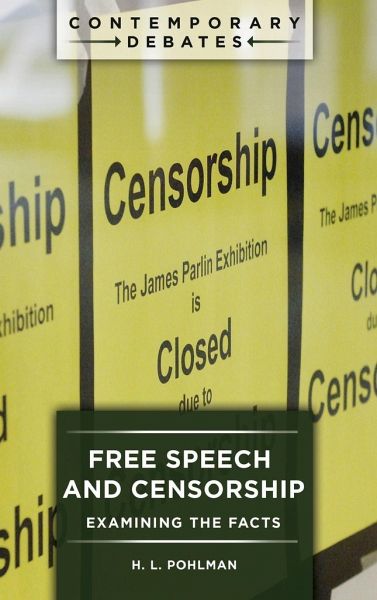
This book provides a comprehensive and impartial overview of laws and norms regarding free speech and censorship in the United States, with a particular focus on free speech rights and restrictions for individuals, politicians, corporations, and news organizations. Free Speech and Censorship: Examining the Facts is part of a series that uses evidence-based documentation to examine the veracity of claims and beliefs about high-profile issues in American culture and politics. This volume examines beliefs, claims, and myths about free speech and censorship issues in American society, including…mehr
This book provides a comprehensive and impartial overview of laws and norms regarding free speech and censorship in the United States, with a particular focus on free speech rights and restrictions for individuals, politicians, corporations, and news organizations. Free Speech and Censorship: Examining the Facts is part of a series that uses evidence-based documentation to examine the veracity of claims and beliefs about high-profile issues in American culture and politics. This volume examines beliefs, claims, and myths about free speech and censorship issues in American society, including landmark court decisions and evolving cultural values that have shaped our understanding of the First Amendment and the liberties it enshrines and protects. Specific chapters in the volume explore basic principles of free speech; unprotected types of speech; conditionally protected speech; restrictions and regulations governing protected speech; free speech limitations in school settings; the corrosive impact of politicians and social media platforms that spread distortions and falsehoods under free speech pretexts; and free speech as a general cultural ideal. Together, these chapters will provide readers with a thorough and accurate grounding in their First Amendment rights and responsibilities.
H. L. Pohlman is Professor of Political Science; A. Lee Fritschler Professor of Public Policy at Dickinson College. He previously served as Judicial Fellow at the Supreme Court of the United States, Washington, DC.
Inhaltsangabe
How to Use This Book Introduction 1 Basic Principles of Free Speech Q1. Is free speech a "fundamental" constitutional right and, if so, why? Q2. Does the constitutional right of free speech only include the right to speak and publish? Q3. Is free speech an "absolute" constitutional right? Q4. Do corporations have many of the free-speech rights that natural-born U.S. citizens have? Q5. Does the federal constitutional right to freedom of speech limit how states can restrict an individual's right of self-expression? Q6. If a law that prohibits speech contains language that is "vague" and "overly broad," can a speaker who is not protected by freedom of speech challenge it as a violation of the constitutional right of free speech? Q7. Is freedom of speech only a limited individual right to engage in constitutionally protected speech? Q8. If freedom of speech prohibits government from either engaging in "content" or "viewpoint" discrimination or violating the free-speech rights of an individual, is it also an American cultural and societal ideal? 2 Unprotected Speech Q9. Is it consistent with the constitutional right of free speech to convict someone of a "threat" even if he or she has no intention of carrying it out? Q10. Are any face-to-face insults of another person excluded from free speech? Q11. If "libel" is excluded from the scope of freedom of speech, does this category include all "falsehoods" that "harm" another person's "reputation"? Q12. If expressive material is excluded from First Amendment protection on the ground that it is "obscene," does this judgment imply that the material in question is "utterly without redeeming social value"? Q13. If a work of "child pornography" has "serious artistic value" and is therefore not "obscene," is it still excluded from the scope of the constitutional right of free speech? 3 Conditionally Protected Speech Q14. Can the government punish unlawful advocacy if the illegal act does not occur? Q15. Does freedom of speech and association protect someone from criminal liability if he or she organizes or joins a group advocating the violent overthrow of government? Q16. Does freedom of speech protect "hate speech" that denigrates people on the basis of their race, ethnicity, religion, sex, or sexual orientation? Q17. If "harassment" is neither a "true threat" nor a "fighting word," can the state nonetheless punish such expressive behavior? Q18. Can an employer be subject to civil liability or an employee sanctioned for expressive conduct that does not constitute criminal harassment, but creates a "hostile" or "offensive" work environment? Q19. Can the federal government withdraw financial assistance from institutions of higher education if they fail to stop students from engaging in "harassment" of other students based on race, color, national origin, or sex? Q20. Can the state impose criminal or civil liability on a speaker who publishes private information about someone else, perhaps for the purpose of "harassing" him or her? Q21. Can the government prohibit physical conduct that has an expressive or symbolic dimension? 4 Regulation of Protected Speech Q22. Can the state generally prohibit "indecent" or "offensive" speech? Q23. If films, books, and magazines contain graphic representations of sexual activity, but are not "obscene" according to the Supreme Court's definition, can the government nonetheless regulate them? Q24. Is it consistent with freedom of speech to regulate some forms of expressive nudity? Q25. Does freedom of speech permit the state to impose civil liability on someone who intentionally inflicts emotional distress on another by engaging in callous and malicious humor or extremely offensive speech that knowingly causes pain and humiliation? Q26. Can the government regulate speech that occurs on public property? Q27. Does a member of an audience at a public speaking event or an attendee at a political demonstration or protest have a free-speech right to "heckle" a speaker or disrupt the event? 5 Free Speech and the Individual's Place in Society Q28. Does a student attending a public high school have the same free-speech rights inside and outside of the school? Q29. Do students attending public colleges and universities have more free-speech rights than public high school students? Q30: Can a state or the federal government impose limits on the free-speech rights of an employee above and beyond those imposed on the ordinary citizen? Q31. If the government provides an employee with access to classified information, can the government sanction an employee if he or she improperly discloses the information to someone not authorized to receive it? Q32. Does a journalist have more free-speech rights than the ordinary citizen because the First Amendment prohibits Congress from "abridging" not only "freedom of speech," but also the freedom "of the press"? 6 Free Speech as a Cultural Ideal Q33. Is there an authoritative source to decide what types of expressive activities are protected under the American cultural ideal of freedom of speech and what types are not? Q34. Is it consistent with the cultural ideal of freedom of speech to morally criticize a speaker who intentionally, recklessly, or negligently spreads falsehoods or so-called fake news? Q35. Does moral criticism of a speaker who engages in speech that "denigrates" or "stereotypes" others on the basis of race, sex, ethnicity, religion, or sexual orientation violate the American cultural ideal of freedom of speech in all contexts? Q36. Do privately owned social media companies, such as Facebook or Twitter, have a moral obligation to respect the American cultural ideal of freedom of speech by excluding "fake news" from their communications platforms? Index About the Author
How to Use This Book Introduction 1 Basic Principles of Free Speech Q1. Is free speech a "fundamental" constitutional right and, if so, why? Q2. Does the constitutional right of free speech only include the right to speak and publish? Q3. Is free speech an "absolute" constitutional right? Q4. Do corporations have many of the free-speech rights that natural-born U.S. citizens have? Q5. Does the federal constitutional right to freedom of speech limit how states can restrict an individual's right of self-expression? Q6. If a law that prohibits speech contains language that is "vague" and "overly broad," can a speaker who is not protected by freedom of speech challenge it as a violation of the constitutional right of free speech? Q7. Is freedom of speech only a limited individual right to engage in constitutionally protected speech? Q8. If freedom of speech prohibits government from either engaging in "content" or "viewpoint" discrimination or violating the free-speech rights of an individual, is it also an American cultural and societal ideal? 2 Unprotected Speech Q9. Is it consistent with the constitutional right of free speech to convict someone of a "threat" even if he or she has no intention of carrying it out? Q10. Are any face-to-face insults of another person excluded from free speech? Q11. If "libel" is excluded from the scope of freedom of speech, does this category include all "falsehoods" that "harm" another person's "reputation"? Q12. If expressive material is excluded from First Amendment protection on the ground that it is "obscene," does this judgment imply that the material in question is "utterly without redeeming social value"? Q13. If a work of "child pornography" has "serious artistic value" and is therefore not "obscene," is it still excluded from the scope of the constitutional right of free speech? 3 Conditionally Protected Speech Q14. Can the government punish unlawful advocacy if the illegal act does not occur? Q15. Does freedom of speech and association protect someone from criminal liability if he or she organizes or joins a group advocating the violent overthrow of government? Q16. Does freedom of speech protect "hate speech" that denigrates people on the basis of their race, ethnicity, religion, sex, or sexual orientation? Q17. If "harassment" is neither a "true threat" nor a "fighting word," can the state nonetheless punish such expressive behavior? Q18. Can an employer be subject to civil liability or an employee sanctioned for expressive conduct that does not constitute criminal harassment, but creates a "hostile" or "offensive" work environment? Q19. Can the federal government withdraw financial assistance from institutions of higher education if they fail to stop students from engaging in "harassment" of other students based on race, color, national origin, or sex? Q20. Can the state impose criminal or civil liability on a speaker who publishes private information about someone else, perhaps for the purpose of "harassing" him or her? Q21. Can the government prohibit physical conduct that has an expressive or symbolic dimension? 4 Regulation of Protected Speech Q22. Can the state generally prohibit "indecent" or "offensive" speech? Q23. If films, books, and magazines contain graphic representations of sexual activity, but are not "obscene" according to the Supreme Court's definition, can the government nonetheless regulate them? Q24. Is it consistent with freedom of speech to regulate some forms of expressive nudity? Q25. Does freedom of speech permit the state to impose civil liability on someone who intentionally inflicts emotional distress on another by engaging in callous and malicious humor or extremely offensive speech that knowingly causes pain and humiliation? Q26. Can the government regulate speech that occurs on public property? Q27. Does a member of an audience at a public speaking event or an attendee at a political demonstration or protest have a free-speech right to "heckle" a speaker or disrupt the event? 5 Free Speech and the Individual's Place in Society Q28. Does a student attending a public high school have the same free-speech rights inside and outside of the school? Q29. Do students attending public colleges and universities have more free-speech rights than public high school students? Q30: Can a state or the federal government impose limits on the free-speech rights of an employee above and beyond those imposed on the ordinary citizen? Q31. If the government provides an employee with access to classified information, can the government sanction an employee if he or she improperly discloses the information to someone not authorized to receive it? Q32. Does a journalist have more free-speech rights than the ordinary citizen because the First Amendment prohibits Congress from "abridging" not only "freedom of speech," but also the freedom "of the press"? 6 Free Speech as a Cultural Ideal Q33. Is there an authoritative source to decide what types of expressive activities are protected under the American cultural ideal of freedom of speech and what types are not? Q34. Is it consistent with the cultural ideal of freedom of speech to morally criticize a speaker who intentionally, recklessly, or negligently spreads falsehoods or so-called fake news? Q35. Does moral criticism of a speaker who engages in speech that "denigrates" or "stereotypes" others on the basis of race, sex, ethnicity, religion, or sexual orientation violate the American cultural ideal of freedom of speech in all contexts? Q36. Do privately owned social media companies, such as Facebook or Twitter, have a moral obligation to respect the American cultural ideal of freedom of speech by excluding "fake news" from their communications platforms? Index About the Author
Es gelten unsere Allgemeinen Geschäftsbedingungen: www.buecher.de/agb
Impressum
www.buecher.de ist ein Internetauftritt der buecher.de internetstores GmbH
Geschäftsführung: Monica Sawhney | Roland Kölbl | Günter Hilger
Sitz der Gesellschaft: Batheyer Straße 115 - 117, 58099 Hagen
Postanschrift: Bürgermeister-Wegele-Str. 12, 86167 Augsburg
Amtsgericht Hagen HRB 13257
Steuernummer: 321/5800/1497
USt-IdNr: DE450055826