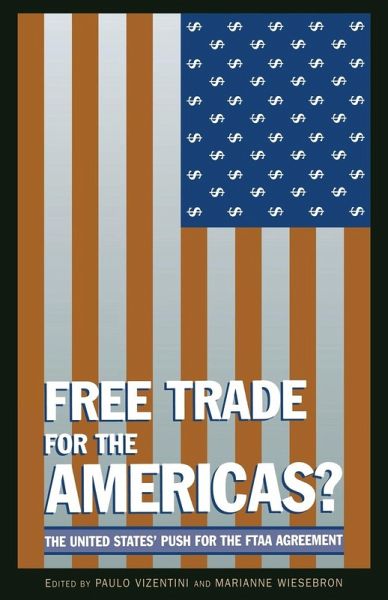
The face of international trade is continuing to change rapidly. But while much attention is focused on where, post-Cancun, any new international negotiations under the auspices of the WTO may go, there are other developments of potentially equal importance. The United States, in particular, is prioritizing new regional trade agreements. This book focuses on the most ambitious of these negotiations -- the Free Trade Area of the Americas Agreement, which is due to be completed in 2005. This US initiative aims to replicate the NAFTA Agreement (which has bound the US, Canada and Mexico into a…mehr
The face of international trade is continuing to change rapidly. But while much attention is focused on where, post-Cancun, any new international negotiations under the auspices of the WTO may go, there are other developments of potentially equal importance. The United States, in particular, is prioritizing new regional trade agreements. This book focuses on the most ambitious of these negotiations -- the Free Trade Area of the Americas Agreement, which is due to be completed in 2005. This US initiative aims to replicate the NAFTA Agreement (which has bound the US, Canada and Mexico into a free trade area since 1994) across all 34 countries of South and North America (bar Cuba). This huge continental market is to be built around US-defined notions of free trade and protection of foreign investment, but will exclude the free movement of labour. This volume explains the origins and process of the negotiations -- both the complicated multilateral discussions and the bilateral agreements that have already been drafted. It explains in detail: * US strategy. * The structures and procedures of the Agreement. * The possible consequences for South America, including: Mercosur; Brazil, as Latin America's largest economy; and the region's many small economies, which cannot possibly compete on a level playing field with the US behemoth. * The wider implications of the FTAA for the global trading system, in particular for China, Japan and the EU. This book -- the first comprehensive, in-depth study of the FTAA -- will be of use to trade specialists, international economists, and all those interested in the FTAA, about which very little information is readily available in the public domain.
Paulo Vizentini is professor of contemporary history at the Universidade Federal do Rio Grande do Sul, Porto Alegre, Brazil. He is director of the Institute of Latin American Advanced Studies. He specialises in international relations, in particular Brazilian Foreign Policy, and international relations in Latin America. Marianne Wiesebron is associate professor of history at the Department of Latin American Studies at Leiden University. She specialises in Brazil. Recently she has been working on current economic and political developments in Latin America, on problems of regional integration, with a focus on social aspects, in particular Mercosur, establishing comparisons with NAFTA and the EU.
Inhaltsangabe
1. Introduction - Paulo Fagundes Vizentini and Marianne Louise Wiesebron Part I: Strategic Issues 2. The FTAA and the US Strategy: A Southern Point of View - Paulo Fagundes Vizentini 3. The US, the FTAA, and the Parameters of Global Governance - Dorval Brunelle 4. Through the Looking Glass: A Canadian Perspective on the NAFTA as a forerunner to the FTAA - Marc Lee Part II: FTAA: Structures and Procedures 5. The Puzzle of Institutionalising a Free Market Continental Zone - The nuts and bolts of the FTAA - Michel Duquette and Maxime Rondeau 6. The Forgotten Society:Lack of Transparency and Democracy - Marianne L. Wiesebron 7. Social and Economic Rights within the Context of the FTAA - Jorge Witker Part III: Implications for South America 8. Brazil, Mercosur, the FTAA and Europe - Samuel Pinheiro Guimarães 9. Brazil's strategy toward the FTAA - Jan van Rompay Part IV: Wider Consequences of the FTAA 10. FTAA: Implications for the World Trade System - Pitou van Dijck 11. FTAA versus the EU Association Agreements - Willy J. Stevens 12. The impact of the FTAA on Japan and China - Kurt W. Radtke 13. China's Reaction and Strategy towards the Creation of the FTAA - Yang Zerui 14. Effects of the FTAA on Japan - Mitsuhiro Kagami 15. Conclusions - Raymond Buve
1. Introduction - Paulo Fagundes Vizentini and Marianne Louise Wiesebron Part I: Strategic Issues 2. The FTAA and the US Strategy: A Southern Point of View - Paulo Fagundes Vizentini 3. The US, the FTAA, and the Parameters of Global Governance - Dorval Brunelle 4. Through the Looking Glass: A Canadian Perspective on the NAFTA as a forerunner to the FTAA - Marc Lee Part II: FTAA: Structures and Procedures 5. The Puzzle of Institutionalising a Free Market Continental Zone - The nuts and bolts of the FTAA - Michel Duquette and Maxime Rondeau 6. The Forgotten Society:Lack of Transparency and Democracy - Marianne L. Wiesebron 7. Social and Economic Rights within the Context of the FTAA - Jorge Witker Part III: Implications for South America 8. Brazil, Mercosur, the FTAA and Europe - Samuel Pinheiro Guimarães 9. Brazil's strategy toward the FTAA - Jan van Rompay Part IV: Wider Consequences of the FTAA 10. FTAA: Implications for the World Trade System - Pitou van Dijck 11. FTAA versus the EU Association Agreements - Willy J. Stevens 12. The impact of the FTAA on Japan and China - Kurt W. Radtke 13. China's Reaction and Strategy towards the Creation of the FTAA - Yang Zerui 14. Effects of the FTAA on Japan - Mitsuhiro Kagami 15. Conclusions - Raymond Buve
Es gelten unsere Allgemeinen Geschäftsbedingungen: www.buecher.de/agb
Impressum
www.buecher.de ist ein Internetauftritt der buecher.de internetstores GmbH
Geschäftsführung: Monica Sawhney | Roland Kölbl | Günter Hilger
Sitz der Gesellschaft: Batheyer Straße 115 - 117, 58099 Hagen
Postanschrift: Bürgermeister-Wegele-Str. 12, 86167 Augsburg
Amtsgericht Hagen HRB 13257
Steuernummer: 321/5800/1497
USt-IdNr: DE450055826