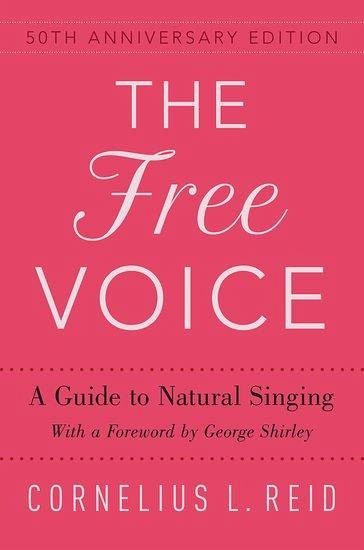
This 50th anniversary edition of Cornelius L. Reid's The Free Voice approaches the teaching of singing in a functional, as opposed to mechanistic, way. Through exercises based on an understanding of the vocal registers and how specific patterns of pitch, intensity, and vowel affect the vocal folds, the singer can develop a well-balanced and coordinated voice and sing without force.
This 50th anniversary edition of Cornelius L. Reid's The Free Voice approaches the teaching of singing in a functional, as opposed to mechanistic, way. Through exercises based on an understanding of the vocal registers and how specific patterns of pitch, intensity, and vowel affect the vocal folds, the singer can develop a well-balanced and coordinated voice and sing without force.
Cornelius L. Reid (1911-2008) began his studies in music at Trinity Church Choir School in New York City as a boy soprano in 1920. His teaching career began as assistant to Dr. Douglas Stanley from 1934 to 1937. From that point on, he developed his own school of functional vocal training based on Italian methods of the pre-scientific era, combined with insights afforded by modern concepts of physiology, acoustics, and psychology.
Inhaltsangabe
Foreword 1 Introduction 2 The Organs of Voice Natural Singing: Correct vs. Habitual 3 Vocal Control Direct Control Control Through Self-Awareness Conceptual Control and Its Limitations 4 The Vocal Registers Mechanics of the Registers 'Pure' Registration Registers and Intensity The 'Break' 'Mixed' Registration A Coordinated or 'Blended' Registration The 'Two-Voiced' Singer Segmentation of the Registers Register Rotation Parallel Relationships Registers and Interpretation 5 Aesthetic Judgment Vowel Quality Vowel Adaptation Common Factors The Legato The Attack Vocal Limitations Voice 'Building' 6 Conceptual Evaluations Textural Properties of the Vowel, Registration and Resonance Temperament, Anatomical Structure and Emotional Identification 7 Vocal Exercises Exercising the Registers Exercises for Separating the Registers, Female Voice Exercises for Separating the Registers, Male Voice Exercises for Register Mutation Preparatory Exercises for Combining the Registers, Female Voice Preparatory Exercises for Combining the Registers, Male Voice The Messa di Voce Messa di Voce-Female Voice Messa di Voce-Male Voice Practice Repertoire and Interpretation 8 Breathing Breath 'Control' Feeling and Emotion 9 Characteristic Voice Movements The Vibrato The Tremolo The Wobble 10 Attitudes Toward Teaching and Learning Self-Perception Freedom and Intuition Spontaneity Stimulus Control Tangible Control Energy and Movement The Conditioned Reflex Theory APPENDIX The Composition of Vocal Tone Pitch Intensity Resonance Duration Quality-The Vowel-Timbre Index
Foreword 1 Introduction 2 The Organs of Voice Natural Singing: Correct vs. Habitual 3 Vocal Control Direct Control Control Through Self-Awareness Conceptual Control and Its Limitations 4 The Vocal Registers Mechanics of the Registers 'Pure' Registration Registers and Intensity The 'Break' 'Mixed' Registration A Coordinated or 'Blended' Registration The 'Two-Voiced' Singer Segmentation of the Registers Register Rotation Parallel Relationships Registers and Interpretation 5 Aesthetic Judgment Vowel Quality Vowel Adaptation Common Factors The Legato The Attack Vocal Limitations Voice 'Building' 6 Conceptual Evaluations Textural Properties of the Vowel, Registration and Resonance Temperament, Anatomical Structure and Emotional Identification 7 Vocal Exercises Exercising the Registers Exercises for Separating the Registers, Female Voice Exercises for Separating the Registers, Male Voice Exercises for Register Mutation Preparatory Exercises for Combining the Registers, Female Voice Preparatory Exercises for Combining the Registers, Male Voice The Messa di Voce Messa di Voce-Female Voice Messa di Voce-Male Voice Practice Repertoire and Interpretation 8 Breathing Breath 'Control' Feeling and Emotion 9 Characteristic Voice Movements The Vibrato The Tremolo The Wobble 10 Attitudes Toward Teaching and Learning Self-Perception Freedom and Intuition Spontaneity Stimulus Control Tangible Control Energy and Movement The Conditioned Reflex Theory APPENDIX The Composition of Vocal Tone Pitch Intensity Resonance Duration Quality-The Vowel-Timbre Index
Es gelten unsere Allgemeinen Geschäftsbedingungen: www.buecher.de/agb
Impressum
www.buecher.de ist ein Internetauftritt der buecher.de internetstores GmbH
Geschäftsführung: Monica Sawhney | Roland Kölbl | Günter Hilger
Sitz der Gesellschaft: Batheyer Straße 115 - 117, 58099 Hagen
Postanschrift: Bürgermeister-Wegele-Str. 12, 86167 Augsburg
Amtsgericht Hagen HRB 13257
Steuernummer: 321/5800/1497
USt-IdNr: DE450055826