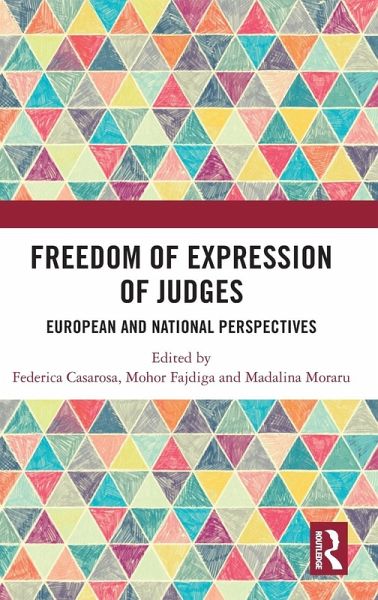
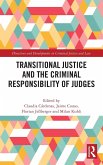
This book addresses the impact of developments surrounding the freedom of expression of judges by building on the experience of judges themselves, legal practitioners and academics across Europe. Like everybody, judges enjoy freedom of expression. However, historically, there have been starker limitations to the free speech of judges compared to ordinary citizens, the rationale being to safeguard judicial independence, impartiality and public trust in the judiciary. Where exactly the boundary lies is a highly complex question. The recent developments in Europe have rekindled the dilemma of…mehr
This book addresses the impact of developments surrounding the freedom of expression of judges by building on the experience of judges themselves, legal practitioners and academics across Europe. Like everybody, judges enjoy freedom of expression. However, historically, there have been starker limitations to the free speech of judges compared to ordinary citizens, the rationale being to safeguard judicial independence, impartiality and public trust in the judiciary. Where exactly the boundary lies is a highly complex question. The recent developments in Europe have rekindled the dilemma of guaranteeing freedom of expression to judges. The rule of law crisis has led many judges to speak out against the attacks of autocratic governments targeting judges and courts. The rapid expansion of the digital world has opened up new channels of communication, and the growing role of courts in society has expanded the reach of courts to practically any social issue, even the most polarised. This work critically analyses the recent jurisprudence of the Court of Justice of the EU and the European Court of Human Rights, its reception at the national level and the contribution of national judiciaries to the discussion pervading the European judicial space. It seeks to raise awareness that judicial speech is a multifaceted phenomenon shaped by complex legal and social considerations worth further exploration. The book will be of interest to academics, researchers, and policy-makers working in the areas of Human Rights Law, Constitutional Law and Politics, and Comparative Law.
Federica Casarosa, Research Affiliate at Sant'Anna School of Advanced Studies, Pisa, and part-time Professor at the European University Institute, Florence. Mohor Fajdiga, Teaching Assistant and PhD candidate at the Faculty of Law, University of Ljubljana. Madalina Moraru, Associate Professor of EU Law, Department of Political Science, University of Bologna, and part-time Associate Professor at the European University Institute, Florence.
Inhaltsangabe
Part I: Judicial free speech standards emerging from the European courts jurisprudence and other horizontal issues; 1. 2. The freedom of expression of judges in Europe: an analysis of the case law under Article 10 of the European Convention of Human Rights. The rule of law in the leading role; 3. 'Chilling Effect' of Limiting Freedom of Expression of Judges: Connecting the Dots from Legal and Extra-legal Doctrine; 4. What standards should be applied to judges exercising freedom of expression on social networks? 5. All quiet in the judiciary: low voice of Hungarian judges and the role of European courts; 6. Speech is silver. Is silence golden? 7. Judges' presence on social media in times of constitutional breakdown in Poland; 8. Working as a judge or being a judge: on the specific features of freedom of expression of the judiciary in Italy; Part III : Epilogue; 9. (Personal) reflections on (legal) developments concerning freedom of expression of judges
Part I: Judicial free speech standards emerging from the European courts jurisprudence and other horizontal issues; 1. 2. The freedom of expression of judges in Europe: an analysis of the case law under Article 10 of the European Convention of Human Rights. The rule of law in the leading role; 3. 'Chilling Effect' of Limiting Freedom of Expression of Judges: Connecting the Dots from Legal and Extra-legal Doctrine; 4. What standards should be applied to judges exercising freedom of expression on social networks? 5. All quiet in the judiciary: low voice of Hungarian judges and the role of European courts; 6. Speech is silver. Is silence golden? 7. Judges' presence on social media in times of constitutional breakdown in Poland; 8. Working as a judge or being a judge: on the specific features of freedom of expression of the judiciary in Italy; Part III : Epilogue; 9. (Personal) reflections on (legal) developments concerning freedom of expression of judges
Es gelten unsere Allgemeinen Geschäftsbedingungen: www.buecher.de/agb
Impressum
www.buecher.de ist ein Internetauftritt der buecher.de internetstores GmbH
Geschäftsführung: Monica Sawhney | Roland Kölbl | Günter Hilger
Sitz der Gesellschaft: Batheyer Straße 115 - 117, 58099 Hagen
Postanschrift: Bürgermeister-Wegele-Str. 12, 86167 Augsburg
Amtsgericht Hagen HRB 13257
Steuernummer: 321/5800/1497
USt-IdNr: DE450055826