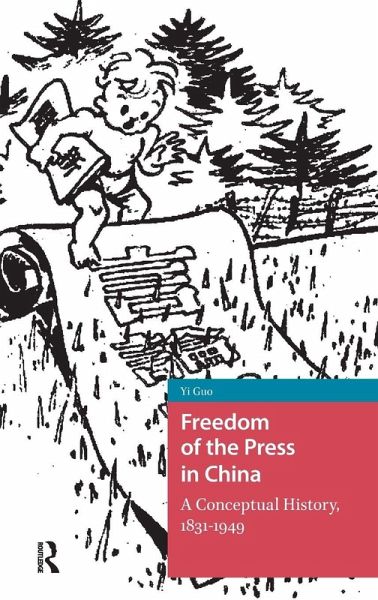
By examining intellectuals' thoughts, common people's attitudes, and official opinions, along with the social-cultural factors that were involved in negotiating Chinese interpretations and practices in history, this book uncovers the dynamic and changing meanings of press freedom in modern China.
By examining intellectuals' thoughts, common people's attitudes, and official opinions, along with the social-cultural factors that were involved in negotiating Chinese interpretations and practices in history, this book uncovers the dynamic and changing meanings of press freedom in modern China.
Dr. Yi Guo is an Assistant Professor in the School of Journalism and Communication at Chongqing University. He is also affiliated with the Centre for Media History at Macquarie University as an honorary member. He was formerly a journalist for the Xinhua News Agency.
Inhaltsangabe
Notes on the Text Acknowledgement Foreword Introduction 1. The Enlightenment of the West China in a Transitional Period The Earliest Writings on Press Freedom Writings of Western Protestant Missionaries Writings of Chinese Students in the West Writings of Chinese Envoys List of Works Cited 2. Chuban Ziyou: The Invention of a Neologism Liang Qichao and the Birth of Chuban Ziyou Chinese Students in Japan and Their Introductions to Press Freedom The Problematic Origins of Chinese Press Freedom List of Works Cited 3. The Liminal Landscape The Pragmatic View Press Freedom as a Civil Right List of Works Cited 4. The Intellectual Legacy of Sun Yat-sen The New Era Sun Yat-sen's Anti-Liberal Thoughts Sun Yat-sen Worship The San-min Doctrine of Journalism Theory List of Works Cited 5. The Empty Phrase and the Popular Ignorance Press Freedom in Constitutional Documents Press Freedom in School Textbooks Violent Mobs and Ignored Freedom List of Works Cited 6. Conceptual Debates in the 1920s and 1930s Minquan (People's Rights) or Human Rights Press Freedom versus Press Control List of Works Cited 7. The Last Call for Press Freedom The Constitutional Movement and Democrats' Propositions The Movement for Freedom of Information The Fear of Communist Publications List of Works Cited Conclusion List of Works Cited Bibliography Index.
Notes on the Text Acknowledgement Foreword Introduction 1. The Enlightenment of the West China in a Transitional Period The Earliest Writings on Press Freedom Writings of Western Protestant Missionaries Writings of Chinese Students in the West Writings of Chinese Envoys List of Works Cited 2. Chuban Ziyou: The Invention of a Neologism Liang Qichao and the Birth of Chuban Ziyou Chinese Students in Japan and Their Introductions to Press Freedom The Problematic Origins of Chinese Press Freedom List of Works Cited 3. The Liminal Landscape The Pragmatic View Press Freedom as a Civil Right List of Works Cited 4. The Intellectual Legacy of Sun Yat-sen The New Era Sun Yat-sen's Anti-Liberal Thoughts Sun Yat-sen Worship The San-min Doctrine of Journalism Theory List of Works Cited 5. The Empty Phrase and the Popular Ignorance Press Freedom in Constitutional Documents Press Freedom in School Textbooks Violent Mobs and Ignored Freedom List of Works Cited 6. Conceptual Debates in the 1920s and 1930s Minquan (People's Rights) or Human Rights Press Freedom versus Press Control List of Works Cited 7. The Last Call for Press Freedom The Constitutional Movement and Democrats' Propositions The Movement for Freedom of Information The Fear of Communist Publications List of Works Cited Conclusion List of Works Cited Bibliography Index.
Es gelten unsere Allgemeinen Geschäftsbedingungen: www.buecher.de/agb
Impressum
www.buecher.de ist ein Internetauftritt der buecher.de internetstores GmbH
Geschäftsführung: Monica Sawhney | Roland Kölbl | Günter Hilger
Sitz der Gesellschaft: Batheyer Straße 115 - 117, 58099 Hagen
Postanschrift: Bürgermeister-Wegele-Str. 12, 86167 Augsburg
Amtsgericht Hagen HRB 13257
Steuernummer: 321/5800/1497
USt-IdNr: DE450055826