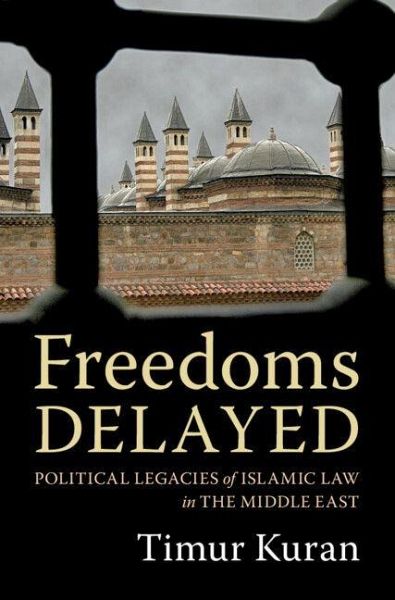
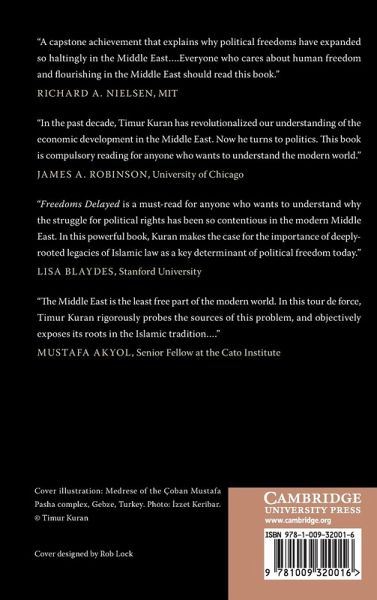
Freedoms Delayed is written for educated readers interested in the deep historical forces that account for the Middle East's poor record on basic human freedoms. It shows that the region's traditional institutions are critical to both understanding its political history and identifying its potential for liberalization on various fronts.
Freedoms Delayed is written for educated readers interested in the deep historical forces that account for the Middle East's poor record on basic human freedoms. It shows that the region's traditional institutions are critical to both understanding its political history and identifying its potential for liberalization on various fronts.
Timur Kuran is Professor of Economics and Political Science, and Gorter Family Professor of Islamic Studies at Duke University. His publications include Private Truths, Public Lies: The Social Consequences of Preference Falsification (1995) and The Long Divergence: How Islamic Law Held Back the Middle East (2011), each widely translated.
Inhaltsangabe
Preface Part I. The Modern Middle East's Authoritarian Face: 1. Islam and political development 2. Explaining illiberalism, identifying opportunities for liberalization Part II. Persistent Social Atomization: 3. Non-governmental organizations under Islamic law 4. The political impotence of Islamic Waqfs 5. Waqf corruption and its degradation of civic life 6. The Islamic Waqf's long civic shadow Part III. Religious Repression: 7. Religious freedoms in Islamic history 8. Marginalization of Islam 9. Resurgence of assertive Islam 10. The absence of liberal schisms Part IV. Economic Hindrances: 11. Unshackled states, shallow economic governance 12. Politically powerless entrepreneurs and enterprises 13. Islamism's missed opportunity to strengthen rule of law Part V. Conclusion: 14. Islam and Muslim freedoms References.
Preface Part I. The Modern Middle East's Authoritarian Face: 1. Islam and political development 2. Explaining illiberalism, identifying opportunities for liberalization Part II. Persistent Social Atomization: 3. Non-governmental organizations under Islamic law 4. The political impotence of Islamic Waqfs 5. Waqf corruption and its degradation of civic life 6. The Islamic Waqf's long civic shadow Part III. Religious Repression: 7. Religious freedoms in Islamic history 8. Marginalization of Islam 9. Resurgence of assertive Islam 10. The absence of liberal schisms Part IV. Economic Hindrances: 11. Unshackled states, shallow economic governance 12. Politically powerless entrepreneurs and enterprises 13. Islamism's missed opportunity to strengthen rule of law Part V. Conclusion: 14. Islam and Muslim freedoms References.
Es gelten unsere Allgemeinen Geschäftsbedingungen: www.buecher.de/agb
Impressum
www.buecher.de ist ein Internetauftritt der buecher.de internetstores GmbH
Geschäftsführung: Monica Sawhney | Roland Kölbl | Günter Hilger
Sitz der Gesellschaft: Batheyer Straße 115 - 117, 58099 Hagen
Postanschrift: Bürgermeister-Wegele-Str. 12, 86167 Augsburg
Amtsgericht Hagen HRB 13257
Steuernummer: 321/5800/1497
USt-IdNr: DE450055826