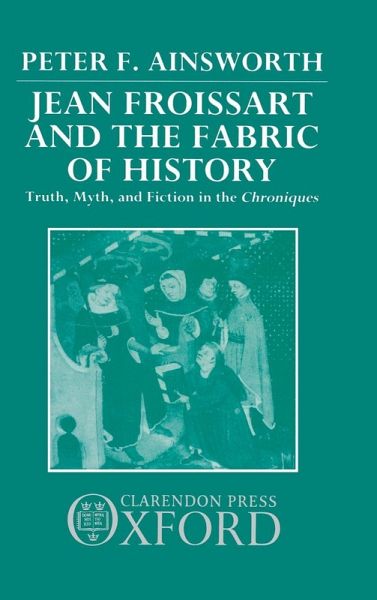
Why do Froissart's Chroniques still find enthusiastic readers six hundred years after they were written? In this fresh reading Peter Ainsworth shows that their strength lies as much in their textual richness and complexity as in their appealing subject matter: the exploits of French and English noblemen during the Hundred Years War. A record of international chivalry that pretends to the title of `history', the Chroniques are in fact neither history nor romance, though they partake a little of both and are still valued by scholars as a historical source. Rather they constitute a variegated and…mehr
Why do Froissart's Chroniques still find enthusiastic readers six hundred years after they were written? In this fresh reading Peter Ainsworth shows that their strength lies as much in their textual richness and complexity as in their appealing subject matter: the exploits of French and English noblemen during the Hundred Years War. A record of international chivalry that pretends to the title of `history', the Chroniques are in fact neither history nor romance, though they partake a little of both and are still valued by scholars as a historical source. Rather they constitute a variegated and enthralling narrative of vast proportions, veering from the historical to the outrageously fictional, from the journalistic travelogue to the moral tale, from self-effacement in the service of impartiality to unshamed self-celebration.
Abbreviations Introduction Part I: Representations - Froissart and the discourse of history: Telling the truth: the discourse of history Chronicle, history, romance Of verse and prose . . . The 'lost' chronicle History and ideology in fourteenth-century France Knight, Magnate, King and Clerk: Froissart's vision of aristocratic and military society War and chivalry Kings, barons, clerks, and peasants Part II: Transgrassions - L'estoire and its fortunes: Bending the truth: "Ceci n'est pas un conte" - Froissart, Mérigot Marchès, and the well-ordered narrative Anecdote, tale, and nouvelle Black, white, and grey - a tomb embellished The quest for truth: "Je, sire Jehan Froissart, fay narracion . . ." -Froissart-Scriptor and the metaphor of the journey Knife, key, bear, and book: poisoned metonymies and the problem of translatio The transmission of truth: the theme of translatio in the later Chroniques 'Jones et à venir': promise or folly in the young king Magnates, Marmousets, and marmousets Translatio militii Part III: Image-building - The rewriting (and re-reading) of Book I: Re-writing the past: dramatic 'landscape' in the Rome Manuscript The Orwell 'landscape' and the invasion of 1325 Sources, significance, tradition Meliador and the Isle of Man Creating an image: Edward III in the Rome Manuscript A changing ethos The apprentice king "A tout le mains faites asambler vous hommes et vostre consel": Edward III and his counsellors Confiance, vaillance . . . et sagesse? Li senglers de Windesore Lessons and trials: Edward the wise Conclusion Bibliography Index
Es gelten unsere Allgemeinen Geschäftsbedingungen: www.buecher.de/agb
Impressum
www.buecher.de ist ein Internetauftritt der buecher.de internetstores GmbH
Geschäftsführung: Monica Sawhney | Roland Kölbl | Günter Hilger
Sitz der Gesellschaft: Batheyer Straße 115 - 117, 58099 Hagen
Postanschrift: Bürgermeister-Wegele-Str. 12, 86167 Augsburg
Amtsgericht Hagen HRB 13257
Steuernummer: 321/5800/1497
USt-IdNr: DE450055826