
From Animals to Animats 12
12th International Conference on Simulation of Adaptive Behavior, SAB 2012, Odense, Denmark, August 27-30, 2012, Proceedings
Herausgegeben:Ziemke, Tom; Balkenius, Christian; Hallam, John
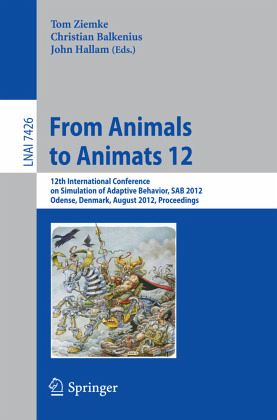
From Animals to Animats 12
12th International Conference on Simulation of Adaptive Behavior, SAB 2012, Odense, Denmark, August 27-30, 2012, Proceedings
Herausgegeben:Ziemke, Tom; Balkenius, Christian; Hallam, John
- Broschiertes Buch
- Merkliste
- Auf die Merkliste
- Bewerten Bewerten
- Teilen
- Produkt teilen
- Produkterinnerung
- Produkterinnerung
This book constitutes the proceedings of the 12th International Conference on Simulation of Adaptive Behavior, SAB 2012, held in Odense, Denmark, in August 2012. The 22 full papers as well as 22 poster papers included in this volume were carefully reviewed and selected from 66 submissions. They are organized in topical sections named: animat approach and methodology; perception and motor control; evolution; learning and adaptation, and collective and social behavior.
Andere Kunden interessierten sich auch für
 Advances in Applied Self-Organizing Systems76,99 €
 Minoru Asada / John C.T. Hallam / Jean-Arcady Meyer / Jun Tani (eds.)From Animals to Animats 1077,99 €
 Martin V. Butz / Olivier Sigaud / Giovanni Pezzulo / Gianluca Baldassarre (eds.)Anticipatory Behavior in Adaptive Learning Systems38,99 €
 Artificial Immune Systems39,99 €
 Lipo Wang / Licheng Jiao / Guanming Shi / Xue Lu / Jing LiuFuzzy Systems and Knowledge Discovery77,99 €
 From Animals to Animats 1438,99 €
 Biomimetic and Biohybrid Systems39,99 €
-
-
-




This book constitutes the proceedings of the 12th International Conference on Simulation of Adaptive Behavior, SAB 2012, held in Odense, Denmark, in August 2012.
The 22 full papers as well as 22 poster papers included in this volume were carefully reviewed and selected from 66 submissions. They are organized in topical sections named: animat approach and methodology; perception and motor control; evolution; learning and adaptation, and collective and social behavior.
The 22 full papers as well as 22 poster papers included in this volume were carefully reviewed and selected from 66 submissions. They are organized in topical sections named: animat approach and methodology; perception and motor control; evolution; learning and adaptation, and collective and social behavior.
Produktdetails
- Produktdetails
- Lecture Notes in Computer Science 7426
- Verlag: Springer / Springer Berlin Heidelberg / Springer, Berlin
- Artikelnr. des Verlages: 978-3-642-33092-6
- Seitenzahl: 468
- Erscheinungstermin: 1. August 2012
- Englisch
- Abmessung: 235mm x 155mm x 26mm
- Gewicht: 704g
- ISBN-13: 9783642330926
- ISBN-10: 3642330924
- Artikelnr.: 36186710
- Herstellerkennzeichnung
- Springer-Verlag GmbH
- Tiergartenstr. 17
- 69121 Heidelberg
- ProductSafety@springernature.com
- Lecture Notes in Computer Science 7426
- Verlag: Springer / Springer Berlin Heidelberg / Springer, Berlin
- Artikelnr. des Verlages: 978-3-642-33092-6
- Seitenzahl: 468
- Erscheinungstermin: 1. August 2012
- Englisch
- Abmessung: 235mm x 155mm x 26mm
- Gewicht: 704g
- ISBN-13: 9783642330926
- ISBN-10: 3642330924
- Artikelnr.: 36186710
- Herstellerkennzeichnung
- Springer-Verlag GmbH
- Tiergartenstr. 17
- 69121 Heidelberg
- ProductSafety@springernature.com
Natural and Artificial Systems: Compare, Model or Engineer?.- Functional Morphologies.- An Introduction to the Analysis of Braitenberg Vehicles 2 and 3 UsingPhase Plane Portrait.- Perception and Motor ControlSynthesis and Adaptation of Effective Motor Synergies for the Solutionof Reaching Tasks.- Gaze Allocation Analysis for a Visually Guided Manipulation Task.- Using Sensorimotor Contingencies for Terrain Discrimination andAdaptive Walking Behavior in the Quadruped Robot Puppy .- How Walking Influences the Development of Absolute DistancePerception.- Modelling Interaction in Multi-modal Affordance Processingwith Neural Dynamics.- A Bio-inspired Model Reliably Predicts the Collision of ApproachingObjects under Different Light Conditions.- Synthesising a Motor-Primitive Inspired Control Architecturefor Redundant Compliant Robots .- Using Sensorimotor Contingencies for Prediction and ActionPlanning.- A Bio-inspired Control System for a Wearable Human-MachineInterface.- A Finite Element Method of Electric Image in Weakly Electric Fish.- Multimodal Integration of Visual Place Cells and Grid Cellsfor Navigation Tasks of a Real Robot.- Towards a Neural Hierarchy of Time Scales for Motor Control.- Modelling Walking Behaviors Based on CPGs: A Simplified Bio-inspiredArchitecture.- Plastic Representation of the Reachable Space for a HumanoidRobot.- EvolutionTowards Behavioral Consistency in Neuroevolution.- Evolving Variants of Neuro-Control Using Constraint Masks.- The Search for Beauty: Evolution of Minimal Cognition in an AnimatControlled by a Gene Regulatory Network and Powered by a MetabolicSystem.- Evolving Reactive Controller for a Modular Robot: Benefits of theProperty of State-Switching in Fractal Gene Regulatory Networks.- Adaptation and Genomic Evolution in EcoSim.- Degeneration of a von Neumann Self-reproducer into a Self-copierwithin the Avida World.- The Emergence of Pathological Constructors When Implementingthe von Neumann Architecture for Self-reproduction in Tierra.- Automatic Synthesis of Controllers for Real Robots Based onPreprogrammed Behaviors.- Self-Organization of Visual Sensor Topologies Based on SpatiotemporalCross-Correlation.- Self-organization of Spinal Reflexes Involving Homonymous, Antagonistand Synergistic Interactions.- A Computational Model of the Role of Serotonin in ReversalLearning.- Which Temporal Difference Learning Algorithm Best ReproducesDopamine Activity in a Multi-choice Task ?.- Multi-timescale Nexting in a Reinforcement Learning Robot.- Self-organizing Developmental Reinforcement Learning.- Adaptive Learning in Continuous Environment Using Actor-CriticDesign and Echo-State Networks.- Learning Adjectives and Nouns from Affordances on the iCubHumanoid Robot.- Learning and Adaptation of Sensorimotor Contingencies:Prism-Adaptation, a Case Study.- Unsupervised Learning of a Reduced Dimensional Controllerfor a Tendon Driven Robot Platform.- Adaptive Quadruped Locomotion: Learning to Detect and Avoidan Obstacle.- Pedro Silva, Vitor Matos, and Cristina P. SantosAttentional Action Selection Using Reinforcement Learning.- Analysing an Evolved Robotic Behaviour Using a Biological Modelof Collegial Decision Making.- On the Evolution of Homogeneous Multi-robot Teams:Clonal versus Aclonal Approach.- Biologically-Inspired Deceptive Behavior for a Robot.- Automated Synthesis of Locomotion Controllers for Self-reconfigurableModular Robots.- Towards Detecting Group Identities in Complex Artificial Societies.- Cost, Precision, and Task Structure in Aggression-Based Arbitrationfor Minimalist Robot Cooperation.- Examining the Information Requirements for Flocking Motion.
Natural and Artificial Systems: Compare, Model or Engineer?.- Functional Morphologies.- An Introduction to the Analysis of Braitenberg Vehicles 2 and 3 UsingPhase Plane Portrait.- Perception and Motor ControlSynthesis and Adaptation of Effective Motor Synergies for the Solutionof Reaching Tasks.- Gaze Allocation Analysis for a Visually Guided Manipulation Task.- Using Sensorimotor Contingencies for Terrain Discrimination andAdaptive Walking Behavior in the Quadruped Robot Puppy .- How Walking Influences the Development of Absolute DistancePerception.- Modelling Interaction in Multi-modal Affordance Processingwith Neural Dynamics.- A Bio-inspired Model Reliably Predicts the Collision of ApproachingObjects under Different Light Conditions.- Synthesising a Motor-Primitive Inspired Control Architecturefor Redundant Compliant Robots .- Using Sensorimotor Contingencies for Prediction and ActionPlanning.- A Bio-inspired Control System for a Wearable Human-MachineInterface.- A Finite Element Method of Electric Image in Weakly Electric Fish.- Multimodal Integration of Visual Place Cells and Grid Cellsfor Navigation Tasks of a Real Robot.- Towards a Neural Hierarchy of Time Scales for Motor Control.- Modelling Walking Behaviors Based on CPGs: A Simplified Bio-inspiredArchitecture.- Plastic Representation of the Reachable Space for a HumanoidRobot.- EvolutionTowards Behavioral Consistency in Neuroevolution.- Evolving Variants of Neuro-Control Using Constraint Masks.- The Search for Beauty: Evolution of Minimal Cognition in an AnimatControlled by a Gene Regulatory Network and Powered by a MetabolicSystem.- Evolving Reactive Controller for a Modular Robot: Benefits of theProperty of State-Switching in Fractal Gene Regulatory Networks.- Adaptation and Genomic Evolution in EcoSim.- Degeneration of a von Neumann Self-reproducer into a Self-copierwithin the Avida World.- The Emergence of Pathological Constructors When Implementingthe von Neumann Architecture for Self-reproduction in Tierra.- Automatic Synthesis of Controllers for Real Robots Based onPreprogrammed Behaviors.- Self-Organization of Visual Sensor Topologies Based on SpatiotemporalCross-Correlation.- Self-organization of Spinal Reflexes Involving Homonymous, Antagonistand Synergistic Interactions.- A Computational Model of the Role of Serotonin in ReversalLearning.- Which Temporal Difference Learning Algorithm Best ReproducesDopamine Activity in a Multi-choice Task ?.- Multi-timescale Nexting in a Reinforcement Learning Robot.- Self-organizing Developmental Reinforcement Learning.- Adaptive Learning in Continuous Environment Using Actor-CriticDesign and Echo-State Networks.- Learning Adjectives and Nouns from Affordances on the iCubHumanoid Robot.- Learning and Adaptation of Sensorimotor Contingencies:Prism-Adaptation, a Case Study.- Unsupervised Learning of a Reduced Dimensional Controllerfor a Tendon Driven Robot Platform.- Adaptive Quadruped Locomotion: Learning to Detect and Avoidan Obstacle.- Pedro Silva, Vitor Matos, and Cristina P. SantosAttentional Action Selection Using Reinforcement Learning.- Analysing an Evolved Robotic Behaviour Using a Biological Modelof Collegial Decision Making.- On the Evolution of Homogeneous Multi-robot Teams:Clonal versus Aclonal Approach.- Biologically-Inspired Deceptive Behavior for a Robot.- Automated Synthesis of Locomotion Controllers for Self-reconfigurableModular Robots.- Towards Detecting Group Identities in Complex Artificial Societies.- Cost, Precision, and Task Structure in Aggression-Based Arbitrationfor Minimalist Robot Cooperation.- Examining the Information Requirements for Flocking Motion.