

Andere Kunden interessierten sich auch für
 From Antagonism to Re-engagement49,99 €
 The Frontiers of Public Diplomacy168,99 €
 Discourse, Hegemony, and Populism in the Visegrád Four168,99 €
 The Era of Private Peacemakers36,99 €
 The Era of Private Peacemakers46,99 €
 Universalization of Human Rights?167,65 €
 Úrsula Oswald Spring: Pioneer on Gender, Peace, Development, Environment, Food and Water77,99 €
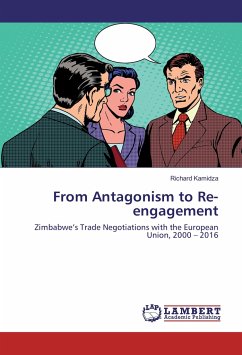



The book interrogates the European Union (EU) - Zimbabwe Economic Partnership Agreement (EPA) negotiations, covering trade in goods, trade-related rules and development cooperation. The negotiations coincided with EU’s motives as the dominant development partner, and Zimbabwe’s state-stakeholder fault-lines, creating dilemmas in the pursuit of a fair EPA outcome. As a result, the economically weak Zimbabwe signed and ratified an asymmetrical interim EPA (iEPA) with an economically powerful EU in 2009 and 2012, respectively. Meanwhile, direct bilateral re-engagement which eluded the Government of National Unity (GNU), became real following ZANU-PF landslide victory on 31 July 2013, that sufficiently altered the power balance to trigger the process between the former nemesis in support of iEPA domestication, and social and economic development. ZANU-PF government stopped blaming the EU and other western nations for the country’s continued economic underperformance, signaling a softening approach on its part. Similarly, the EU and its member states softened its perception on ZANU-PF leadership leading to resumption and intensification of re-engagement despite failure to implement the Global Political Agreement-related constitutional and democratic reforms, agreed by GNU. This re-engagement was firmly endorsed when the EU and Zimbabwe signed an agreement in July 2015 to normalise bilateral relations and start cooperation.