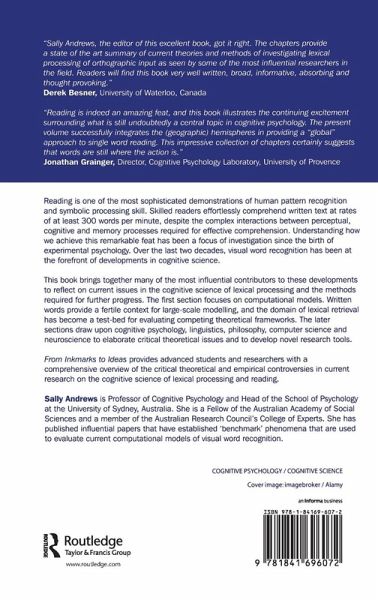
Provides a comprehensive overview of the critical theoretical and empirical controversies in current research on the cognitive science of lexical processing and reading.
Provides a comprehensive overview of the critical theoretical and empirical controversies in current research on the cognitive science of lexical processing and reading.
Sally Andrews is Professor of Cognitive Psychology and Head of the School of Psychology at the University of Sydney, Australia. She is a Fellow of the Australian Academy of Social Sciences and a member of the Australian Research Council's College of Experts. She has published influential papers that have established "benchmark" phenomena that are used to evaluate current computational models of visual word recognition.
Inhaltsangabe
S. Andrews Preface. Part I - Theories of lexical retrieval: Computational models and mechanisms. K. Rastle M. Coltheart Is there serial processing in the reading system; and are there local representations? M.S. Seidenberg D.C. Plaut Progress in understanding word reading: Data fitting versus theory building. C.T. Kello Considering the junction model of lexical processing. M. Taft A localist-cum-distributed (LCD) framework for lexical processing. K.I. Forster Five challenges for activation models. K. Rayner E.D. Reichle A. Pollatsek Cognitive processes in reading: The E-Z Reader model of eye movement control. Part II - Models methods measures: Converging approaches to investigating lexical processing. A. Castles K. Nation How does orthographic learning happen? C.J. Davis Orthographic input coding: A review of behavioural evidence and current models. C. Davis J. Kim Changing circumstance: How flexible is lexical access? D.A. Balota M.J. Yap Attentional control and flexible lexical processing: Explorations of the magic moment of word recognition. G. Libben Reading complex morphological structures. A. Pollatsek J. Hyönä Processing of morphemically complex words in context: What can be learned from eye movements. K. Patterson M.C. MacDonald Sweet nothings: Narrative speech in semantic dementia. S. Andrews All about words: A lexicalist perspective on reading.
S. Andrews Preface. Part I - Theories of lexical retrieval: Computational models and mechanisms. K. Rastle M. Coltheart Is there serial processing in the reading system; and are there local representations? M.S. Seidenberg D.C. Plaut Progress in understanding word reading: Data fitting versus theory building. C.T. Kello Considering the junction model of lexical processing. M. Taft A localist-cum-distributed (LCD) framework for lexical processing. K.I. Forster Five challenges for activation models. K. Rayner E.D. Reichle A. Pollatsek Cognitive processes in reading: The E-Z Reader model of eye movement control. Part II - Models methods measures: Converging approaches to investigating lexical processing. A. Castles K. Nation How does orthographic learning happen? C.J. Davis Orthographic input coding: A review of behavioural evidence and current models. C. Davis J. Kim Changing circumstance: How flexible is lexical access? D.A. Balota M.J. Yap Attentional control and flexible lexical processing: Explorations of the magic moment of word recognition. G. Libben Reading complex morphological structures. A. Pollatsek J. Hyönä Processing of morphemically complex words in context: What can be learned from eye movements. K. Patterson M.C. MacDonald Sweet nothings: Narrative speech in semantic dementia. S. Andrews All about words: A lexicalist perspective on reading.
Es gelten unsere Allgemeinen Geschäftsbedingungen: www.buecher.de/agb
Impressum
www.buecher.de ist ein Internetauftritt der buecher.de internetstores GmbH
Geschäftsführung: Monica Sawhney | Roland Kölbl | Günter Hilger
Sitz der Gesellschaft: Batheyer Straße 115 - 117, 58099 Hagen
Postanschrift: Bürgermeister-Wegele-Str. 12, 86167 Augsburg
Amtsgericht Hagen HRB 13257
Steuernummer: 321/5800/1497
USt-IdNr: DE450055826