From Orientalism to Cultural Capital presents a fascinating account of the wave of Russophilia that pervaded British literary culture in the early twentieth century. The authors bring a new approach to the study of this period, exploring the literary phenomenon through two theoretical models from the social sciences: Orientalism and the notion of «cultural capital» associated with Pierre Bourdieu. Examining the responses of leading literary practitioners who had a significant impact on the institutional transmission of Russian culture, they reassess the mechanics of cultural dialogism,…mehr
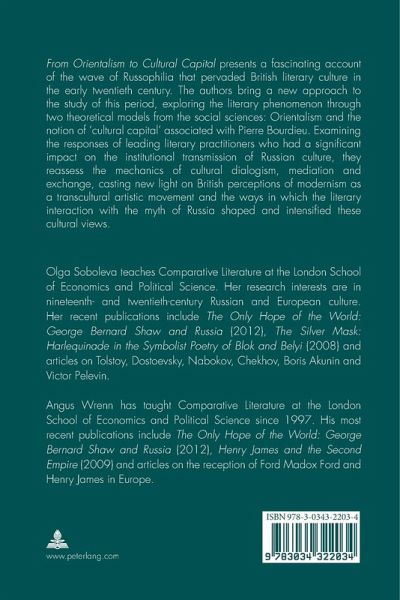
From Orientalism to Cultural Capital presents a fascinating account of the wave of Russophilia that pervaded British literary culture in the early twentieth century. The authors bring a new approach to the study of this period, exploring the literary phenomenon through two theoretical models from the social sciences: Orientalism and the notion of «cultural capital» associated with Pierre Bourdieu. Examining the responses of leading literary practitioners who had a significant impact on the institutional transmission of Russian culture, they reassess the mechanics of cultural dialogism, mediation and exchange, casting new light on British perceptions of modernism as a transcultural artistic movement and the ways in which the literary interaction with the myth of Russia shaped and intensified these cultural views.
Olga Soboleva teaches Comparative Literature at the London School of Economics and Political Science. Her research interests are in nineteenth- and twentieth-century Russian and European culture. Her recent publications include The Only Hope of the World: George Bernard Shaw and Russia (2012), The Silver Mask: Harlequinade in the Symbolist Poetry of Blok and Belyi (2008) and articles on Tolstoy, Dostoevsky, Nabokov, Chekhov, Boris Akunin and Victor Pelevin. Angus Wrenn has taught Comparative Literature at the London School of Economics and Political Science since 1997. His most recent publications include The Only Hope of the World: George Bernard Shaw and Russia (2012), Henry James and the Second Empire (2009) and articles on the reception of Ford Madox Ford and Henry James in Europe.
Inhaltsangabe
CONTENTS: Philip Ross Bullock: Preface - The East Wind of Russianness - John Galsworthy: Is It Possible to «De-Anglicise the Englishman»? - H. G. Wells: Interpreting the «Writing on the Eastern Wall of Europe» - J. M. Barrie and The Truth about the Russian Dancers - D. H. Lawrence: «Russia Will Certainly Inherit the Future» - «Lappin and Lapinova»: Woolf's Beleaguered Russian Monarchs - «Not a Story of Detection, of Crime and Punishment, but of Sin and Expiation»: T. S. Eliot's Debt to Russia, Dostoevsky and Turgenev.
Es gelten unsere Allgemeinen Geschäftsbedingungen: www.buecher.de/agb
Impressum
www.buecher.de ist ein Internetauftritt der buecher.de internetstores GmbH
Geschäftsführung: Monica Sawhney | Roland Kölbl | Günter Hilger
Sitz der Gesellschaft: Batheyer Straße 115 - 117, 58099 Hagen
Postanschrift: Bürgermeister-Wegele-Str. 12, 86167 Augsburg
Amtsgericht Hagen HRB 13257
Steuernummer: 321/5800/1497
USt-IdNr: DE450055826