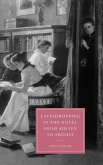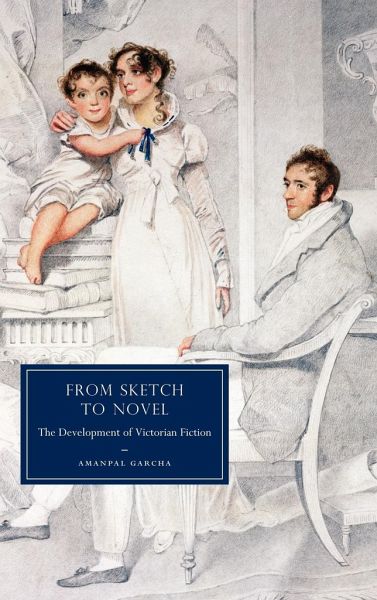
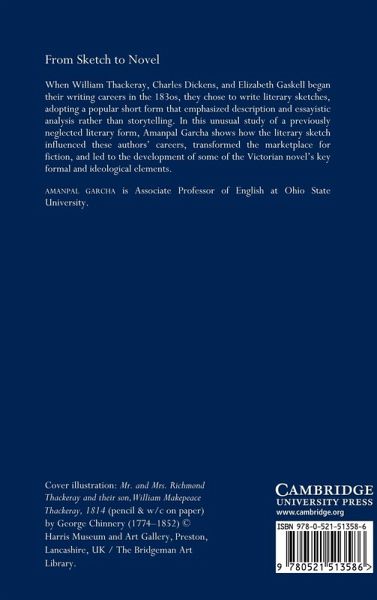
When William Thackeray, Charles Dickens and Elizabeth Gaskell began their writing careers in the 1830s, they chose to write literary sketches, adopting a popular short form that emphasized description and essayistic analysis rather than storytelling. In this unusual study of a previously neglected literary form, Amanpal Garcha shows how the literary sketch influenced these authors' careers, transformed the marketplace for fiction and led to the development of some of the Victorian novel's key formal and ideological elements.
Acknowledgments; Part I. Introduction: From Sketch to Novel: 1. Modern change and aestheticized stasis in the early nineteenth century; 2. Plotless styles in novel history and theory; Part II. Journalism, Modernity, and Stasis in The Paris Sketch Book and The History of Pendennis: 3. Capitalist excess, gentlemanly atavism: Thackeray's devils in his early sketches; 4. Pendennis's stasis and Thackeray's professional sensibilities; Part III. Styles of Stillness and Motion: Charles Dickens's Lower-Class Descriptions: 5. Sketches by Boz: narrative form and market culture; 6. Narrating stasis, describing reform: Nicholas Nickleby; Part IV. Elizabeth Gaskell's Individualism, from 'Sketches among the Poor' to Cranford: 7. 'Leave me, leave me to repose': Gaskell's descriptive individualism; 8. Cranford's individualistic style; Conclusion: 'nothing democratic': intelligence, abstraction, and avant-garde plotlessness; Notes; Bibliography; Index.
Es gelten unsere Allgemeinen Geschäftsbedingungen: www.buecher.de/agb
Impressum
www.buecher.de ist ein Internetauftritt der buecher.de internetstores GmbH
Geschäftsführung: Monica Sawhney | Roland Kölbl | Günter Hilger
Sitz der Gesellschaft: Batheyer Straße 115 - 117, 58099 Hagen
Postanschrift: Bürgermeister-Wegele-Str. 12, 86167 Augsburg
Amtsgericht Hagen HRB 13257
Steuernummer: 321/5800/1497
USt-IdNr: DE450055826