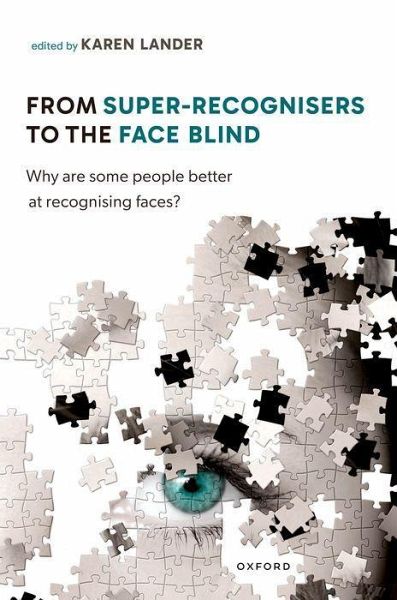
From Super Recognisers to the Face Blind provides readers with a wide-ranging, detailed, and critical overview of individual differences in face recognition ability.
From Super Recognisers to the Face Blind provides readers with a wide-ranging, detailed, and critical overview of individual differences in face recognition ability.
Karen Lander is an Experimental Psychologist at the University of Manchester, UK. She has been researching face recognition for over 25 years with a particular focus on individual differences in the last decade. She is especially interested in understanding the theoretical mechanisms behind these differences and their practical consequences in the real-world.
Inhaltsangabe
* List of Tables * List of Figures * List of Contributors * 1: Karen Lander: How much variation is there in face recognition? * 2: Antônio Mello;Brad Duchaine: What do we know about people with developmental prosopagnosia? * 3: David White: What is special about super-recognisers? * 4: Holger Wiese;Maria Ciocan: How are individual differences in face recognition ability related to heritability, environmental factors, and neuro-cognitive implementation? * 5: Kyriaki Giannou;Karen Lander: Is face recognition ability related to socio-emotional functioning or personality? * 6: James W. Tanaka;Megan K. Lall: How do people recognise 'own-' and 'other-' race faces? * 7: Jodie Davies-Thompson;Jeremy J Tree;Jason J. S. Barton: Can training improve face recognition in typical, autistic, and prosopagnosic individuals? * 8: Professor Markus Bindemann;Professor Sarah Bate: What are the implications of individual differences in face identification ability for occupations involving face recognition? * 9: Karen Lander;Andy Young: What are the practical and theoretical implications of individual differences? * 10: Index
* List of Tables * List of Figures * List of Contributors * 1: Karen Lander: How much variation is there in face recognition? * 2: Antônio Mello;Brad Duchaine: What do we know about people with developmental prosopagnosia? * 3: David White: What is special about super-recognisers? * 4: Holger Wiese;Maria Ciocan: How are individual differences in face recognition ability related to heritability, environmental factors, and neuro-cognitive implementation? * 5: Kyriaki Giannou;Karen Lander: Is face recognition ability related to socio-emotional functioning or personality? * 6: James W. Tanaka;Megan K. Lall: How do people recognise 'own-' and 'other-' race faces? * 7: Jodie Davies-Thompson;Jeremy J Tree;Jason J. S. Barton: Can training improve face recognition in typical, autistic, and prosopagnosic individuals? * 8: Professor Markus Bindemann;Professor Sarah Bate: What are the implications of individual differences in face identification ability for occupations involving face recognition? * 9: Karen Lander;Andy Young: What are the practical and theoretical implications of individual differences? * 10: Index
Es gelten unsere Allgemeinen Geschäftsbedingungen: www.buecher.de/agb
Impressum
www.buecher.de ist ein Internetauftritt der buecher.de internetstores GmbH
Geschäftsführung: Monica Sawhney | Roland Kölbl | Günter Hilger
Sitz der Gesellschaft: Batheyer Straße 115 - 117, 58099 Hagen
Postanschrift: Bürgermeister-Wegele-Str. 12, 86167 Augsburg
Amtsgericht Hagen HRB 13257
Steuernummer: 321/5800/1497
USt-IdNr: DE450055826