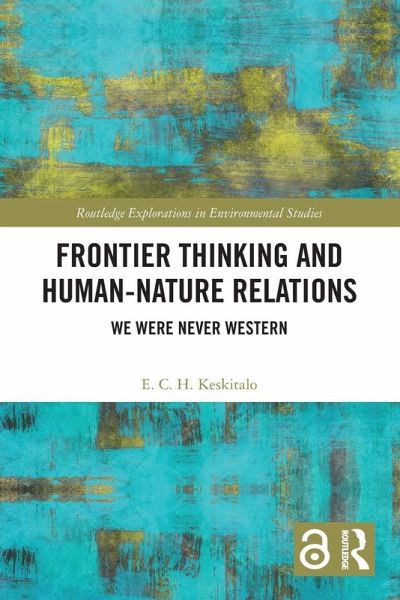
This book builds a compelling critique of 'frontier thinking' and demonstrates its pernicious amplification in contemporary human affairs. It will be of wide interest to a range of academics and students in the fields of geography, anthropology, environmental studies, sociology, political science and development studies, amongst others.
This book builds a compelling critique of 'frontier thinking' and demonstrates its pernicious amplification in contemporary human affairs. It will be of wide interest to a range of academics and students in the fields of geography, anthropology, environmental studies, sociology, political science and development studies, amongst others.
E. C. H. Keskitalo is Professor of Political Science at the Department of Geography, Umeå University. She has published widely on Arctic regional development and environmental and natural resource policy.
Inhaltsangabe
1. Frontier thinking 2. Understanding the role of history in the present 3. Frontier thinking: Why is a distinction drawn between close-to-nature 'communities' and 'modern civilised' societies or states? 4. The role of frontier thinking in the development of the American state and society 5. The following through of frontier myth by Turner and the wilderness movement in the US 6. Differences in the historical construction of development in Fennoscandian contexts 7. Consequences of frontier thinking - from state to individual levels 8. Consequences of frontier thinking on conceptions of the rural - historically and in present day 9. Alternative conceptions of rurality in present-day Fennoscandia 10. Conclusion: What is the social, and what do we base our policies on?
1. Frontier thinking 2. Understanding the role of history in the present 3. Frontier thinking: Why is a distinction drawn between close-to-nature 'communities' and 'modern civilised' societies or states? 4. The role of frontier thinking in the development of the American state and society 5. The following through of frontier myth by Turner and the wilderness movement in the US 6. Differences in the historical construction of development in Fennoscandian contexts 7. Consequences of frontier thinking - from state to individual levels 8. Consequences of frontier thinking on conceptions of the rural - historically and in present day 9. Alternative conceptions of rurality in present-day Fennoscandia 10. Conclusion: What is the social, and what do we base our policies on?
1. Frontier thinking 2. Understanding the role of history in the present 3. Frontier thinking: Why is a distinction drawn between close-to-nature 'communities' and 'modern civilised' societies or states? 4. The role of frontier thinking in the development of the American state and society 5. The following through of frontier myth by Turner and the wilderness movement in the US 6. Differences in the historical construction of development in Fennoscandian contexts 7. Consequences of frontier thinking - from state to individual levels 8. Consequences of frontier thinking on conceptions of the rural - historically and in present day 9. Alternative conceptions of rurality in present-day Fennoscandia 10. Conclusion: What is the social, and what do we base our policies on?
1. Frontier thinking 2. Understanding the role of history in the present 3. Frontier thinking: Why is a distinction drawn between close-to-nature 'communities' and 'modern civilised' societies or states? 4. The role of frontier thinking in the development of the American state and society 5. The following through of frontier myth by Turner and the wilderness movement in the US 6. Differences in the historical construction of development in Fennoscandian contexts 7. Consequences of frontier thinking - from state to individual levels 8. Consequences of frontier thinking on conceptions of the rural - historically and in present day 9. Alternative conceptions of rurality in present-day Fennoscandia 10. Conclusion: What is the social, and what do we base our policies on?
Es gelten unsere Allgemeinen Geschäftsbedingungen: www.buecher.de/agb
Impressum
www.buecher.de ist ein Internetauftritt der buecher.de internetstores GmbH
Geschäftsführung: Monica Sawhney | Roland Kölbl | Günter Hilger
Sitz der Gesellschaft: Batheyer Straße 115 - 117, 58099 Hagen
Postanschrift: Bürgermeister-Wegele-Str. 12, 86167 Augsburg
Amtsgericht Hagen HRB 13257
Steuernummer: 321/5800/1497
USt-IdNr: DE450055826