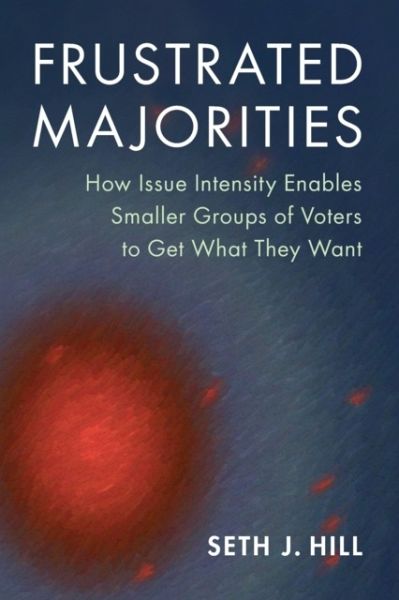
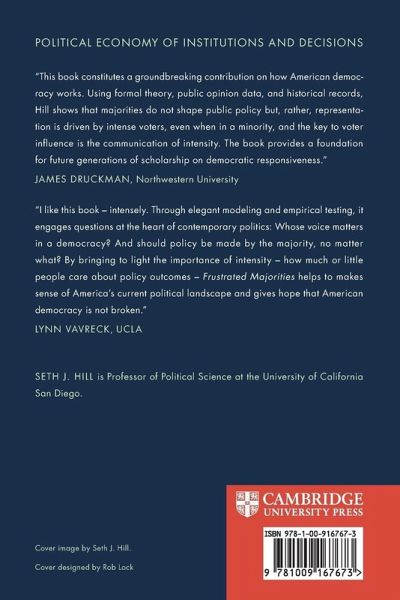
Introduces a theory of issue intensity to help explain political representation, special interest politics, elections, and voter behavior. It explains why politicians sometimes support policies opposed by electoral majorities and why some voters spend time and effort participating in politics while others do not.
Introduces a theory of issue intensity to help explain political representation, special interest politics, elections, and voter behavior. It explains why politicians sometimes support policies opposed by electoral majorities and why some voters spend time and effort participating in politics while others do not.
Seth J. Hill is Professor of Political Science at the University of California San Diego.
Inhaltsangabe
Part I. Frustrated Majorities, Issue Intensity, and Political Action: 1. Majoritarian politics and minority interests 2. The political science of representation, elections, and intensity Part II. Argument: An Intensity Theory of Electoral Competition: 3. Sketching a theory of intensity and electoral competition 4. Theory and model results: Issue intensity, costly action, and minority representation 5. Model extensions: Varying size of the minority, the free-rider problem, and social welfare Part III. Evidence: Empirical Patterns and Intensity Theory: 6. Introduction to empirical evidence 7. Politicians side with intense minorities 8. Issues of intensity explain vote choice 9. Opening avenues of costly action: Institutional change to costs of campaign contributions 10. Closing avenues of costly action: Reform to primary elections Part IV. Conclusions: 11. Conclusion: Implications for representative democracy and the study of politics Part V. Appendix A. Mathematical model of intensity and electoral competition B. Formalities of Chapter 5 C. Supplementary information for Chapter 8 D. Supplementary information for Chapter 9 E. Supplementary information for Chapter 10 Bibliography Index.
Part I. Frustrated Majorities, Issue Intensity, and Political Action: 1. Majoritarian politics and minority interests 2. The political science of representation, elections, and intensity Part II. Argument: An Intensity Theory of Electoral Competition: 3. Sketching a theory of intensity and electoral competition 4. Theory and model results: Issue intensity, costly action, and minority representation 5. Model extensions: Varying size of the minority, the free-rider problem, and social welfare Part III. Evidence: Empirical Patterns and Intensity Theory: 6. Introduction to empirical evidence 7. Politicians side with intense minorities 8. Issues of intensity explain vote choice 9. Opening avenues of costly action: Institutional change to costs of campaign contributions 10. Closing avenues of costly action: Reform to primary elections Part IV. Conclusions: 11. Conclusion: Implications for representative democracy and the study of politics Part V. Appendix A. Mathematical model of intensity and electoral competition B. Formalities of Chapter 5 C. Supplementary information for Chapter 8 D. Supplementary information for Chapter 9 E. Supplementary information for Chapter 10 Bibliography Index.
Es gelten unsere Allgemeinen Geschäftsbedingungen: www.buecher.de/agb
Impressum
www.buecher.de ist ein Internetauftritt der buecher.de internetstores GmbH
Geschäftsführung: Monica Sawhney | Roland Kölbl | Günter Hilger
Sitz der Gesellschaft: Batheyer Straße 115 - 117, 58099 Hagen
Postanschrift: Bürgermeister-Wegele-Str. 12, 86167 Augsburg
Amtsgericht Hagen HRB 13257
Steuernummer: 321/5800/1497
USt-IdNr: DE450055826