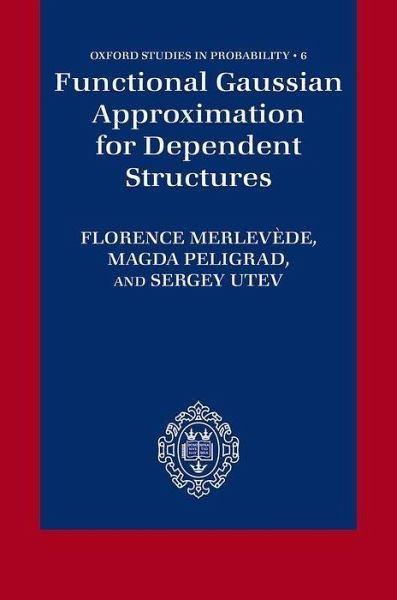
Functional Gaussian Approximation for Dependent Structures develops and analyses mathematical models for phenomena that evolve in time and influence each another. It provides a better understanding of the structure and asymptotic behaviour of stochastic processes. Two approaches are taken. Firstly, the authors present tools for dealing with the dependent structures used to obtain normal approximations. Secondly, they apply normal approximations to various examples. The main tools consist of inequalities for dependent sequences of random variables, leading to limit theorems, including the…mehr
Functional Gaussian Approximation for Dependent Structures develops and analyses mathematical models for phenomena that evolve in time and influence each another. It provides a better understanding of the structure and asymptotic behaviour of stochastic processes. Two approaches are taken. Firstly, the authors present tools for dealing with the dependent structures used to obtain normal approximations. Secondly, they apply normal approximations to various examples. The main tools consist of inequalities for dependent sequences of random variables, leading to limit theorems, including the functional central limit theorem and functional moderate deviation principle. The results point out large classes of dependent random variables which satisfy invariance principles, making possible the statistical study of data coming from stochastic processes both with short and long memory. The dependence structures considered throughout the book include the traditional mixing structures, martingale-like structures, and weakly negatively dependent structures, which link the notion of mixing to the notions of association and negative dependence. Several applications are carefully selected to exhibit the importance of the theoretical results. They include random walks in random scenery and determinantal processes. In addition, due to their importance in analysing new data in economics, linear processes with dependent innovations will also be considered and analysed.
Florence Merlevède is Professor at the Laboratory of Analysis and Applied Mathematics of the University of Paris-Est. Her main research interests are in moment inequalities, deviations probability inequalities, limit theorems for partial sums associated to dependent processes, empirical processes but include also dynamical systems and random matrices Magda Peligrad is a distinguished Taft Professor in the Department of Mathematical Sciences of the University of Cincinnati whose area of expertise is Probability Theory and Stochastic Processes. Her research deals with dependent structures and covers various aspects of modelling the dependence, maximal inequalities, and limit theorems. Her research was rewarded by numerous National Science Foundation, National Security Agency, and Taft research center grants. In 1995 she was elected as fellow of the Institute of Mathematical Statistics, in 2003 she received the title of Taft Professor at the University of Cincinnati and in 2010 her contributions to Probability theory were recognized in a meeting held in her honor in Paris, France Sergey Utev is Professor in the Department of Mathematics of the University of Leicester. His area of expertise covers many aspects of Probability theory and their applications. In particular he wrote many important papers concerning mathematical inequalities and their applications, Quantum probability and stochastic comparisons, Stochastic processes with applications to Financial Mathematics, Actuarial Sciences and Epidemics
Inhaltsangabe
* 1: Introduction to Stochastic Processes * 2: Moment Inequalities and Gaussian Approximation for Martingales * 3: Moment Inequalities via Martingale Methods * 4: Gaussian Approximation via Martingale Methods * 5: Dependence coefficients for sequences * 6: Moment Inequalities and Gaussian Approximation for Mixing Sequences * 7: Weakly associated random variables : L2-bounds and approximation by independent structures * 8: Maximal moment inequalities for weakly negatively dependent variables * 9: Gaussian approximation under asymptotic negative dependence * 10: Examples of Stationary Sequences with Approximate Negative Dependence * 11: Stationary Sequences in a Random Time Scenery * 12: Linear Processes * 13: Random walk in random scenery * 14: Reversible Markov chains * 15: Functional central limit theorem for empirical processes * 16: Application to the uniform laws of large numbers for dependent processes * 17: Examples and Counterexamples
* 1: Introduction to Stochastic Processes * 2: Moment Inequalities and Gaussian Approximation for Martingales * 3: Moment Inequalities via Martingale Methods * 4: Gaussian Approximation via Martingale Methods * 5: Dependence coefficients for sequences * 6: Moment Inequalities and Gaussian Approximation for Mixing Sequences * 7: Weakly associated random variables : L2-bounds and approximation by independent structures * 8: Maximal moment inequalities for weakly negatively dependent variables * 9: Gaussian approximation under asymptotic negative dependence * 10: Examples of Stationary Sequences with Approximate Negative Dependence * 11: Stationary Sequences in a Random Time Scenery * 12: Linear Processes * 13: Random walk in random scenery * 14: Reversible Markov chains * 15: Functional central limit theorem for empirical processes * 16: Application to the uniform laws of large numbers for dependent processes * 17: Examples and Counterexamples
Es gelten unsere Allgemeinen Geschäftsbedingungen: www.buecher.de/agb
Impressum
www.buecher.de ist ein Internetauftritt der buecher.de internetstores GmbH
Geschäftsführung: Monica Sawhney | Roland Kölbl | Günter Hilger
Sitz der Gesellschaft: Batheyer Straße 115 - 117, 58099 Hagen
Postanschrift: Bürgermeister-Wegele-Str. 12, 86167 Augsburg
Amtsgericht Hagen HRB 13257
Steuernummer: 321/5800/1497
USt-IdNr: DE450055826