This book provides innovative solutions to fundamental problems in finance, such as the valuation of bond and equity, the pricing of debt, equity and total asset, the determination of optimal capital structure, etc., which are unsolved or poor-solved so far. The solutions in this book all have the following features: Based on essential assumptions in line with reality, the final solutions are analytical solutions with closed-form models, the forms and variables of the models are determined by strict and objective logic processes rather than chosen or presumed subjectively, such as the…mehr
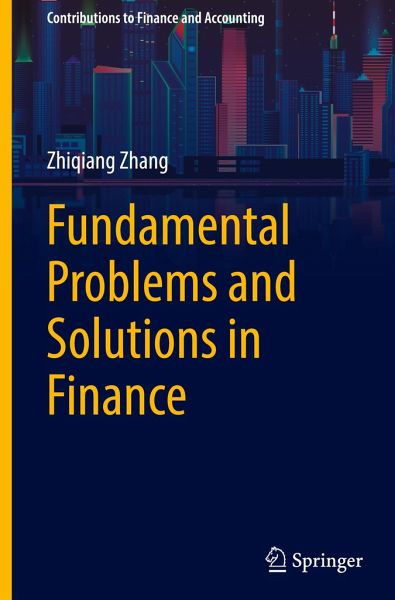
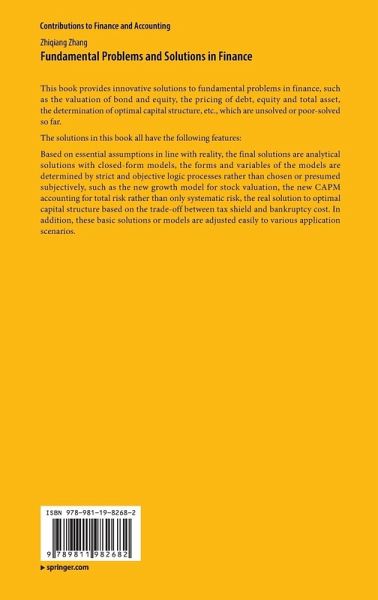
This book provides innovative solutions to fundamental problems in finance, such as the valuation of bond and equity, the pricing of debt, equity and total asset, the determination of optimal capital structure, etc., which are unsolved or poor-solved so far.
The solutions in this book all have the following features:
Based on essential assumptions in line with reality, the final solutions are analytical solutions with closed-form models, the forms and variables of the models are determined by strict and objective logic processes rather than chosen or presumed subjectively, such as the new growth model for stock valuation, the new CAPM accounting for total risk rather than only systematic risk, the real solution to optimal capital structure based on the trade-off between tax shield and bankruptcy cost. In addition, these basic solutions or models are adjusted easily to various application scenarios.
Zhiqiang Zhang is an associate professor in the finance area at the School of Business, Renmin University of China. He currently teaches courses on corporate finance, valuation, real options etc. for the undergraduate and graduate students as well as MBA students. His primary research interests are in corporate finance and asset pricing. He has published more than 30 papers in domestic and international journals, and he has written and translated (from English to Chinese) more than 10 books in the area of finance. His research can be summarized as three series in finance. The first series mainly concerns valuation, where he develops a brand-new approach. Based on the new valuation method, he creates a new stock valuation model, which can overcome most of the shortcomings of traditional models (such as the Gordon growth model); he further derives the theoretical models of P/E, P/B, and P/S, which are useful in stock and portfolio valuation as well as stock market bubble measuring. The second series mainly focuses on incorporating risk into valuation. He derives the theoretical models of certainty equivalents, risk equivalents (a brand new method for assessing risk), risk premiums and the new capital asset pricing model (CAPM), which accounts for both systematic and non-systematic risks. This may be the most important advance in this area since Sharpe's CAPM (1964). The third series primarily examines firm's capital structure decisions. Here the author solves the problem of optimal capital structure by creating new models of tax shield and bankruptcy cost and further deriving the optimal capital structure model based on the trade-off between the tax shield and the bankruptcy cost, potentially the most essential progress in this area since MM model I and II (1958 and 1963). All solutions and models presented are theoretical and decision-oriented, and hence have broad application potential in academic research as well as in practical decision-making, especially in valuation, investment, capital budgeting, risk management, financing and capital structure decision, etc.
Inhaltsangabe
Asset Valuation.- Finance and its Fundamental Problems.- Discounting and Bond Valuation.- Stock and Equity Valuation: Where Discounting Does Not Work.- Asset Pricing.- Option Pricing and Valuation of Contingent Cash Flow.- Certainty Equivalent, Risk Premium and Asset Pricing.- Debt/Loan Risk, Bankruptcy Cost and Debt/Loan Pricing.- Capital Asset Pricing: An Easy and Unified Solution.- Leverage and Risks.- Tax Shield, Bankruptcy Cost and Optimal Capital Structure.- Some Extensive Discussions of ZZ Leverage Model.- Bankruptcy Probability and Firm Life Expectancy.
Asset Valuation.- Finance and its Fundamental Problems.- Discounting and Bond Valuation.- Stock and Equity Valuation: Where Discounting Does Not Work.- Asset Pricing.- Option Pricing and Valuation of Contingent Cash Flow.- Certainty Equivalent, Risk Premium and Asset Pricing.- Debt/Loan Risk, Bankruptcy Cost and Debt/Loan Pricing.- Capital Asset Pricing: An Easy and Unified Solution.- Leverage and Risks.- Tax Shield, Bankruptcy Cost and Optimal Capital Structure.- Some Extensive Discussions of ZZ Leverage Model.- Bankruptcy Probability and Firm Life Expectancy.
Es gelten unsere Allgemeinen Geschäftsbedingungen: www.buecher.de/agb
Impressum
www.buecher.de ist ein Internetauftritt der buecher.de internetstores GmbH
Geschäftsführung: Monica Sawhney | Roland Kölbl | Günter Hilger
Sitz der Gesellschaft: Batheyer Straße 115 - 117, 58099 Hagen
Postanschrift: Bürgermeister-Wegele-Str. 12, 86167 Augsburg
Amtsgericht Hagen HRB 13257
Steuernummer: 321/5800/1497
USt-IdNr: DE450055826