
Andere Kunden interessierten sich auch für
 Linear and Multiobjective Programming with Fuzzy Stochastic Extensions38,99 €
 Markov Chains91,99 €
 Stochastic Versus Fuzzy Approaches to Multiobjective Mathematical Programming under Uncertainty153,99 €
 Modeling with Stochastic Programming42,99 €
 Multiobjective Programming and Goal Programming76,99 €
 Fuzzy Set Theory-and Its Applications153,99 €
 Aggregation and Fusion of Imperfect Information76,99 €
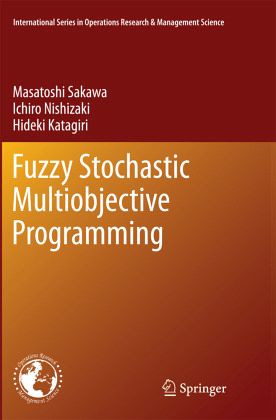
Although studies on multiobjective mathematical programming under uncertainty have been accumulated and several books on multiobjective mathematical programming under uncertainty have been published (e.g., Stancu-Minasian (1984); Slowinski and Teghem (1990); Sakawa (1993); Lai and Hwang (1994); Sakawa (2000)), there seems to be no book which concerns both randomness of events related to environments and fuzziness of human judgments simultaneously in multiobjective decision making problems. In this book, the authors are concerned with introducing the latest advances in the field of multiobjective optimization under both fuzziness and randomness on the basis of the authors' continuing research works. Special stress is placed on interactive decision making aspects of fuzzy stochastic multiobjective programming for human-centered systems under uncertainty in most realistic situations when dealing with both fuzziness and randomness. Organization of each chapter is briefly summarized as follows:
Chapter 2 is devoted to mathematical preliminaries, which will be used throughout the remainder
of the book. Starting with basic notions and methods of multiobjective programming, interactive
fuzzy multiobjective programming as well as fuzzy multiobjective programming is outlined.
In Chapter 3, by considering the imprecision of decision maker's (DM's) judgment for stochastic
objective functions and/or constraints in multiobjective problems, fuzzy multiobjective stochastic
programming is developed.
In Chapter 4, through the consideration of not only the randomness of parameters involved in
objective functions and/or constraints but also the experts' ambiguous understanding of the realized values of the random parameters, multiobjective programming problems with fuzzy random variables are formulated.
In Chapter 5, for resolving conflict of decision making problems in hierarchical managerial or
public organizations where there exist two DMs who have different priorities in making decisions, two-level programming problems are discussed.
Finally, Chapter 6 outlines some future research directions.
Chapter 2 is devoted to mathematical preliminaries, which will be used throughout the remainder
of the book. Starting with basic notions and methods of multiobjective programming, interactive
fuzzy multiobjective programming as well as fuzzy multiobjective programming is outlined.
In Chapter 3, by considering the imprecision of decision maker's (DM's) judgment for stochastic
objective functions and/or constraints in multiobjective problems, fuzzy multiobjective stochastic
programming is developed.
In Chapter 4, through the consideration of not only the randomness of parameters involved in
objective functions and/or constraints but also the experts' ambiguous understanding of the realized values of the random parameters, multiobjective programming problems with fuzzy random variables are formulated.
In Chapter 5, for resolving conflict of decision making problems in hierarchical managerial or
public organizations where there exist two DMs who have different priorities in making decisions, two-level programming problems are discussed.
Finally, Chapter 6 outlines some future research directions.
From the book reviews:
"Drawing heavily on their own research, the authors summarize recent developments in the field of multiobjective optimization under fuzziness and randomness. ... The book may be useful for graduate and doctoral students in operations research." (Róbert Fullér, Mathematical Reviews, March, 2015)
"This is an excellent textbook on fuzzy stochastic multiobjective programming. ... The book is beautifully written and inspiring as a source for further research. The style is clear and rigorous. I warmly recommend this book and also other publications of these authors. Everyone who is interested in optimization should be a acquainted with this work." (I. M. Stancu-Minasian, Zentralblatt MATH, Vol. 1214, 2011)
"Drawing heavily on their own research, the authors summarize recent developments in the field of multiobjective optimization under fuzziness and randomness. ... The book may be useful for graduate and doctoral students in operations research." (Róbert Fullér, Mathematical Reviews, March, 2015)
"This is an excellent textbook on fuzzy stochastic multiobjective programming. ... The book is beautifully written and inspiring as a source for further research. The style is clear and rigorous. I warmly recommend this book and also other publications of these authors. Everyone who is interested in optimization should be a acquainted with this work." (I. M. Stancu-Minasian, Zentralblatt MATH, Vol. 1214, 2011)