
Andere Kunden interessierten sich auch für
 Heisenberg's 1958 Weltformel and the Roots of Post-Empirical Physics42,99 €
 The Mathematical Representation of Physical Reality42,99 €
 The Mathematical Representation of Physical Reality42,99 €
 A History of Physics: Phenomena, Ideas and Mechanisms115,99 €
 The Genesis of Feynman Diagrams121,99 €
 The Second Physicist166,99 €
 The Genesis of Feynman Diagrams121,99 €
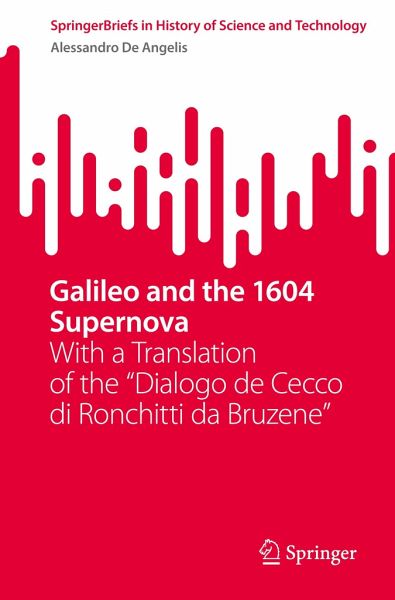
This book is about the 1604 supernova and presents the translation of key documents discussing this astronomical event in Italy. Only seven Galactic supernovae visible to the naked eye are documented, with the 1604 event, the last in history, profoundly impacting astronomy, cosmology, and culture in general. The 1604 supernova challenged the prevailing belief in the unchanging nature of stars. Astronomers like Galileo and Kepler, alongside counterparts from Arab, Chinese, and Korean backgrounds, collaborated to explain its origin, analyzing astronomical and astrological signals five years before the invention of the telescope. Galileo, approached for interpretation while teaching in Padua, cautiously expressed his views in three unpublished lectures, a pseudonymous treatise written in Paduan dialect, and a poem immediately withdrawn, sparking a dispute with Aristotelian scholars in Italy. The 1604 supernova, a pivotal historical event, spurred collaborative efforts and debates, reshaping perceptions of the cosmos. This debate dominated science from 1604 to 1606, preceding Kepler's treatise {em De Stella Nova}. Remnants of the explosion of the supernova, called today Kepler's supernova, are still visible and are the subject of studies by modern observatories and discussions in the astrophysical community.