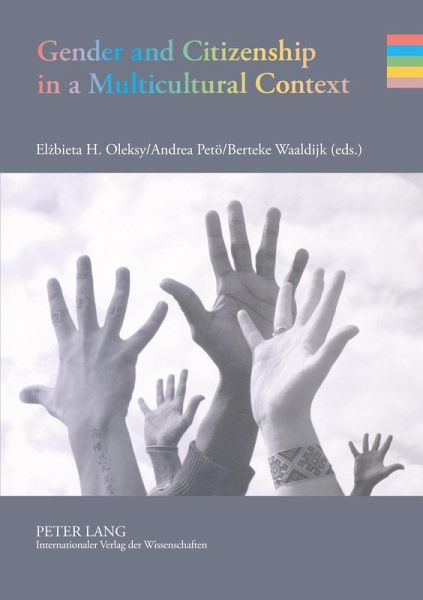
The articles in this book share a dedication to broadening and stretching the scholarly field of feminist citizenship studies and invite the reader to reflect on the many different ways citizenship is formed in contemporary Europe. They do so by stretching the concept of citizenship itself, going beyond legalistic definitions, and by asking new questions about the ways in which citizenship is constructed, the entitlements to benefits, and to social and political participation, how cultures of knowledge allow participation and how inclusion and exclusion can be represented. In all cases…mehr
The articles in this book share a dedication to broadening and stretching the scholarly field of feminist citizenship studies and invite the reader to reflect on the many different ways citizenship is formed in contemporary Europe. They do so by stretching the concept of citizenship itself, going beyond legalistic definitions, and by asking new questions about the ways in which citizenship is constructed, the entitlements to benefits, and to social and political participation, how cultures of knowledge allow participation and how inclusion and exclusion can be represented. In all cases "gender" is one of the categories that allow a deeper insight and a better perception of the way the ideals of citizenship have helped people to overcome exclusion. As the articles show, access to citizenship differs from context to context. Citizenship is never only a legal status: it has to do with cultural diversity, with recognition of difference, with access to professions and hierarchies on the labour market, not least in universities with traditions in political as well as visual representation. The collection is an introduction to new research in the field of European gender studies.
The Editors: El¿bieta H. Oleksy is Professor of Humanities at the University of ¿ód¿ and the University of Warsaw in Poland. She is Founding Director of Women's Studies Centre at University of ¿ód¿. Her research and teaching focus on cultural studies. Andrea Petö is a historian. She is Associate Professor at the Department of Gender Studies at the Central European University and Associate Professor at the University of Miskolc (Hungary), where she directs the Equal Opportunity and Gender Studies Center. Berteke Waaldijk is a historian. She is Professor of Language and Culture Studies at Utrecht University (the Netherlands). She is the academic coordinator of ATHENA3, Advanced Thematic Network in European Women's Studies, an EU-sponsored network for Women's Studies.
Inhaltsangabe
Contents: Ingrid Maria Hoofd: Feminist Activism in the High-tech West: The Complicity of Transversal and Networked Politics in Speed - Daniela Gronold: A European Matter: Examples of «Lived Citizenship» in the Slovenian Nation State - Isabelle Carles: Interdisciplinary Research Group on «Gender and Migration». Citizenship and Rights: the Use of Racial Anti-discrimination Laws in a Gender Perspective - Simon Lapierre/Katrin Bain: Parental Responsibility and Partnership: Citizenship and Gender in British Children and Families Social Services - Arturas Tereskinas: Lithuanian Gays and Lesbians «Coming Out» in the Public/Private Divide: Sexual Citizenship Lithuanian Style - Barbara Bagilhole/Abigail Powell/Andrew Dainty: What Is It About UK Engineering Higher Education (HE) that Deters Women from an Engineering Career - Cathrine Hasse/Maja Hojer: Acknowledging Materiality as Agential Literacy - Malgorzata Miazek/Jenny Vainio: Reconciliation of Work and Family: Gender Differences Among Finnish and Polish Physicists - Marie-Pierre Moreau: « Plus Ça Change, Plus C'est La Même Chose ? » : A Cross-National Comparison Of Gender Inequalities In The Teaching Profession - Julie Jarty: «Work/Life» Balance Regulations and Citizenship in Europe: A Comparative Study of Teachers' Careers in France and Spain - Cornelia Schneider: Gender Action Plans - Effective Instruments for Promoting Gender Equality in the Sixth EU Framework Programme? Results of a Survey carried out by the FiF Contact Point «Women into EU Research» - Liedeke Plate: A Chapter in Cultural History? Literary «Re-Vision» and Citizenship - Edyta Just: The Visual Representation of IVF - Julie D. Palmer: The «Technofetus» as Citizen: The Impact of Three-Dimensional Ultrasound - Jelena Petrovic: Screening the Margins: The Representation of the Roma/Gypsy Woman in Film Production - Katarzyna Szmigiero: Masculinity and Madness: Cultural Representations of Mentally Ill Men - Carolyn Pedwell: Intersections and Entanglements: Tracing «the Anorexic» and «the Veiled Woman» - Emilia Korytkowska: «He Will Make You Suffer!» - Masculism's Encounters with «the Arab» in the Context of Polish-Arab Intermarriages.
Contents: Ingrid Maria Hoofd: Feminist Activism in the High-tech West: The Complicity of Transversal and Networked Politics in Speed - Daniela Gronold: A European Matter: Examples of «Lived Citizenship» in the Slovenian Nation State - Isabelle Carles: Interdisciplinary Research Group on «Gender and Migration». Citizenship and Rights: the Use of Racial Anti-discrimination Laws in a Gender Perspective - Simon Lapierre/Katrin Bain: Parental Responsibility and Partnership: Citizenship and Gender in British Children and Families Social Services - Arturas Tereskinas: Lithuanian Gays and Lesbians «Coming Out» in the Public/Private Divide: Sexual Citizenship Lithuanian Style - Barbara Bagilhole/Abigail Powell/Andrew Dainty: What Is It About UK Engineering Higher Education (HE) that Deters Women from an Engineering Career - Cathrine Hasse/Maja Hojer: Acknowledging Materiality as Agential Literacy - Malgorzata Miazek/Jenny Vainio: Reconciliation of Work and Family: Gender Differences Among Finnish and Polish Physicists - Marie-Pierre Moreau: « Plus Ça Change, Plus C'est La Même Chose ? » : A Cross-National Comparison Of Gender Inequalities In The Teaching Profession - Julie Jarty: «Work/Life» Balance Regulations and Citizenship in Europe: A Comparative Study of Teachers' Careers in France and Spain - Cornelia Schneider: Gender Action Plans - Effective Instruments for Promoting Gender Equality in the Sixth EU Framework Programme? Results of a Survey carried out by the FiF Contact Point «Women into EU Research» - Liedeke Plate: A Chapter in Cultural History? Literary «Re-Vision» and Citizenship - Edyta Just: The Visual Representation of IVF - Julie D. Palmer: The «Technofetus» as Citizen: The Impact of Three-Dimensional Ultrasound - Jelena Petrovic: Screening the Margins: The Representation of the Roma/Gypsy Woman in Film Production - Katarzyna Szmigiero: Masculinity and Madness: Cultural Representations of Mentally Ill Men - Carolyn Pedwell: Intersections and Entanglements: Tracing «the Anorexic» and «the Veiled Woman» - Emilia Korytkowska: «He Will Make You Suffer!» - Masculism's Encounters with «the Arab» in the Context of Polish-Arab Intermarriages.
Es gelten unsere Allgemeinen Geschäftsbedingungen: www.buecher.de/agb
Impressum
www.buecher.de ist ein Internetauftritt der buecher.de internetstores GmbH
Geschäftsführung: Monica Sawhney | Roland Kölbl | Günter Hilger
Sitz der Gesellschaft: Batheyer Straße 115 - 117, 58099 Hagen
Postanschrift: Bürgermeister-Wegele-Str. 12, 86167 Augsburg
Amtsgericht Hagen HRB 13257
Steuernummer: 321/5800/1497
USt-IdNr: DE450055826