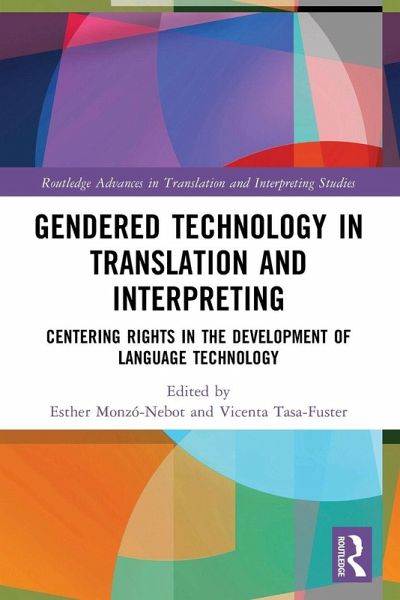
This collection takes an interdisciplinary approach to the study of gendered technology, an emerging area of inquiry which draws on a range of fields to explore how technology is designed and used in a way which reinforces or challenges gender norms and inequalities.
This collection takes an interdisciplinary approach to the study of gendered technology, an emerging area of inquiry which draws on a range of fields to explore how technology is designed and used in a way which reinforces or challenges gender norms and inequalities.
Esther Monzó-Nebot is Associate Professor in Translation and Interpreting Studies in the Department of Translation and Communication Studies at Universitat Jaume I, Spain. Vicenta Tasa-Fuster is Assistant Professor of Constitutional Law in the Department of Constitutional Law and Political Science and Administration at Universitat de Valencia, Spain.
Inhaltsangabe
Part I: Introduction 1. The Omnirelevance of Gendered Technology: Translation, Interpreting, and the Law Esther Monzó-Nebot and Vicenta Tasa-Fuster 2. The Legal Rationales of the Leading Technological Models: The Challenges of Regulating Linguistic and Gender Biases Vicenta Tasa-Fuster Part II: Interpreting and Gendered and Gendering Technology 3. Deconstructing the En-Gendering Binary Mechanisms of Interpreting Technologies: A Posthumanist Feminist Inquiry Deborah Giustini 4. Remote Interpreting and the Politics of Diversity: The Lived Experiences of LGBTIQ+ Interpreters in International Organizations Esther Monzó-Nebot 5. Gendered Approaches to Remote Interpreting: A Booth of One's Own Ozum Arzik-Erzurumlu 6. Is Self-care a Gendered Behavior for Interpreters? Self-reported Practices of Australian and New Zealand Community Interpreters Going Remote During the Pandemic Ineke H. Crezee and Miranda Lai Part III: Present and Future of Gendered and Gendering Automated Translation 7. The Role of Human Translators in the Human-Machine Era: Assessing Gender Neutrality in Galician Machine and Human Translation Marta García González 8. Gender Bias and Women's Rights in the Workplace: The Potential Impact of English-German Translation Tools Jasmina P. or evi 9. Gender Bias in Machine Translation and The Era of Large Language Models Eva Vanmassenhove 10. Exploring Gender Bias in Machine Translation of Legal Texts Celia Rico Pérez and Antonio Jesús Martínez Pleguezuelos 11. Misgendering and Assuming Gender in Machine Translation when Working with Low-Resource Languages Sourojit Ghosh and Srishti Chatterjee Part IV: Conclusion 12. The Tech Landscape in Translation and Interpreting: Gender Inequalities, Language Hierarchies, and the Call for a Level Playing Field Esther Monzó-Nebot and Vicenta Tasa-Fuster
Part I: Introduction 1. The Omnirelevance of Gendered Technology: Translation, Interpreting, and the Law Esther Monzó-Nebot and Vicenta Tasa-Fuster 2. The Legal Rationales of the Leading Technological Models: The Challenges of Regulating Linguistic and Gender Biases Vicenta Tasa-Fuster Part II: Interpreting and Gendered and Gendering Technology 3. Deconstructing the En-Gendering Binary Mechanisms of Interpreting Technologies: A Posthumanist Feminist Inquiry Deborah Giustini 4. Remote Interpreting and the Politics of Diversity: The Lived Experiences of LGBTIQ+ Interpreters in International Organizations Esther Monzó-Nebot 5. Gendered Approaches to Remote Interpreting: A Booth of One's Own Ozum Arzik-Erzurumlu 6. Is Self-care a Gendered Behavior for Interpreters? Self-reported Practices of Australian and New Zealand Community Interpreters Going Remote During the Pandemic Ineke H. Crezee and Miranda Lai Part III: Present and Future of Gendered and Gendering Automated Translation 7. The Role of Human Translators in the Human-Machine Era: Assessing Gender Neutrality in Galician Machine and Human Translation Marta García González 8. Gender Bias and Women's Rights in the Workplace: The Potential Impact of English-German Translation Tools Jasmina P. or evi 9. Gender Bias in Machine Translation and The Era of Large Language Models Eva Vanmassenhove 10. Exploring Gender Bias in Machine Translation of Legal Texts Celia Rico Pérez and Antonio Jesús Martínez Pleguezuelos 11. Misgendering and Assuming Gender in Machine Translation when Working with Low-Resource Languages Sourojit Ghosh and Srishti Chatterjee Part IV: Conclusion 12. The Tech Landscape in Translation and Interpreting: Gender Inequalities, Language Hierarchies, and the Call for a Level Playing Field Esther Monzó-Nebot and Vicenta Tasa-Fuster
Es gelten unsere Allgemeinen Geschäftsbedingungen: www.buecher.de/agb
Impressum
www.buecher.de ist ein Internetauftritt der buecher.de internetstores GmbH
Geschäftsführung: Monica Sawhney | Roland Kölbl | Günter Hilger
Sitz der Gesellschaft: Batheyer Straße 115 - 117, 58099 Hagen
Postanschrift: Bürgermeister-Wegele-Str. 12, 86167 Augsburg
Amtsgericht Hagen HRB 13257
Steuernummer: 321/5800/1497
USt-IdNr: DE450055826