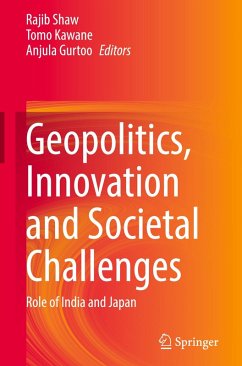
In an era defined by shifting global dynamics, this book explores the transformative partnership between two of Asia s most influential democracies. This volume delves into the strategic convergence of India and Japan, examining their collaborative efforts to address pressing geopolitical, technological, and societal challenges in the Indo-Pacific and beyond. From the bustling connectivity corridors of Northeast India to the sustainable energy initiatives driving net-zero ambitions, this book unpacks the multifaceted India-Japan relationship. It highlights their shared vision for a Free and…mehr
In an era defined by shifting global dynamics, this book explores the transformative partnership between two of Asia s most influential democracies. This volume delves into the strategic convergence of India and Japan, examining their collaborative efforts to address pressing geopolitical, technological, and societal challenges in the Indo-Pacific and beyond. From the bustling connectivity corridors of Northeast India to the sustainable energy initiatives driving net-zero ambitions, this book unpacks the multifaceted India-Japan relationship. It highlights their shared vision for a Free and Open Indo-Pacific, bolstered by robust defense collaborations, cutting-edge technology transfers, and innovative approaches to sustainable development. Chapters explore critical topics such as infrastructure development, renewable energy partnerships, artificial intelligence cooperation, and the Blue Economy, while addressing societal challenges like rural revitalization, healthcare infrastructure, and waste management. The book also examines how cultural and business exchanges, alongside feminist foreign policies, strengthen bilateral ties and foster regional stability.Through rigorous analysis and case studies, this book reveals how India and Japan are not only navigating their own national priorities but also shaping a resilient, multipolar world order. This book showcases the power of strategic alliances in building a sustainable and inclusive future.
Rajib Shaw (0000-0003-3153-1800) is a professor in Graduate School of Media and Governance of Keio University, Japan. He is the co-founder of a Delhi (India) based social entrepreneur startup Resilience Innovation Knowledge Academy (RIKA), and RIKA Institute. He is the Co-chair of the United Nations Asia Pacific Science Technology Advisory Group (AP-STAG) and was CLA for IPCC’s 6th Assessment Report. Professor Shaw is the recipient of prestigious “Pravasi Bharatiya Samman Award (PBSA)” in 2021 for his contribution in the education sector. He also received the United Nations Sasakawa Award in 2022 for his lifetime contributions in the field of disaster risk reduction. He published 85 books and over 450 research papers. More about his work can be found in: www.rajibshaw.org Tomo Kawane (0000-0001-5395-8675) is a senior researcher at the India-Japan Laboratory at Keio University, a researcher in Hiroshima University and a visiting researcher at the Asia Eurasia Research Institute in Tokyo. She has been a Salzburg Global Fellow for Japan India Transformative Technology Network. She has over 30 years of experience in advising government and corporate entities in India and Japan on bilateral projects. She has worked on ODA funding NGO projects for the Consulate General of Japan, coordinated Japan's first official emergency relief post-Gujarat Earthquake of 2001, and served as the only Japanese expert for the People's Linguistic Survey of India. Tomo has a PhD degree from the Graduate School of Media and Governance at Keio University in Japan. She holds a B.A. in International and Cultural Studies from Tsuda College, an M.A. in International Studies and Politics from Jawaharlal Nehru University, and an M.Phil in Political Science from Maharaja Sayajirao University of Baroda, India. Anjula Gurtoo (0000-0002-6245-1910) is a Professor at the Department of Management Studies and chairs the Mphasis Research Lab for Sustainable Solutions at the Indian Institute of Science, Bangalore. She is leading several national and international research projects in the domain of public and urban systems. She obtained her master’s in psychology from the University of Delhi in 1992 and pursued doctoral research at the Indian Institute of Management, Ahmedabad in 1998. She has been a Fellow of the International University of Japan, Niigata (2015), University of Leeds, United Kingdom (2006), and Social Science Research Council, Washington DC, USA (2003). She has authored three books and over 70 research articles in leading international refereed journals. She is a recipient of various national and international recognitions. She also has expert membership of various government and academic committees.
Inhaltsangabe
Introduction: Geopolitics, innovation and societal challenges in terms of India Japan partnership. Part I Geopolitics. The Post 2014 Indo Japan Convergence in Northeast India. Promoting Indo Pacific Peace and Development through India Japan Special Strategic Partnership. India Japan Partnership in the Indo Pacific Region: Infrastructure Technology Transfer and Regional Economic Collaboration. India Japan Defence Collaboration: Emphasis on Defence Exercises and Defence Technology. India Japan Energy Ties: Progress and Prospects. Understanding and Walking in the Path of Blue Economy for a Sustainable INDIA JAPAN Future. The Role of India Japan Reproductive Health Policies in Feminist Foreign Policy and Geopolitical Influence. From Fossil Fuels to Hydrogen: Evaluating the India Japan Collaboration in Pursuit of Sustainable Development Goals. Negotiating Privacy in Quest for Regulation: Legal Framework on Digital Identification System. Part II Societal Challenges. Can branding of cultural commodities stop extinction of rural communities (genkai shuraku): Case studies from Japan and India. Addressing India’s Healthcare Infrastructure through India Japan Collaboration: Addressing Climate Change and Dengue Outbreaks. Addressing rural challenges in India: Lessons learned from Japan. Learning from Circular City Experiences of Japan The Economic and Behavioural Challenges for Adoption in India. Japan’s Labour Shortage and India’s Unemployment: Developing a Complementary Relationship. Waste to Wealth Japanese Mantra for Tackling India's Menace. Sustainable Tourism in Japan: A Role Model for India and the World. Predictors of Social Behavior and Resource Access Among Expatriates in India and Japan.
Introduction: Geopolitics, innovation and societal challenges in terms of India Japan partnership. Part I Geopolitics. The Post 2014 Indo Japan Convergence in Northeast India. Promoting Indo Pacific Peace and Development through India Japan Special Strategic Partnership. India Japan Partnership in the Indo Pacific Region: Infrastructure Technology Transfer and Regional Economic Collaboration. India Japan Defence Collaboration: Emphasis on Defence Exercises and Defence Technology. India Japan Energy Ties: Progress and Prospects. Understanding and Walking in the Path of Blue Economy for a Sustainable INDIA JAPAN Future. The Role of India Japan Reproductive Health Policies in Feminist Foreign Policy and Geopolitical Influence. From Fossil Fuels to Hydrogen: Evaluating the India Japan Collaboration in Pursuit of Sustainable Development Goals. Negotiating Privacy in Quest for Regulation: Legal Framework on Digital Identification System. Part II Societal Challenges. Can branding of cultural commodities stop extinction of rural communities (genkai shuraku): Case studies from Japan and India. Addressing India’s Healthcare Infrastructure through India Japan Collaboration: Addressing Climate Change and Dengue Outbreaks. Addressing rural challenges in India: Lessons learned from Japan. Learning from Circular City Experiences of Japan The Economic and Behavioural Challenges for Adoption in India. Japan’s Labour Shortage and India’s Unemployment: Developing a Complementary Relationship. Waste to Wealth Japanese Mantra for Tackling India's Menace. Sustainable Tourism in Japan: A Role Model for India and the World. Predictors of Social Behavior and Resource Access Among Expatriates in India and Japan.
Es gelten unsere Allgemeinen Geschäftsbedingungen: www.buecher.de/agb
Impressum
www.buecher.de ist ein Internetauftritt der buecher.de internetstores GmbH
Geschäftsführung: Monica Sawhney | Roland Kölbl | Günter Hilger
Sitz der Gesellschaft: Batheyer Straße 115 - 117, 58099 Hagen
Postanschrift: Bürgermeister-Wegele-Str. 12, 86167 Augsburg
Amtsgericht Hagen HRB 13257
Steuernummer: 321/5800/1497
USt-IdNr: DE450055826