

Andere Kunden interessierten sich auch für
 Market-Consistent Actuarial Valuation34,99 €
 Fundamentals of the Insurance Business100,99 €
 Actuarial Sciences and Quantitative Finance77,99 €
 Actuarial Sciences and Quantitative Finance76,99 €
 Mathematical and Statistical Methods for Actuarial Sciences and Finance83,99 €
 Mathematical and Statistical Methods for Actuarial Sciences and Finance91,99 €
 Introduction to Queueing Systems with Telecommunication Applications54,99 €
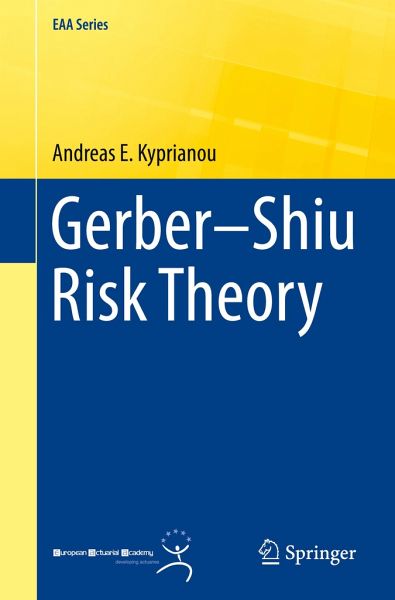
Motivated by the many and long-standing contributions of H. Gerber and E. Shiu, this book gives a modern perspective on the problem of ruin for the classical Cramér-Lundberg model and the surplus of an insurance company. The book studies martingales and path decompositions, which are the main tools used in analysing the distribution of the time of ruin, the wealth prior to ruin and the deficit at ruin. Recent developments in exotic ruin theory are also considered. In particular, by making dividend or tax payments out of the surplus process, the effect on ruin is explored.
Gerber-Shiu Risk Theory can be used as lecture notes and is suitable for a graduate course. Each chapter corresponds to approximately two hours of lectures.
Gerber-Shiu Risk Theory can be used as lecture notes and is suitable for a graduate course. Each chapter corresponds to approximately two hours of lectures.
From the book reviews:
"The book under review gives a modern perspective on the problems in ruin theory in the framework of the classical Cramér-Lundberg risk model. ... This compact book combines rigorous mathematical treatments with discussions and contains a comprehensive bibliography on the related topics at the end of each chapter. ... this book is well written and can serve as a major reference book for researchers and graduate students in ruin theory and related areas." (Shuanming Li, Mathematical Reviews, January, 2015)
"The book under review gives a modern perspective on the problems in ruin theory in the framework of the classical Cramér-Lundberg risk model. ... This compact book combines rigorous mathematical treatments with discussions and contains a comprehensive bibliography on the related topics at the end of each chapter. ... this book is well written and can serve as a major reference book for researchers and graduate students in ruin theory and related areas." (Shuanming Li, Mathematical Reviews, January, 2015)